
An October 21 Marist poll adds fresh evidence of a generational divide in Michigan’s Senate contest. The findings also raise questions about whether younger voters’ participation could affect other statewide races.
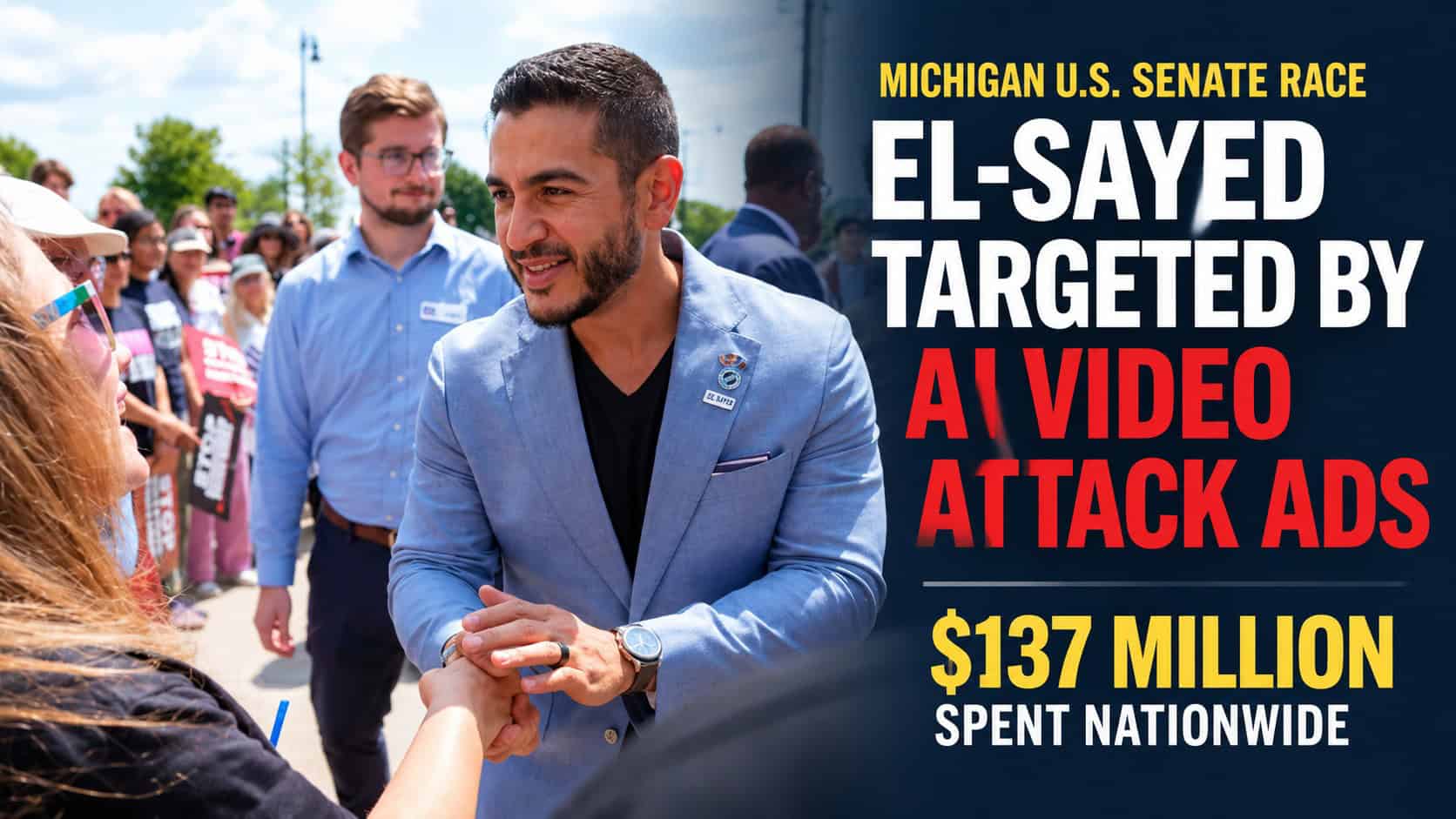
ANN ARBOR – President Donald Trump’s approval among younger Michigan voters is deeply negative, while Democratic U.S. Senate candidate Abdul El-Sayed holds substantial support among younger voters, according to new polling released Wednesday.
The findings come less than two weeks before Michigan’s November 3 midterm election and raise a broader question: Could younger voters’ participation influence not only the U.S. Senate race but also contests for governor, attorney general, secretary of state and Congress?
A new Marist College poll, conducted October 15–18 and released October 21, found El-Sayed receiving 50% support among likely Michigan voters compared with 48% for Republican Mike Rogers.
That two-point difference is within the survey’s margin of error of plus or minus 4.3 percentage points.
But the poll’s age breakdown reveals a much larger divide.
Among likely voters classified as Generation Z or Millennials, El-Sayed received 68% support compared with 28% for Rogers.
The same generational group registered just 18% approval of Trump’s overall job performance, while 80% disapproved.
The findings are detailed in Marist’s polling tables.
The results provide a new Michigan-specific perspective on national polling showing significant dissatisfaction with Trump’s handling of inflation among younger Americans.
CNN: Just 9% of Young Voters Approve of Trump’s Handling of Inflation
During an October 15 CNN News Central broadcast, chief data analyst Harry Enten highlighted polling showing only 9% of voters under age 30 approved of Trump’s handling of inflation.
The remaining 91% disapproved.
That figure measures Trump’s handling of inflation specifically, not his overall presidential approval rating.
Enten also reported Trump’s net presidential job approval among younger voters at negative 50 percentage points, while his net economic approval stood at negative 64 points.
The findings were based on an October Fox News national survey.
The survey covered registered voters nationally, not Michigan voters alone. Its younger-voter subgroup carries greater statistical uncertainty than the overall sample.
Nevertheless, the national findings and Marist’s Michigan results both document substantial dissatisfaction with Trump among younger respondents, although they measure different aspects of his performance.
Three Polls Show El-Sayed’s Support Among Younger Voters
The new Marist findings add to earlier surveys identifying a generational divide in Michigan’s Senate contest.
Survey Younger-voter group El-Sayed Rogers EPIC-MRA, August Ages 18–34 62% 31% NYT/Siena, September, as reported by MLive Ages 18–29 82% 11% Marist, October Gen Z and Millennials 68% 28% An October 21 MLive report cited the September New York Times/Siena results and described El-Sayed’s efforts to reach voters on Michigan college campuses.
The three surveys use different age categories, sampling methods and field dates. They cannot be interpreted as a continuous trend, and subgroup margins of error are larger than those for full statewide samples.
Marist did not publish a separate 18–29 Senate estimate because that subgroup’s sample was too small to report reliably.
The October survey also found El-Sayed receiving 63% among likely voters under 45, compared with 32% for Rogers.
While the younger-voter results differ across surveys, each reports higher support for El-Sayed than Rogers within its defined younger group.Michigan Has a History of High Youth Turnout
Michigan’s younger voters have participated at relatively high rates compared with their counterparts in other states.
According to Tufts University’s Center for Information & Research on Civic Learning and Engagement, approximately 37.6% of eligible Michigan voters ages 18–29 participated in the 2022 midterm election, ranking the state first nationally.
In the 2024 presidential election, Michigan’s youth turnout reached approximately 58%, placing it third nationally.
Presidential elections typically attract more voters than midterms, making the 2022 figure a more relevant historical comparison for November 2026.
Michigan also ranks prominently in CIRCLE’s 2026 Youth Electoral Significance Index, which examines where younger voters could have a meaningful role in electoral participation.
However, past turnout does not establish how many young voters will participate this year.
MITechNews Requests Updated Voter Registration Data
MITechNews sought updated figures from the Michigan Secretary of State’s office showing how many registered voters are ages 18–34.
The department declined to provide the requested breakdown, explaining that Michigan’s Freedom of Information Act does not require agencies to conduct research, analyze data or create new records in response to a request.
The department advised MITechNews to submit a revised request identifying existing records through the FOIA process.
Consequently, a current statewide registration total for voters ages 18–34 was not available for this report.
The department directed MITechNews to its election data resources and voter participation dashboard.
The registration count would help establish the size of this age group within Michigan’s electorate, although registration alone does not measure actual turnout.
Could El-Sayed’s Youth Support Affect Other Michigan Races?
The new Marist poll also found Democrats holding advantages in two other statewide measurements.
In the governor’s race, Democrat Jocelyn Benson received 51% support among likely voters, compared with 45% for Republican John James.
On the generic congressional ballot, 52% of Michigan likely voters supported Democratic candidates, compared with 46% supporting Republicans.
Marist also found that 44% of likely voters described their congressional choice as primarily a vote against Trump. Another 18% described it as primarily a vote for the president, while 37% said Trump had little influence on their congressional decision.
Polls, Analysis, Learning, and More
These findings raise the possibility of a broader electoral effect, but they do not demonstrate that El-Sayed’s popularity is responsible for support in other races.
Political scientists sometimes refer to a coattail effect when interest in one candidate is associated with increased participation or support for other candidates on the same ballot.
If El-Sayed’s campaign brings additional younger voters to the polls, those voters will also have opportunities to participate in the contests for governor, attorney general, secretary of state and the Michigan Legislature.
However, voters may split their tickets, leave individual races blank or support El-Sayed without supporting other Democratic candidates.
Another possibility is that younger voters’ dissatisfaction with Trump is independently shaping preferences across several contests, rather than enthusiasm for any one candidate producing a coattail effect.
The Marist findings cannot distinguish between those explanations.
Economic Concerns Could Be an Important Factor
The latest Michigan survey also suggests economic dissatisfaction extends beyond younger voters.
Marist found 43% of likely Michigan voters saying their family’s finances had worsened during the previous year. Another 40% said their finances had stayed about the same, while 16% reported improvement.
The findings provide context for both campaigns’ emphasis on jobs, affordability and Michigan’s economic future.
El-Sayed has campaigned on expanded healthcare access, lower living costs and reducing corporate influence in government.
Rogers has emphasized manufacturing employment, domestic investment and economic growth, while criticizing some electric-vehicle investments and federal policies.
Both candidates are competing for support in a state where the automotive industry, manufacturing employment and household expenses remain prominent political issues.
Their different policy proposals offer voters competing approaches to those concerns.
What Will November 3 Reveal?
The latest polling documents three developments: substantial dissatisfaction with Trump among younger respondents, a marked generational divide in Michigan’s Senate contest and close statewide competition between El-Sayed and Rogers.
Michigan’s history of relatively high youth turnout adds another dimension.
Yet polling measures preferences at the time respondents are interviewed. It does not establish who will ultimately vote or how individual voters will complete their ballots.
The most important unanswered questions are whether younger Michiganders will participate at rates comparable to previous elections and whether their voting patterns will differ across the Senate, gubernatorial, congressional and other contests.
The November 3 results will provide a test of whether the youth-voter preferences documented in recent surveys are reflected in actual ballots — and whether similar patterns appear across Michigan’s statewide races.