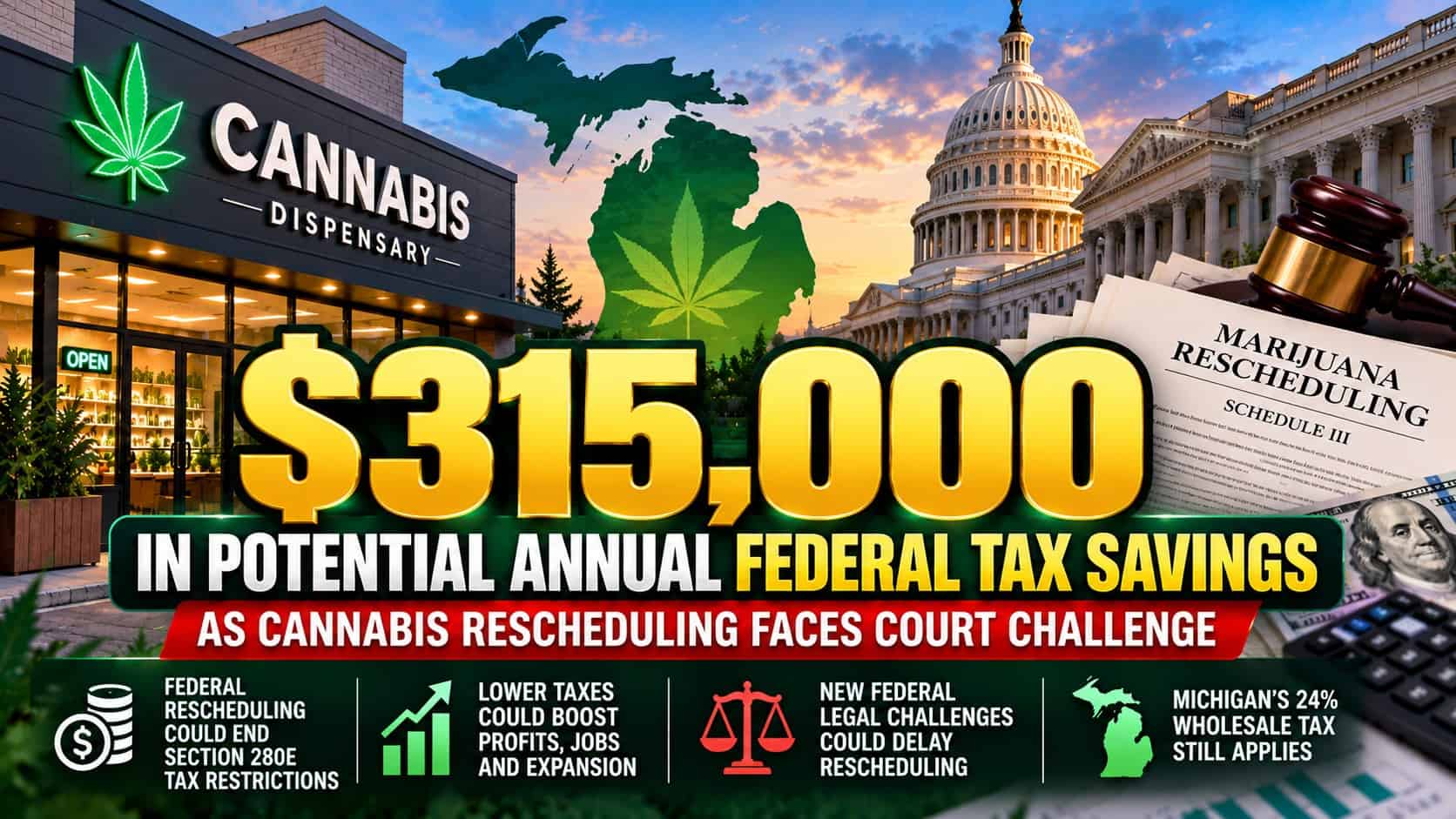

Michigan recreational marijuana sales declined in September compared with both August and a year earlier, while the average retail price of an ounce of flower fell to $59.99. But state figures also show that September’s monthly sales decline was smaller than in 2025, complicating efforts to determine how much the state’s controversial 24% wholesale marijuana tax is affecting the industry.
LANSING — Michigan’s recreational marijuana industry generated $242.26 million in retail sales during September 2026, down approximately 3.4% from the same month last year, according to the latest figures from the Michigan Cannabis Regulatory Agency.
September sales also declined 6.4% from August’s $258.79 million, representing a decrease of approximately $16.53 million in a single month.
Meanwhile, the average retail price of recreational marijuana flower slipped to $59.99 per ounce, compared with $60.33 in August and $63.16 in September 2025.
The figures present a mixed picture for Michigan’s cannabis industry. Consumers benefit from inexpensive legal marijuana, while growers, processors and dispensaries face intense competition and pressure to maintain profitability.
But the comparison with last year’s sales provides important context: Michigan recreational marijuana sales declined 11.3% between August and September 2025, compared with 6.4% during the same period this year.
That difference suggests September’s slowdown cannot automatically be attributed to the additional 24% wholesale marijuana tax that took effect January 1, 2026.
Michigan Marijuana Sales: 2025 Versus 2026
The CRA’s monthly reports provide a comparison of marijuana sales, pricing and purchasing activity.
Reporting Period Adult-Use Sales August 2025 $282.84 million September 2025 $250.91 million August 2026 $258.79 million September 2026 $242.26 million
Sources: August 2025 CRA report, September 2025 CRA report, and CRA monthly statistical reports.
September 2026 sales were approximately $8.65 million below September 2025.
The August-to-September sales decline was less pronounced in 2026 than in 2025. However, two years of comparisons are insufficient to establish a consistent seasonal pattern.
The year-over-year decline indicates that Michigan’s recreational marijuana market generated less retail revenue in September 2026 than it did a year earlier.
Marijuana Ounce Prices Fall Below $60
One of the most notable findings in the September CRA report is the average recreational marijuana flower price of $59.99 per ounce.
That represents a decline of approximately 5% from September 2025.
For consumers, the price translates to roughly $2.14 per gram before applicable retail taxes.
For cannabis businesses, however, declining prices can create challenges.
Growers must cover cultivation expenses, including electricity, labor, security, equipment, testing and regulatory compliance. Processors and dispensaries face additional costs associated with manufacturing, packaging, transportation, retail operations and employee compensation.
As retail prices decline, businesses may need to sell more marijuana to maintain revenue.
However, September’s figures show that flower sales volume also declined.
Michigan retailers sold approximately 102,858 pounds of recreational marijuana flower during September, compared with approximately 108,245 pounds in September 2025.
Flower revenue declined from approximately $109.39 million to $98.73 million over the same period, a decrease of nearly 10%.
That means Michigan’s flower market experienced both lower retail prices and reduced sales volume compared with a year earlier.
The CRA figures do not establish whether individual marijuana businesses are profitable.
Vape Cartridges Show Different Sales Trends
Traditional marijuana flower remains Michigan’s largest recreational cannabis product category, but vape cartridges, concentrates and edibles account for a substantial portion of retail revenue.
According to the CRA’s September report:
Product Category September 2026 Sales Flower $98.73 million Vape cartridges $46.61 million Inhalable compound concentrates $41.85 million Shake and trim $20.46 million Infused edibles $19.59 million Other cannabis products $15.02 million Total $242.26 million
Flower represented approximately 40.8% of recreational marijuana sales.
Vape cartridge revenue increased approximately 2% compared with September 2025, even as flower revenue declined nearly 10%.
However, vape cartridge sales declined from August 2026, when retailers generated approximately $50.44 million in that category.
The differences illustrate why overall cannabis sales figures do not necessarily reflect the performance of every segment of the industry.
They also raise questions about whether consumer preferences are changing as the legal marijuana market matures. The CRA’s figures document product-category revenue but do not establish why consumers choose particular products.
Michigan’s 24% Wholesale Marijuana Tax Remains A Major Issue
Michigan’s cannabis industry is operating under an additional 24% wholesale marijuana tax that took effect January 1, 2026.
The wholesale levy is separate from Michigan’s existing 10% recreational marijuana excise tax and 6% sales tax. It was enacted as part of a state transportation funding package intended to support road improvements.
According to the Michigan Department of Treasury, the tax applies to certain wholesale sales and transfers of recreational marijuana. The wholesaler is legally responsible for paying and remitting the tax, although the cost can be passed along to retail businesses.
Cannabis industry representatives argue that the wholesale tax adds financial pressure to businesses already dealing with low retail prices, intense competition and operating expenses.
The legal challenge to Michigan’s 24% wholesale marijuana tax remains unresolved.
On April 22, 2026, the Michigan Supreme Court ordered the state Court of Appeals to conduct an expedited review of a lawsuit filed by the Michigan Cannabis Industry Association and PG Manufacturing LLC.
The Supreme Court also stayed proceedings in the Court of Claims while the appeal proceeds.
The industry argues that the tax unlawfully alters Michigan’s 2018 voter-approved recreational marijuana law without the required three-fourths legislative majority.
The state maintains that the tax is a separate road-funding measure permitted under Michigan law. In an earlier ruling, the Court of Claims declined to block the tax, citing language in the voter-approved law allowing the existing recreational excise tax in addition to other taxes.
As of October 15, 2026, MITechNews could not verify a final appellate ruling, and the tax remains in effect.
The CRA’s September sales figures do not establish a direct causal relationship between the wholesale tax and changes in marijuana prices or retail revenue.
The year-over-year comparison is relevant because September 2025 preceded the additional tax, while September 2026 followed its implementation.
However, recreational marijuana sales declined more sharply between August and September 2025 than during the same period this year. Purchasing patterns, supply conditions and competition also deserve consideration when assessing the industry’s performance.
Marijuana Inventory Raises Questions About Oversupply
The CRA’s September report provides a picture of marijuana inventory held throughout Michigan’s regulated supply chain.
As of September 30, recreational marijuana businesses reported:
- 211,518 pounds of flower at retailers.
- 727,875 pounds of flower at processors.
- 121,393 pounds of tested flower at growers.
- 468,314 pounds of fresh-frozen flower at processors.
- 365,261 pounds of fresh-frozen cannabis at growers.
The August report provides a useful comparison.
Retailers held approximately 220,396 pounds of flower at the end of August, meaning retail flower inventory declined about 4% by the end of September.
However, flower inventory held by processors increased from approximately 548,979 pounds in August to 727,875 pounds in September, an increase of approximately 33%.
That increase deserves attention because processors play a major role in converting harvested cannabis into products sold through Michigan dispensaries.
The figures do not mean all marijuana held by processors is immediately available for retail sale. Some inventory is intended for extraction, manufacturing or other processing.
Nevertheless, the combination of substantial inventory, low retail prices and declining flower revenue raises questions about whether Michigan’s cannabis production capacity exceeds current consumer demand.
The CRA reports do not independently establish an oversupply condition.
Medical Marijuana Sales Fall Again
Michigan’s medical marijuana industry now represents only a fraction of the state’s regulated cannabis market.
The CRA reported $264,549 in medical marijuana sales during September, compared with $295,941 in August, a decline of approximately 10.6%.
Medical marijuana sales were also down approximately 34.4% from September 2025, when the state recorded about $403,124.
The average medical marijuana flower price was $82.34 per ounce in September, substantially higher than the $59.99 recreational average.
The figures illustrate the relatively small role of medical marijuana sales compared with the recreational market, which generated more than $242 million in September alone.
What The September Numbers Mean For Michigan
Michigan’s cannabis industry enters the final quarter of 2026 facing several competing forces.
Consumers benefit from low marijuana prices and a broad selection of products.
Businesses must contend with competition, operating expenses, substantial inventories and the additional wholesale tax.
The September CRA report establishes that recreational marijuana revenue declined both month over month and year over year.
It also shows that the August-to-September slowdown was smaller than during the same period in 2025.
That distinction matters when assessing the health of Michigan’s cannabis economy.
A single month’s sales decline does not establish an industry collapse, just as hundreds of millions of dollars in monthly revenue do not necessarily indicate healthy business profits.
For Michigan growers, processors and dispensaries, the central issue remains whether retail prices and sales volumes can support sustainable operations.
The CRA’s upcoming monthly reports will help determine whether September represents a temporary slowdown or part of a broader pattern of declining marijuana revenue.
MITechNews will continue tracking Michigan marijuana sales, retail prices, cannabis inventories and the legal challenge to the state’s 24% wholesale tax.