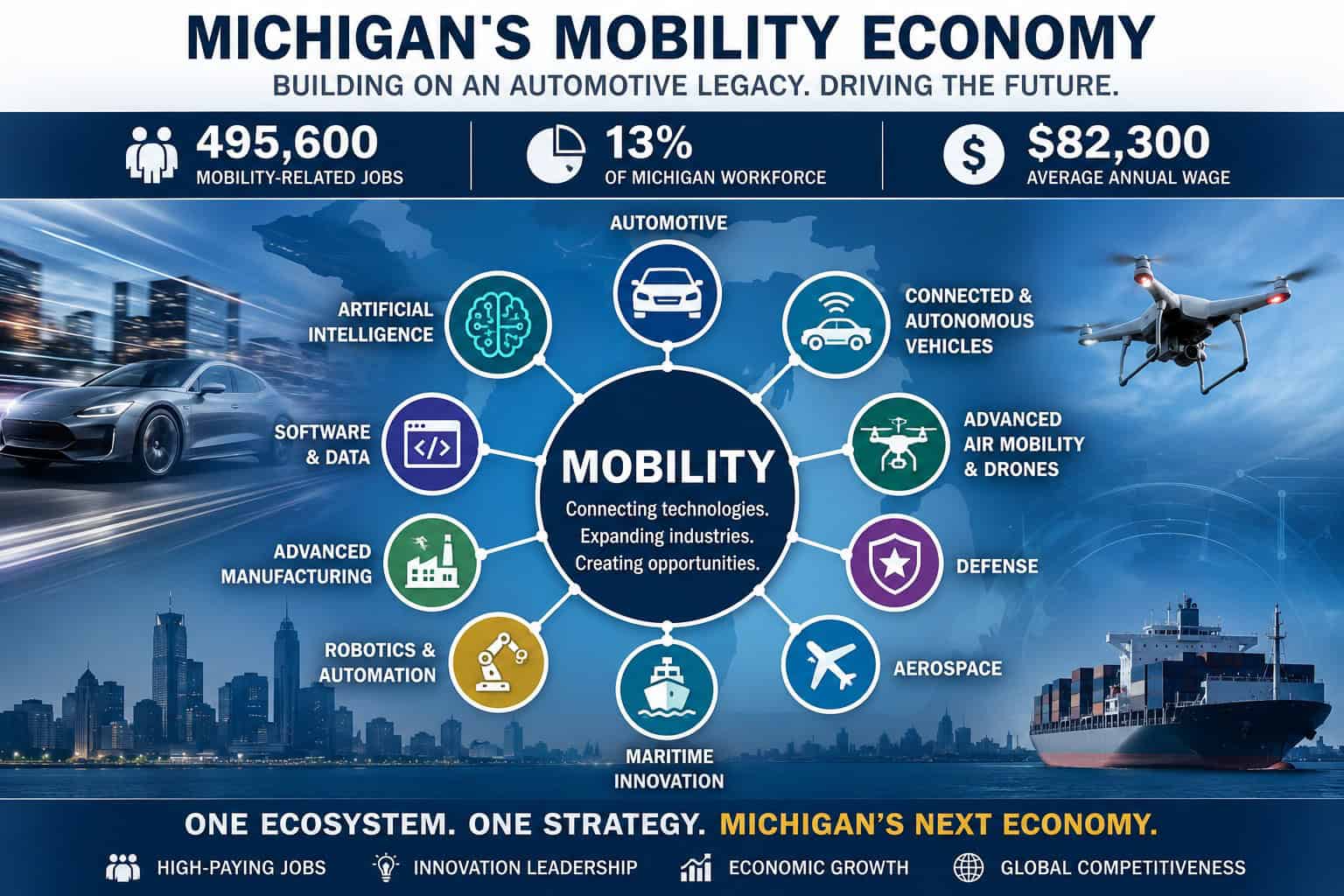
LANSING – Nearly 500,000 Michiganders already work in what state officials define as the mobility economy—a fast-growing sector that reaches far beyond the automobile industry to include artificial intelligence, autonomous vehicles, drones, robotics, maritime technologies, aerospace, defense and advanced manufacturing. The Michigan mobility economy has quietly become one of the state’s largest employment sectors.
The sector already employs about 495,600 people, representing roughly 13 percent of Michigan’s workforce, and pays an average annual wage of more than $82,000—well above the statewide average.
Now Michigan is making an ambitious bet that this broader mobility economy—not automobiles alone—will drive the state’s next generation of economic growth, private investment, startup creation and high-paying engineering and technology jobs.
That strategy will be showcased Sept. 17 when hundreds of executives, entrepreneurs, investors and policymakers gather at M1 Concourse in Pontiac for the Michigan Mobility Innovation Exchange (MIX) Summit and Centrepolis Accelerator Demo Day.
But the conference itself isn’t the story.
The real story is Michigan’s effort to transform more than a century of automotive leadership into a broader innovation economy built around the technologies shaping the future of transportation.
Michigan’s Mobility Economy By The Numbers
- 495,600 mobility-related jobs
- 13% of Michigan’s workforce
- $82,300 average annual wage
- $50+ million invested in Michigan’s Advanced Air Mobility initiative
- 4,000 defense-related companies
- 900+ aerospace suppliers
From Automotive To Mobility
For more than a century, Michigan’s identity was defined by designing, engineering and manufacturing automobiles.
Today, state leaders are using a much broader term—mobility.
The change reflects a dramatic shift in transportation itself.
Modern vehicles increasingly depend on artificial intelligence, advanced software, sensors, connectivity, electrification and automation. Many of those same technologies are also powering commercial drones, autonomous military vehicles, smart infrastructure, logistics systems and next-generation manufacturing.
“Michigan’s automotive industry remains the foundation of our mobility leadership, but mobility today extends far beyond the automobile itself,” said Justine Johnson, chief mobility officer for the Michigan Office of Future Mobility and Electrification (OFME).
“It includes the technologies, infrastructure and systems that move people and goods more safely, efficiently and sustainably.”
Johnson said the engineering talent, manufacturing expertise and culture of innovation that made Michigan the automotive capital of the world are now helping the state expand into electrification, autonomous systems, maritime innovation and Advanced Air Mobility.
“The same talent, expertise and culture of innovation that made Michigan the automotive capital of the world are now helping the state lead in electrification, autonomous systems, maritime innovation and Advanced Air Mobility,” she said. “Michigan is building on its automotive legacy while creating new opportunities in some of the fastest-growing segments of transportation.”
Rather than replacing Michigan’s automotive heritage, mobility builds upon it.
Why Michigan Thinks It Can Lead The Michigan Mobility Economy
Few places begin with Michigan’s advantages.
The state remains home to the Detroit Three automakers, one of the nation’s largest concentrations of automotive engineers, hundreds of suppliers, world-class research universities and nationally recognized testing facilities.
Over the past decade, Michigan has expanded that foundation by investing in organizations such as Centrepolis Accelerator, Michigan Central, Mcity at the University of Michigan and the American Center for Mobility—organizations designed to help researchers, entrepreneurs and established manufacturers develop and commercialize next-generation transportation technologies.
Michigan’s mobility strategy also reflects a broader effort to better coordinate the state’s innovation economy.
Chris Rizik, CEO of the Innovation Alliance of Michigan and managing partner of Renaissance Venture Capital Fund, believes Michigan’s greatest challenge isn’t producing innovation—but connecting it.
“In many ways, Michigan has organically conquered the toughest part of being an innovation state,” Rizik said in an earlier interview with MITechNews. “We have incredible innovation engines at our universities and some of our corporate research groups, both of which are the envy of other parts of the world. What we’ve lacked is an agreed-upon uniform vision to optimize those strengths.”
Michigan’s mobility strategy reflects that philosophy by bringing together automakers, suppliers, startups, universities, investors and government agencies around a common objective: ensuring next-generation transportation technologies are designed, tested, commercialized and manufactured in Michigan.
Investing In The Next Generation
One of the fastest-growing pieces of Michigan’s mobility strategy is Advanced Air Mobility (AAM), which includes commercial drones, autonomous aircraft and related technologies.
Johnson said Michigan has invested more than $50 million during the past year through its AAM Initiative, bringing together universities, startups, government agencies and private industry to accelerate projects involving public safety, infrastructure inspection, logistics and healthcare.
She said the initiative also aligns with growing national priorities surrounding domestic drone manufacturing, supply chain resilience and technological competitiveness.
The MIX Summit will highlight those efforts with sessions covering Advanced Air Mobility, maritime transportation, manufacturing, transit and defense technologies, while Centrepolis Demo Day will showcase startups developing drones, autonomous ground vehicles and other emerging products.
“MIX is more than a conference,” Johnson said. “It’s an opportunity to demonstrate what makes Michigan the global center of mobility innovation.”
A Growing Global Testbed
Michigan also possesses one of the nation’s strongest transportation testing ecosystems.
“The American Center for Mobility has been measurably successful in serving as a hub for the development of safe, secure and sustainable mobility,” said Paul Krutko, interim CEO of the American Center for Mobility and president and CEO of Ann Arbor SPARK.
“We are attracting fast-moving companies at the heart of mobility advancements, including an impressive cadre of international, national and local companies.”
Krutko said attracting companies from around the world demonstrates that Michigan’s investments in mobility infrastructure are gaining international attention while reinforcing the state’s reputation as a destination for transportation innovation.
The Michigan Mobility Economy Is More Than Just Cars
Michigan officials increasingly view mobility as an umbrella that connects industries once considered separate.
That includes:
- Automotive manufacturing
- Artificial intelligence
- Connected and autonomous vehicles
- Advanced Air Mobility and drones
- Maritime technologies
- Robotics and automation
- Advanced manufacturing
- Software-defined transportation
- Logistics and smart infrastructure
Another rapidly growing component is defense.
Many of the same companies developing autonomous vehicles, AI, robotics and advanced manufacturing technologies for commercial transportation are also supplying the defense industry. Michigan is home to approximately 4,000 defense-related companies, more than 900 aerospace suppliers, and key military organizations including TACOM and the U.S. Army’s Ground Vehicle Systems Center.
MITechNews will take a deeper look at how defense is becoming an important part of Michigan’s mobility economy in an upcoming special report.
The Road Ahead For The Michigan Mobility Economy
Johnson said Michigan is not betting on a single breakthrough technology.
Instead, she expects growth across the entire mobility ecosystem.
“We expect growth to come from across the mobility ecosystem rather than any single sector,” she said.
Michigan’s automotive industry will remain the foundation, while electrification, Advanced Air Mobility, autonomous technologies, defense, maritime innovation and artificial intelligence create new opportunities alongside it.
If Michigan succeeds, the state won’t simply remain the automotive capital of the world.
It could become the world’s mobility capital.
Conclusion:
The Michigan mobility economy already supports nearly 500,000 jobs statewide. Automotive remains the foundation, but AI, drones, and defense are expanding fast. However, state leaders say no single technology will drive future growth. Meanwhile, investments in testing facilities and startups continue building on that momentum. For now, Michigan is betting that this broader mobility economy — not cars alone — defines its future.
Coming in Part 2: Can Michigan Keep Its Mobility Startups From Leaving? The State’s Strategy for Turning Innovation Into Long-Term Jobs.
FAQs:
1. What is the Michigan mobility economy?
The Michigan mobility economy includes automotive manufacturing, AI, autonomous vehicles, drones, robotics, maritime technology and defense, employing nearly 500,000 workers.
2. How many jobs does the Michigan mobility economy support?
It supports about 495,600 jobs, roughly 13% of Michigan’s workforce, with an average annual wage of $82,300.
3. How much has Michigan invested in Advanced Air Mobility?
Michigan has invested more than $50 million over the past year through its AAM Initiative to accelerate drone and autonomous aircraft projects.