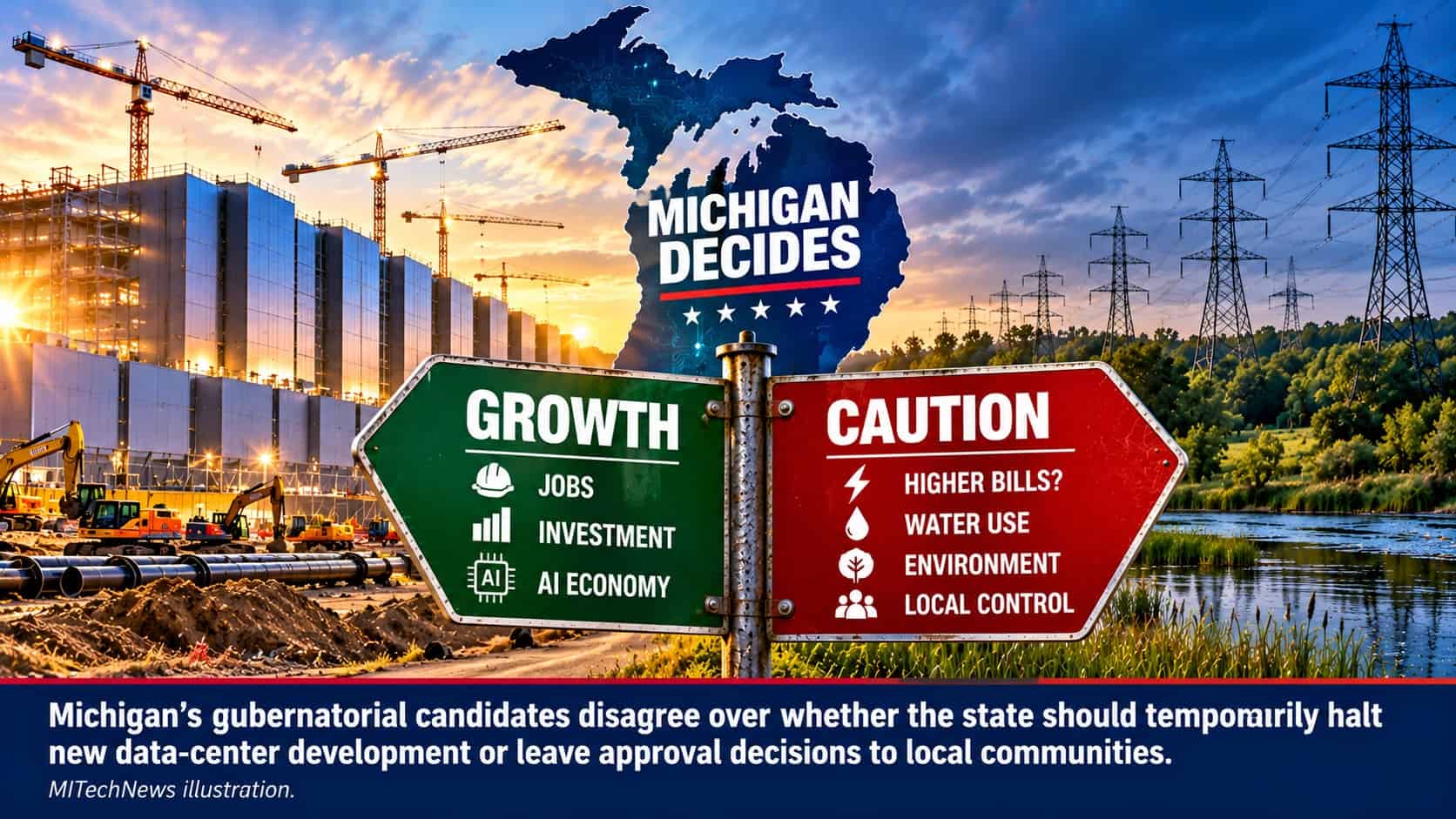
Michigan wants billions of dollars in AI data center investment, but local communities increasingly want rules covering electricity, water, noise and infrastructure costs before Big Tech comes knocking. Saginaw could become the latest city to act Monday.
SAGINAW — Michigan communities increasingly aren’t waiting for massive data centers to arrive before deciding how they should be regulated.
Saginaw City Council is scheduled to vote Monday on a detailed ordinance governing future data centers — even though city officials say none has been proposed.
The ordinance would regulate where data centers could locate, noise levels, water and electricity demands and who pays if public infrastructure must be expanded.
The vote comes as a new University of Michigan survey shows growing skepticism among Michigan local government leaders about the enormous facilities being built to support cloud computing and artificial intelligence.
Fifty-five percent of Michigan local officials surveyed said they believe residents would strongly oppose data center development nearby. Only 2% believe residents would support it.
And 59% said regulating large-scale data centers should be a very high priority for state and local governments.
The findings suggest Michigan’s data center boom is entering a new phase: communities increasingly are asking what they get from the projects, what they cost — and who pays.
Jobs And Investment Versus Water And Electricity
Supporters point to billions of dollars in investment, construction jobs, property-tax revenue and Michigan’s opportunity to participate in the rapidly expanding AI economy.
The U-M survey found 51% of local officials expect data centers to positively affect temporary construction employment, while 32% anticipate a positive impact on local property-tax revenue.
But only 18% agreed the benefits of large-scale data centers generally outweigh their costs. Forty-six percent disagreed.
Sixty percent expect negative effects on Michigan’s freshwater supply. Majorities also anticipate negative impacts on utility bills, public health, quality of life and electric-grid reliability.
The enormous scale of Michigan’s newest AI projects helps explain those concerns.
Saline Township Shows How Big The Stakes Can Get
In Saline Township near Ann Arbor, construction is underway on The Barn, a hyperscale AI data center campus being developed by Related Digital for Oracle as part of Oracle’s partnership with OpenAI.
The project was initially valued at about $4.8 billion. Related Digital later announced financing for a $16 billion data center campus, while Oracle’s subsequent property-tax abatement request was based on approximately $43 billion in proposed investment.
The roughly 250-acre campus could require as much as 1.4 gigawatts of electricity.
Documents filed with the Michigan Public Service Commission said the project could increase DTE Energy’s forecast retail electricity sales by more than 25%.
Developers say the project will create more than 2,500 union construction jobs, more than 450 permanent on-site jobs and approximately 1,500 jobs countywide supporting the facility.
The project also illustrates the tax questions surrounding data centers.
Oracle sought a 12-year, 50% property-tax abatement. Saline Township initially voted to limit the abatement to the project’s original roughly $4.8 billion valuation but reversed that decision three days later after an attorney warned the township could violate an earlier consent judgment.
The township subsequently approved the application based on approximately $43 billion in proposed investment.
Developers say The Barn will use a closed-loop, air-cooled system requiring approximately as much water as a conventional office building. They also say Oracle will pay for electricity infrastructure required by the project.
Related Digital projects Oracle’s contribution toward DTE’s fixed grid costs could produce roughly $300 million in savings for existing customers. That is a developer projection, not an independent estimate.
The combination of enormous investment, thousands of construction jobs and unprecedented electricity demand helps explain why other Michigan communities are establishing rules before developers arrive.
Saginaw Writes The Rules First
Saginaw imposed a moratorium on data center development for 2026 while officials developed permanent regulations.
Under the ordinance scheduled for a vote Monday, data centers would be special land uses restricted to light- and general-industrial districts.
Developers would have to disclose anticipated electricity demand, water consumption, wastewater discharge, cooling systems, noise, heat mitigation and emergency-response plans.
Data centers and associated mechanical equipment would generally have to be at least 500 feet from residential areas and homes, while noise at the nearest residential or other sensitive property would generally be limited to 55 decibels.
Developers also would have to notify property owners within a half-mile and conduct at least two neighborhood meetings.
One provision could prove especially important as other communities consider similar regulations:
If a data center requires Saginaw to expand public water or wastewater capacity, the developer would pay the cost.
That addresses a central question in the debate: whether taxpayers and existing utility customers could end up subsidizing infrastructure needed by massive new industrial users.
Michigan Communities Aren’t Waiting
Saginaw isn’t alone.
Big Rapids Charter Township approved a one-year moratorium while officials develop their own regulations.
At least 18 Michigan local governments have approved or proposed temporary restrictions on new data center development, according to Bridge Michigan.
Lake Township in Huron County is considering requirements that include a hydrogeological study covering a two-mile radius around a proposed facility, along with setbacks and protections involving neighboring water wells.
More could follow.
Only about 5% of Michigan jurisdictions with land potentially available for data centers currently have formal ordinances regulating them, according to U-M researchers. More than half, however, say they are developing regulations or plan to do so.
Rural Michigan Is More Skeptical
The U-M survey also uncovered a significant geographic divide.
Only 12% of rural Michigan officials said data center benefits outweigh their costs, while 53% disagreed.
Among urban officials, 40% said the benefits outweigh the costs, compared with 18% who disagreed.
That matters because rural and semi-rural communities often offer something hyperscale developers need: large tracts of relatively inexpensive land.
They may also have less infrastructure available to accommodate enormous electricity and water demands.
Michigan’s Data Center Rulebook Takes Shape
U-M researchers estimate roughly 60 to 80 large-scale data centers already operate across Michigan.
More are being proposed as technology companies race to secure electricity, land and computing capacity for AI.
The question for Michigan communities increasingly isn’t simply whether they want data centers.
It’s what rules developers must follow if they come.
Saginaw could provide one model: require disclosure of electricity and water demand, establish residential setbacks and noise limits, mandate public meetings and make developers pay for public infrastructure expansions their projects require.
Saline Township demonstrates how quickly the stakes can escalate — from undeveloped land to a project potentially valued in the tens of billions of dollars and requiring more than a gigawatt of electricity.
Saginaw City Council is scheduled to consider its ordinance Monday.
Whether Saginaw ever lands a hyperscale data center remains unknown.
But city leaders appear determined to have the rules written before Big Tech comes knocking.