
Michigan’s first midterm election with statewide early in-person voting is underway. A look at the 2022 county results shows the state’s political divisions, but early turnout does not reveal which party is benefiting.
LANSING — Michigan voters are entering the final full week before the November 3 general election with more opportunities to cast ballots early, while verified state election figures show absentee ballot requests have increased sharply compared with the 2022 midterms.
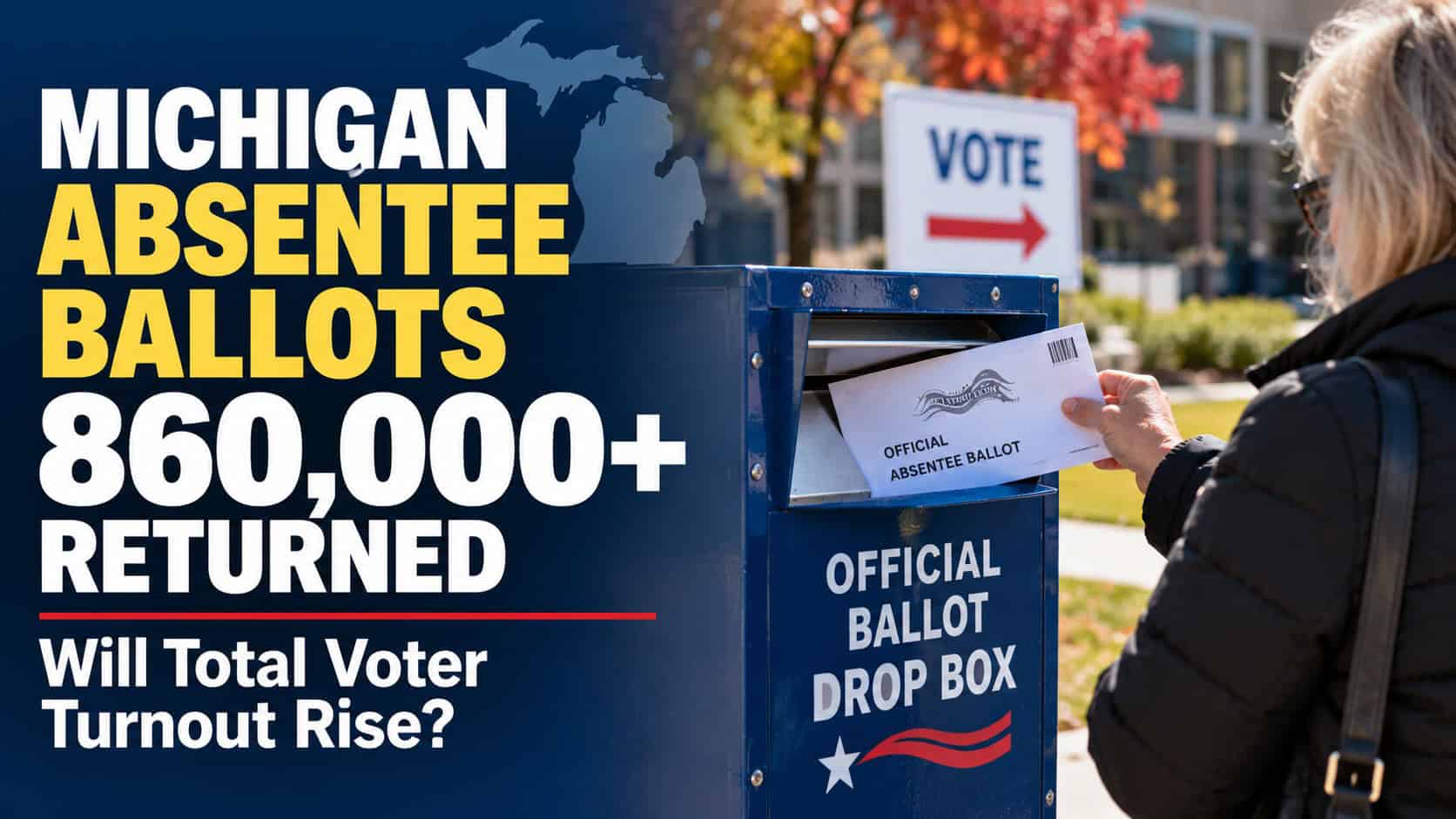
Absentee ballot requests were up 17.2% compared with the equivalent point four years ago, according to the Michigan Secretary of State. But completed absentee ballot returns increased only 2.3%.
The difference raises an important question: Will expanded voting opportunities produce higher overall turnout, or primarily change when Michiganders cast their ballots?
Michigan began its mandatory nine-day statewide early in-person voting period October 24. This is the state’s first midterm general election under the system, which was implemented statewide in 2024.
The political significance of turnout will depend partly on where voters participate. Michigan’s counties have markedly different election histories, particularly in the Detroit metropolitan area, West Michigan and northern Michigan.
How Michigan’s Key Counties Voted in 2022
The 2022 gubernatorial election provides a historical comparison for the upcoming election.
Democratic Gov. Gretchen Whitmer defeated Republican Tudor Dixon statewide, but county results varied substantially.
COUNTY POLITICAL COMPARISON — 2022 GOVERNOR’S RACE
Michigan county 2022 winning candidate Party Wayne Gretchen Whitmer Democratic Oakland Gretchen Whitmer Democratic Macomb Gretchen Whitmer Democratic Kent Gretchen Whitmer Democratic Washtenaw Gretchen Whitmer Democratic Genesee Gretchen Whitmer Democratic Ingham Gretchen Whitmer Democratic Leelanau Gretchen Whitmer Democratic Grand Traverse Gretchen Whitmer Democratic Emmet Tudor Dixon Republican Source: Michigan’s official 2022 gubernatorial county election analysis. The chart identifies historical county winners, not 2026 voter preferences.
The results show why Michigan’s political geography is more complicated than a simple division between Democratic cities and Republican rural communities.
Whitmer carried Wayne and Washtenaw counties, traditionally important Democratic strongholds, along with the politically competitive suburban counties of Oakland and Macomb.
She also won Kent County in West Michigan and Genesee and Ingham counties.
Northern Michigan presented a mixed picture. Whitmer carried Leelanau and Grand Traverse counties, while Dixon narrowly won Emmet County.
Those historical results matter because turnout changes in politically competitive counties could influence statewide races.
However, the number of people voting early in a county does not establish which candidates they support.
Michigan voters do not register by political party, and the state’s public voting dashboard does not disclose individual candidate preferences.
Higher early participation in a county that voted Democratic or Republican in 2022 cannot automatically be interpreted as an advantage for that party in 2026.
Michigan Absentee Requests Rise Faster Than Completed Votes
The Michigan Department of State’s October 20 report provides a verified comparison of absentee voting activity at the same point before the 2022 and 2026 general elections.
ABSENTEE BALLOT COMPARISON — 14 DAYS BEFORE ELECTION DAY
Measurement 2022 2026 Change Absentee ballots requested 1,810,569 2,121,458 +17.2% Absentee ballots returned 771,967 789,476 +2.3% Share of requested ballots returned 42.6% 37.2% −5.4 percentage points Source: Michigan Department of State. The figures compare October 24, 2022, with October 20, 2026, each 14 days before Election Day.
As of 7 a.m. October 20, Michigan had recorded 789,572 votes, including 789,476 returned absentee ballots and 96 early in-person votes.
That represented 10.7% of active registered voters.
These figures are a verified October 20 benchmark, not a claim about the number of ballots recorded as of October 26.
The much larger increase in ballot requests than in actual returns highlights a major change in Michigan’s voting system.
Permanent Absentee Ballots Change the Meaning of Requests
Michigan now allows voters to enroll in a permanent mail-ballot program, under which they automatically receive absentee ballots for future elections.
Of the 2,121,458 absentee requests recorded October 20, 2,001,574 came from voters enrolled in the permanent mail-ballot program.
That represents approximately 94% of all requests.
As a result, the number of ballots requested is no longer as useful an indicator of voter enthusiasm as it may have been under previous election procedures.
Receiving a ballot does not mean a voter will complete and return it.
The more meaningful measures are completed absentee ballot returns, early in-person votes and final Election Day participation.
Early In-Person Voting Adds Another Variable
Michigan voters approved a constitutional amendment in November 2022 requiring at least nine days of early in-person voting for statewide and federal elections.
The system was implemented statewide in 2024, making the November 2026 election its first use in a midterm general election.
According to the Michigan Department of State’s October 23 announcement, the mandatory early voting period runs from October 24 through November 1.
Early voting sites must operate for at least eight hours each day, although some communities offer additional days.
Unlike absentee voting, early in-person voting allows residents to receive their ballots at designated sites, complete them and insert them directly into tabulators.
The expanded system makes direct comparisons with 2022 more difficult.
Voters who previously waited until Election Day may now cast their ballots earlier.
That could increase the number of votes recorded before Election Day without necessarily increasing final turnout.
Why County Participation Rates Will Matter
Michigan’s Voting Dashboard provides county and municipal data on absentee ballot requests, returns and early in-person voting.
Those figures can help show where participation is strongest.
But raw vote totals alone do not provide a meaningful comparison between counties of different sizes.
Wayne County, for example, has far more registered voters than Leelanau County.
Comparing the percentage of active registered voters who have cast ballots provides a better measure of relative participation.
Even those percentages require caution.
Different voting habits, local election procedures and the timing of reporting can affect the numbers.
The dashboard relies on Michigan’s Qualified Voter File, which local election officials update. Records may be entered or corrected after ballots are cast.
Consequently, changes in daily totals do not necessarily represent the exact number of votes physically cast during the preceding 24 hours.
And without information about candidate preferences, participation rates alone cannot establish a partisan advantage.
Will Michigan Break Its 2022 Midterm Turnout Record?
Michigan recorded approximately 4.5 million ballots in the November 2022 general election, setting a record for a nonpresidential election in the state.
Whether the 2026 election exceeds that total remains uncertain.
Michigan’s expanded voting options could make participation easier for residents who face work, transportation or scheduling obstacles on Election Day.
But convenience does not guarantee that more voters will participate overall.
The most useful comparison will come after November 3, when completed absentee ballots, early in-person votes and Election Day ballots can be combined into a final statewide turnout total.
Until then, early voting figures should be treated as measures of participation, not predictions of election outcomes.
Election Officials Urge Prompt Absentee Ballot Returns
With Election Day approaching, state election officials are encouraging voters who have completed absentee ballots to return them promptly.
Deputy Secretary of State Aghogho Edevbie urged voters in the October 20 announcement to hand-deliver ballots to their assigned drop boxes or local clerks rather than risk postal delays.
For most voters, absentee ballots must be received by local election officials by 8 p.m. November 3 to be counted. Different deadlines apply to eligible military and overseas voters.
Voters can also bring eligible absentee ballots to early voting sites for tabulation under the state’s procedures.
Michigan residents can find their early voting locations, track absentee ballots and obtain registration information at Michigan.gov/Vote.
Michigan’s first midterm election with statewide early in-person voting is changing how voters participate before Election Day. Whether it produces higher overall turnout—and how that turnout affects Michigan’s political balance—will not be known until the votes are counted.