Part 1 of 2: Michigan has climbed near the top of America’s business rankings, but its economy, workforce and population continue to lag national growth. Next week, MITechNews asks Michigan economists and economic-development officials why.
ANN ARBOR – Michigan has once again been ranked the sixth-best state in America for business, according to CNBC’s 2026 America’s Top States for Business rankings. That’s no small accomplishment. Michigan ranked 24th when Gov. Gretchen Whitmer took office in 2019. It climbed to No. 6 in 2025 — its highest position since CNBC began compiling the rankings — and held that position this year.
Michigan now ranks ahead of economic competitors including Georgia, Florida, Tennessee and Indiana. But buried deeper in CNBC’s numbers is a question that may matter considerably more to Michigan businesses and workers: If Michigan is America’s No. 6 state for business, why isn’t Michigan’s economy performing like the sixth-best economy in America? It isn’t. CNBC ranks Michigan just 24th for its economy, 21st for workforce and 29th for education. And Michigan’s recent employment numbers illustrate the disconnect.
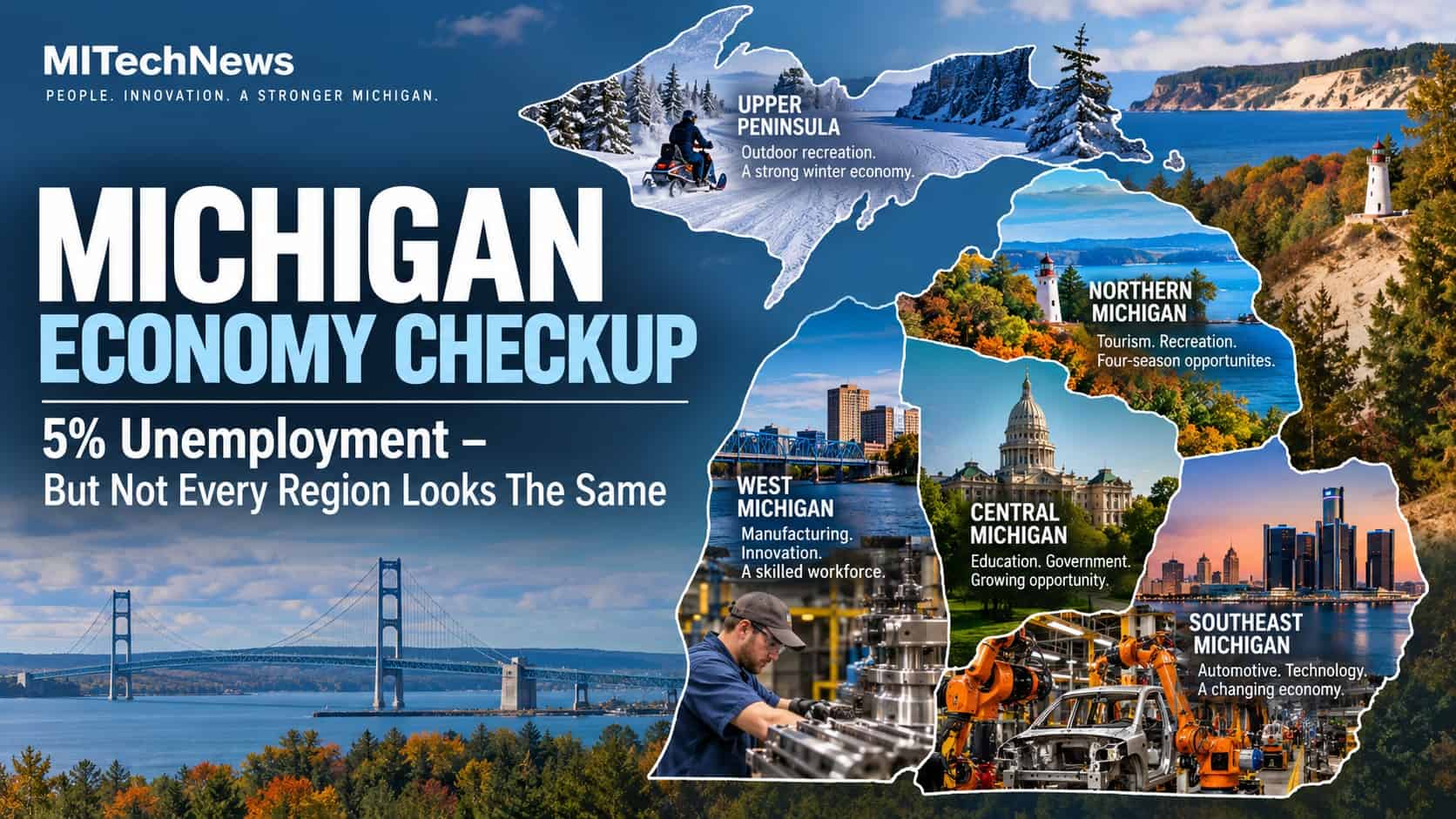
Michigan’s unemployment rate stood at 4.9 percent in July, compared with 4.1 percent nationally. More significantly, Michigan’s civilian labor force was down about 143,000 people from July 2025, a decline of 2.8 percent. Michigan payroll employment has fared better, increasing by about 8,000 jobs over the same period — growth of only 0.2 percent. Michigan, in other words, has created an increasingly attractive environment in which to operate a business without yet translating that advantage into robust statewide economic growth.
Michigan’s Business Climate Is A Genuine Strength
The CNBC ranking shouldn’t be dismissed. CNBC evaluates all 50 states using 138 metrics across 10 categories designed around factors companies consider when deciding where to invest. Michigan’s strongest showing is the cost of doing business, where it ranks fourth nationally. That category incorporates factors including business taxes, wages, utility costs, office and industrial real estate, insurance expenses and economic-development incentives. Michigan also ranks:
-
No. 9 for infrastructure
-
No. 11 for cost of living
-
No. 13 for access to capital
-
No. 15 for quality of life
-
No. 17 for technology and innovation
Those are significant competitive advantages at precisely the time when billions of dollars are being committed nationally to artificial intelligence, data centers, advanced manufacturing, batteries, semiconductors, robotics and other emerging industries. Michigan already possesses many of the ingredients those industries need: engineering talent, manufacturing expertise, industrial infrastructure, universities and one of the world’s most developed automotive supply chains. Yet attracting investment and producing broad economic growth aren’t necessarily the same thing.
The Workforce Problem
One of Michigan’s biggest challenges may be people. Michigan’s population grew just 1.4 percent between 2015 and 2025, according to the Michigan Center for Data and Analytics. The U.S. population grew about 6.2 percent during the same period. That difference matters.
Businesses need customers. They also need workers. A state can offer tax incentives, industrial sites, infrastructure and relatively affordable operating costs. But companies considering major investments also need confidence they can find enough engineers, electricians, skilled trades workers, technicians, programmers and increasingly AI-trained employees.
CNBC’s ranking reflects that weakness. Michigan ranked 13th for workforce in 2025. This year it fell to 21st. That’s a warning sign. The University of Michigan’s latest state economic forecast provides another. U-M economists reported that Michigan wage and salary employment declined by 6,100 jobs between April 2025 and April 2026. They forecast Michigan will lose about 5,900 payroll jobs during 2026 before returning to modest growth in 2027 and 2028. Much of that future growth is expected in health care and government rather than manufacturing.
Michigan May Be Entering Another Economic Transition
The numbers become especially important because Michigan could be approaching one of its biggest economic transitions since the automobile transformed the state more than a century ago. Artificial intelligence is rapidly moving beyond software. AI-powered robotics, autonomous systems, advanced manufacturing and massive data centers will require enormous amounts of equipment, electricity and skilled labor. Michigan has an opportunity to do more than simply use these technologies.
Michigan could manufacture them. The state’s automotive manufacturing base already possesses expertise in robotics, automation, sensors, advanced materials, electronics and precision manufacturing. That creates an opportunity for Michigan companies to participate in building the physical infrastructure of the AI economy. But capturing that opportunity will require more than being an inexpensive place to operate.
Michigan will need workers with the skills those industries require. That means universities, community colleges, private training organizations and union apprenticeship programs may need to accelerate training for AI, robotics, electrical systems, data-center operations and advanced manufacturing.
Energy Could Become The Next Competitive Test
Michigan’s No. 9 infrastructure ranking is encouraging, but the next generation of economic development will put enormous pressure on one particular piece of infrastructure: electricity. AI data centers can require hundreds of megawatts of electricity, while the largest proposed campuses can eventually require power measured in gigawatts. Advanced manufacturing is also becoming increasingly electricity-intensive.
That creates both an opportunity and a risk. If Michigan can provide large industrial users with reliable and competitively priced electricity without shifting excessive costs onto homeowners and existing businesses, energy could become another economic-development advantage.
If it can’t, electricity could become a constraint on growth. That makes decisions being made today about power generation, transmission, natural gas, nuclear power, renewable energy and Michigan’s electric grid part of the state’s long-term economic-development strategy.
No. 6 Is The Beginning, Not The Finish Line
Gov. Whitmer has pointed to Michigan’s CNBC ranking as evidence that the state is becoming increasingly competitive. And there’s considerable evidence supporting the argument that Michigan’s business climate has improved.
Moving from No. 24 to No. 6 in seven years is significant. But the CNBC rankings themselves show there’s considerably more work to do. Michigan is: No. 6 for business. No. 24 for economy. No. 21 for workforce. Those numbers tell two different stories about the same state. Michigan has become increasingly competitive at attracting and operating businesses.
The next challenge is turning that competitive position into sustained job creation, population growth, higher incomes and new industries. The AI economy could provide Michigan with an unusually large opportunity to do exactly that. The question is whether Michigan can convert its No. 6 business climate into an economy that performs like one.
Coming Next Week — Part 2: MITechNews will ask Michigan economists and economic-development officials why Michigan’s improving business climate hasn’t produced stronger economic growth — and what the state must do to turn its No. 6 business ranking into more jobs, workers, investment and prosperity.