
Congress has given hemp businesses another month before sweeping federal restrictions take effect. iHemp Michigan President Blain Bechtold says the delay does little to resolve the industry’s problems and urges lawmakers to adopt age restrictions instead.
LANSING — Michigan hemp businesses face a December 11 federal deadline that could remove many hemp-derived THC beverages, gummies and some CBD products from the market, while the state’s remaining hemp farmers confront another regulatory battle that industry advocates warn could jeopardize their 2027 growing season.
Blain Bechtold, president of iHemp Michigan, told MITechNews that Congress’s decision to postpone most of the new federal restrictions by approximately 30 days does little to resolve uncertainty for hemp businesses and consumers.
“The clock is still ticking on the hemp restriction/ban on CBD products,” Bechtold said. “The 30 day extension is only a bandaid on the issue.”
Bechtold favors a minimum purchasing age of 21 for hemp-derived CBD products, matching the age requirement for recreational marijuana in Michigan and Ohio. He also supports allowing parents and caregivers to make decisions about providing such products to their minor children.
His position contrasts with the federal approach, which would exclude many currently marketed hemp-derived cannabinoid products from the definition of legal hemp.
What Changes December 11?
Congress approved the new restrictions in November 2025 as part of federal spending legislation. A subsequent funding bill signed by President Donald Trump in September 2026 postponed most of the changes until December 11.
The legislation substantially narrows the definition of legal hemp established by the 2018 Farm Bill.
Under the revised definition, finished hemp-derived cannabinoid products containing more than 0.4 milligrams of total THC per container would no longer qualify as federally legal hemp. The standard also addresses certain other cannabinoids with THC-like effects.
For comparison, a single beverage containing 5 milligrams of THC would exceed the 0.4-milligram threshold by more than twelvefold.
The changes could affect many THC beverages, gummies, edibles and other products currently marketed as hemp-derived.
Some full-spectrum CBD products containing small amounts of THC could also be affected, even if they are not marketed as intoxicating.
The legislation does not ban all CBD products. Products that meet the revised definition may remain federally lawful, subject to other applicable requirements, including Food and Drug Administration regulations.
Certain restrictions involving cannabinoids manufactured or synthesized outside the cannabis plant are scheduled to take effect November 12, a month before the broader changes.
The Congressional Research Service has analyzed the revised hemp definition and its implications for agricultural producers and consumer products.
Michigan Hemp Leader Calls For Age Restrictions
Bechtold argues that Congress should establish a regulatory system rather than eliminate access to broad categories of hemp-derived products.
“We are hopeful that congress will act responsibly and introduce legislation that will address the issues with cbd products,” he told MITechNews.
His proposed minimum purchasing age of 21 would apply to hemp-derived CBD products, while preserving a role for parents and caregivers in decisions involving minors.
Such an approach would require lawmakers to establish specific rules governing purchases, product safety and any parental or caregiver exceptions.
Supporters of stricter federal restrictions have raised concerns about intoxicating hemp products being sold through retailers without the age verification, testing and other safeguards required in licensed marijuana markets.
Hemp advocates counter that age restrictions, labeling and product testing could address those concerns without eliminating access to many products.
Bechtold is not optimistic that the November congressional elections will change the outcome.
“I don’t think the midterms will affect the outcome of the ban,” he said.
Michigan Hemp Growers Have Declined Sharply
The federal debate comes as Michigan’s industrial hemp cultivation industry has experienced a dramatic contraction.
According to the Michigan Department of Agriculture and Rural Development, Michigan had 631 registered hemp growers in 2020.
By 2024, the number had fallen to just 34.
A subsequent Michigan Senate Fiscal Agency report identified 24 registered growers as of December 2025.
That represents a decline of approximately 96% from the 2020 registration count.
These figures represent registered growers, not necessarily the number of farms actively planting or harvesting hemp.
MDARD previously reported that declining registrations had made the state-run program financially unsustainable.
Michigan currently charges growers an annual registration fee of $1,250, plus applicable sampling and testing charges.
Under MDARD’s 2026 fee schedule, growers also face $150 charges for sampling visits and laboratory samples.
The costs can be significant for farmers experimenting with hemp as an alternative agricultural crop.
Industry Warns Michigan Could Lose Another Growing Season
In a letter provided to MITechNews, iHemp Michigan urged state lawmakers to approve legislation transferring oversight of industrial hemp cultivation from MDARD to the U.S. Department of Agriculture.
The organization supports House Bills 5094 and 5095 and Senate Bills 608 and 609.
The Senate bills passed the Michigan Senate unanimously on June 4, 2026, and were referred to the House Regulatory Reform Committee.
The House bills were introduced in October 2025 and also referred to that committee. The latest legislative actions reviewed did not establish that the proposals had advanced through the House.
iHemp warned that failure to act this year could prevent the transition from occurring in time for the 2027 planting season.
The organization argues that Michigan’s current licensing system puts farmers at a disadvantage compared with producers in states operating under USDA oversight.
MDARD has also supported transferring grower regulation to USDA. The department previously said the federal program offered three-year licenses without a federal license fee, although growers would remain responsible for sampling, testing and compliance costs.
The transfer would concern hemp cultivation, not an automatic elimination of state oversight of processing, handling or marijuana sales.
The proposed change is also separate from the federal restrictions on hemp-derived consumer products.
Ohio Already Has Tougher Hemp Restrictions
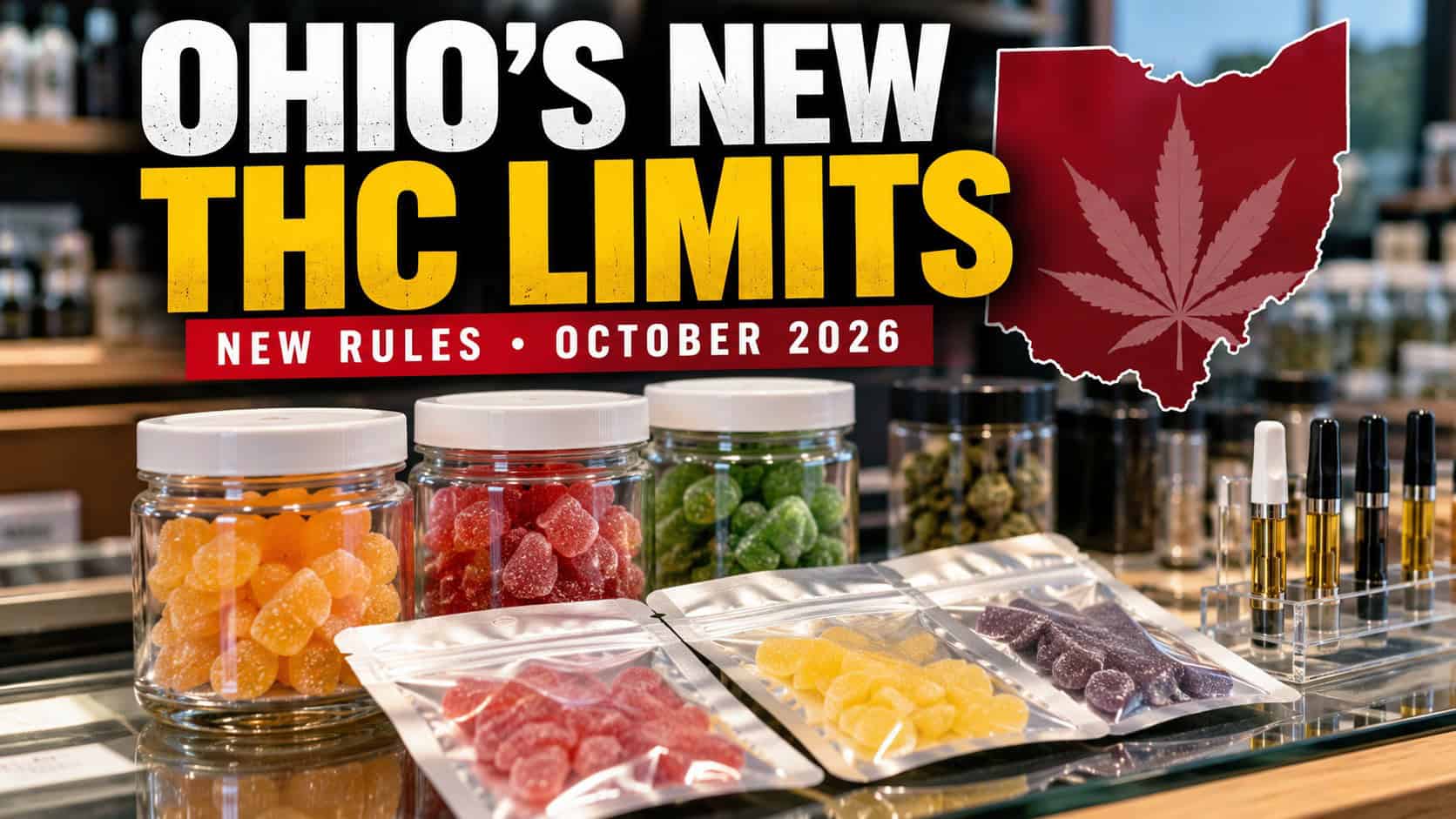
Ohio has moved ahead with its own restrictions on intoxicating hemp-derived products.
Ohio Senate Bill 56, which took effect March 20, 2026, changed the state’s regulatory treatment of intoxicating hemp products.
Ohio’s restrictions limit the manufacture and sale of products that fall within its definition of intoxicating hemp or marijuana, while preserving separate requirements for qualifying industrial hemp.
Consequently, Ohio retailers already face significant state-level restrictions, independent of the approaching federal deadline.
For businesses operating across Michigan and Ohio, the differing regulatory systems complicate decisions about product formulation, distribution and retail sales.
The approaching federal changes could create additional challenges for products that remain permissible under some state laws but no longer qualify as hemp under federal law.
Could Marijuana Dispensaries Benefit?
One potential consequence of the federal restrictions is a shift in consumer spending from hemp-derived THC products sold outside licensed marijuana stores to products sold through state-regulated dispensaries.
Michigan and Ohio both permit recreational marijuana sales to adults 21 and older.
Their licensed dispensaries operate under testing, licensing and other regulatory requirements.
If competing hemp-derived THC products disappear from conventional retail channels, some consumers might turn to licensed dispensaries.
However, that outcome is uncertain.
Consumers purchasing non-intoxicating CBD products may not be interested in recreational marijuana. Others could seek compliant alternatives or stop purchasing the affected products.
The economic consequences will depend on consumer behavior, state enforcement and whether Congress changes the federal law.
Congress Faces A December Decision
Congress has considered proposals to delay, repeal or replace the new hemp restrictions.
Industry advocates favor a framework that preserves access to qualifying products while establishing safeguards for consumers.
Supporters of the restrictions argue that Congress must address intoxicating hemp products that have operated outside the regulatory systems governing state-licensed marijuana.
For Michigan, the debate has two distinct economic dimensions: protecting businesses selling hemp-derived consumer products and determining whether the state can rebuild its sharply diminished industrial hemp farming sector.
For Ohio, where intoxicating hemp products already face substantial restrictions, the federal deadline adds another layer of regulatory uncertainty.
Bechtold hopes Congress will develop a lasting solution, but he considers the recent extension inadequate.
Unless lawmakers act again, certain cannabinoid restrictions are scheduled for November 12, with the broader federal hemp changes following December 11.