
October economic report finds conflicting trends across five Michigan regions as industrial inflation rises, workforce estimates decline and businesses continue investing.
LANSING — Michigan enters the final quarter of 2026 with conflicting economic signals: The state’s labor force has shrunk by 158,000 people over the past year, unemployment has climbed to 5%, and manufacturers face mounting inflation. Yet some employers continue adding jobs and investing in new facilities.
The latest Michigan Department of Technology, Management and Budget employment report shows 154,000 fewer employed Michigan residents in August than a year earlier.
However, that does not mean Michigan employers eliminated 154,000 jobs.
A separate employer survey showed 8,000 additional seasonally adjusted payroll jobs over the same period. The household survey measures employed residents, including self-employed workers, while the employer survey counts jobs at businesses and government agencies. Differences in methodology can produce substantially different results.
Michigan’s 5% unemployment rate exceeded the national rate of 4.1%, ranking fourth-highest among states in August.
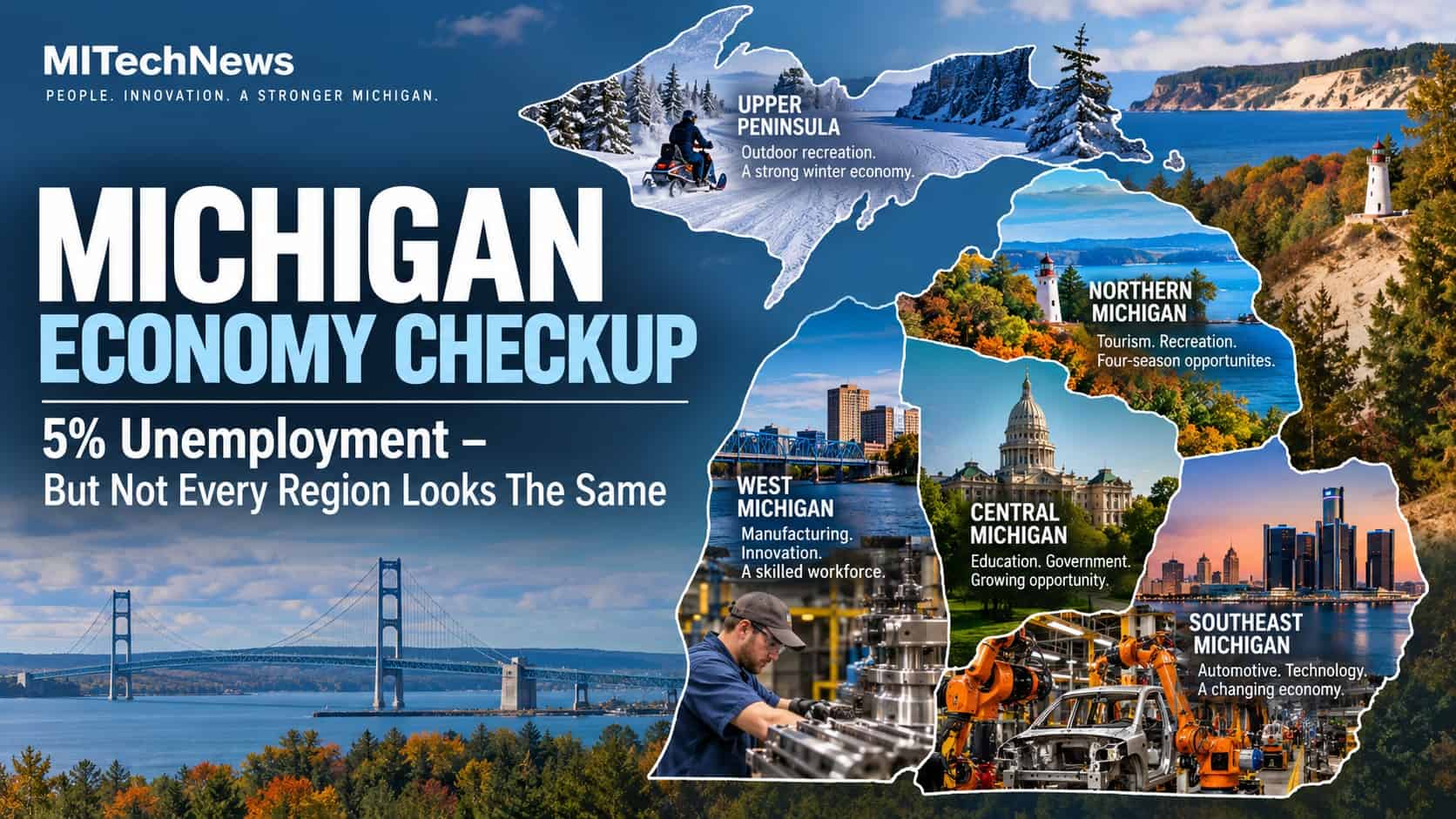
This month’s MITechNews Economic Report combines August employment statistics with September manufacturing findings, regional business surveys and investment announcements to examine conditions across five Michigan regions.
Southeast Michigan: Detroit shows resilience despite higher unemployment
The Detroit-Warren-Dearborn metropolitan area’s seasonally adjusted unemployment rate reached 5.4% in August, up from 4.7% a year earlier.
However, its labor force increased by 27,000 over the year, while the number of employed residents rose by 11,000, contrasting with Michigan’s statewide decline.
A University of Michigan economic forecast projects continued expansion in the city of Detroit through 2031, with local inflation moderating from 3.2% in 2026 to 2.2% in 2028.
But researchers identified significant challenges involving household earnings.
Only 34.4% of Detroit’s primary earners attained a living wage in 2024, according to the university’s analysis.
A living wage represents the estimated income needed to cover basic household expenses, including housing, food, transportation, healthcare, childcare where applicable and taxes. Unlike the legal minimum wage, the amount varies according to household size, working adults, dependents and local living costs.
The finding suggests that economic expansion has not translated into sufficient earnings to meet basic needs for many Detroit households.
The university’s forecast applies to the city of Detroit, not the entire metropolitan region.
West Michigan: Nine months of growth, but inflation accelerates
West Michigan’s industrial economy expanded for the ninth consecutive month in September, according to a Grand Valley State University purchasing managers survey released October 12.
However, expansion slowed.
The new orders index fell from +30 in August to +18 in September. Production declined from +21 to +18, while the employment index slipped from +11 to +6.
All three remained positive, indicating continued expansion at a slower pace.
Brian Long, director of supply management research at GVSU’s Seidman College of Business, said tariffs and material shortages pushed the region’s industrial price index to its highest level since the COVID-19 crisis.
“For the industrial purchasers in our survey, inflation is going wild, and some respondents to our survey say they’ve never seen it so bad,” Long said.
Consumer confidence also weakened considerably in September, approaching historically low levels observed during the preceding six months.
Long said automotive suppliers and office furniture manufacturers are redefining their businesses as economic conditions change.
West Michigan’s diversified industrial base has helped maintain unemployment below statewide averages, but higher costs and slower orders could challenge continued expansion.
Central Michigan: Lansing workforce contracts as companies invest
The Lansing-East Lansing metropolitan area reported approximately 219,000 employed residents in August, down 18,100, or 7.6%, from a year earlier.
Its labor force contracted by 19,700, while its unemployment rate declined from 4.9% to 4.6%.
These not-seasonally-adjusted estimates illustrate how a shrinking workforce can produce a lower unemployment rate despite declining employment.
However, new business investments offer a more encouraging picture.
The Michigan Economic Development Corporation announced September 28 that Lansing-based Niowave plans to invest more than $85 million in expanded medical-radioisotope manufacturing operations.
The project includes a new 80,000-square-foot Clinton County facility and is expected to create at least 73 jobs, with starting wages of $30.29 per hour plus benefits.
The company produces materials used in advanced cancer treatments.
Separately, the Lansing Economic Area Partnership reported that participants and alumni of its small-business accelerator programs generated more than $4.45 million in cumulative revenue through 2025 and created 18 full-time jobs.
These developments demonstrate investment and entrepreneurial activity, although they do not establish whether Central Michigan’s overall economy expanded in September.
Northern Michigan: Housing and workforce challenges persist
Northern Michigan continues to report comparatively low unemployment despite substantial workforce declines.
The Traverse City metropolitan area’s unemployment rate stood at 3.7% in August, among Michigan’s lowest.
However, the region’s estimated number of employed residents declined by 5,000, or 6%, from August 2025.
A Traverse Connect business survey provides another perspective on regional conditions.
In its second-quarter survey, 96% of respondents described the Grand Traverse region as a good place to grow a business, while 87% reported an improving business environment.
However, 37% expressed concerns about attainable housing, up from 26% in the previous quarter. Another 23% identified finding and hiring talent as their primary barrier to growth.
The findings suggest businesses remain optimistic about opportunities even as housing affordability and workforce availability present obstacles.
The survey reflects second-quarter business sentiment rather than September conditions.
Upper Peninsula: Workforce losses contrast with new investment
Michigan’s Upper Peninsula reported approximately 126,400 employed residents in August, down 8,300, or 6.2%, from a year earlier.
Its labor force declined by approximately 9,400, or 6.6%, while unemployment improved from 5.4% to 5%.
The reductions raise questions about the workforce available to employers in mining, forestry, manufacturing, healthcare and tourism.
However, new investment is continuing.
On October 8, the Michigan Economic Development Corporation announced a planned $3.68 million redevelopment of two long-vacant historic buildings in downtown Calumet.
The project, supported by a $1.1 million state grant, is expected to create seven apartments and three commercial spaces.
Although relatively small compared with major industrial investments, the project addresses two important regional economic needs: housing and downtown commercial development.
The broader labor market figures do not establish whether Upper Peninsula business activity expanded or contracted in September, or how much of the workforce decline reflects retirement, migration or reduced participation.
Michigan’s outlook: Can business growth overcome workforce pressures?
Michigan’s economic picture is neither uniformly positive nor negative.
West Michigan manufacturers continue expanding, Detroit economists forecast additional growth, and businesses are investing in advanced manufacturing, healthcare technology and commercial development.
Yet shrinking labor-force estimates, rising industrial costs and uneven regional employment trends present challenges.
The critical questions for the fourth quarter are whether manufacturers can sustain new orders, employers can attract and retain workers, and households can maintain purchasing power.
What’s Next: September Employment Report Due October 15
Michigan’s September statewide employment report is scheduled for Thursday, October 15.
MITechNews will follow up with an analysis of whether unemployment, labor-force participation and payroll employment improved or deteriorated during September.
The state’s September regional labor market report, scheduled for October 22, will provide another opportunity to examine how economic conditions differ across Michigan.