DETROIT – Michigan is investing millions of dollars to build an artificial intelligence economy but questions about Michigan AI investment ROI are mounting. Developers are proposing power-hungry data centers. Universities are expanding AI research. State leaders recently launched a $60 million Michigan Innovation Fund to help technology startups grow.
But as Michigan doubles down on AI, a growing number of corporate executives are asking a simple question: Where’s the payoff?
Axios recently reported that companies across America are beginning to scrutinize rising AI costs as many struggle to measure meaningful returns on investment. The concerns come despite hundreds of billions of dollars being invested globally in data centers, advanced computer chips and AI software platforms.
A new University of Michigan study suggests those concerns may not be misplaced.
Researchers who analyzed more than 11,000 publicly traded companies found that businesses are increasingly using technology to improve efficiency and reduce costs rather than accelerate growth. The findings raise important questions as Michigan positions itself to compete in what many believe will become the next great technology boom.
University Of Michigan Researchers See A Shift
The study found that companies have fundamentally changed their priorities over the past several years.
For decades, growth was king. Investors rewarded companies that expanded revenue, entered new markets and aggressively pursued market share.
Since roughly 2021, however, researchers have found businesses have increasingly focused on productivity, efficiency and profitability.
Rather than pursuing growth at any cost, executives are concentrating on reducing expenses, streamlining operations and improving productivity.
Artificial intelligence appears to be accelerating that transition.
Many organizations are deploying AI tools to automate repetitive work, assist software developers, analyze large volumes of data, improve customer service and reduce administrative workloads.
Those improvements can create real value.
The challenge is that efficiency gains do not always translate immediately into higher revenues or dramatically improved profits.
As a result, companies may be spending heavily on AI while still struggling to demonstrate measurable financial returns.
The study also found that productivity gains increasingly coincide with workforce reductions, suggesting some companies are using AI and automation to accomplish more work with fewer employees.
Why Executives Are Questioning Michigan AI Investment ROI
According to Axios, corporate leaders are beginning to take a closer look at the economics of artificial intelligence.
The issue is not whether AI works.
Most executives agree the technology can improve productivity and automate tasks.
The bigger question is whether those gains justify the rapidly rising costs associated with AI software licenses, cloud computing resources, data storage and employee training.
Businesses across multiple industries have deployed AI tools for coding, customer support, marketing, research and business operations.
Yet many organizations continue struggling to quantify the exact return on investment.
A software engineer who completes projects faster creates value.
A customer service department that handles more inquiries creates value.
An accounting team that automates repetitive tasks creates value.
But translating those improvements into measurable increases in revenue or profit can be difficult.
That uncertainty is prompting more executives to ask whether AI is currently generating enough value to justify continued spending at today’s levels.
Is Michigan’s AI Investment ROI Following The Internet Playbook
Some economists believe the current debate resembles the early years of the internet.
During the 1990s, companies invested billions of dollars in computers, software and networking infrastructure. Yet measurable productivity gains took years to appear in economic data.
Economists eventually called the phenomenon the “productivity paradox.”
Businesses were investing heavily in transformative technology long before the benefits became obvious.
Many analysts believe artificial intelligence may be following a similar path.
Companies are still learning how to redesign workflows, retrain employees and integrate AI into day-to-day operations.
If that theory proves correct, today’s investments could eventually generate substantial returns.
The challenge is that investors, executives and policymakers are being asked to make decisions now, before those returns are fully visible.
Michigan Bets Big on AI Investment ROI
That uncertainty matters because Michigan is making significant investments in the AI economy.
State leaders recently launched the Michigan Innovation Fund to help address startup funding gaps and accelerate commercialization of emerging technologies.
Universities across the state are expanding AI research, workforce development and commercialization efforts.
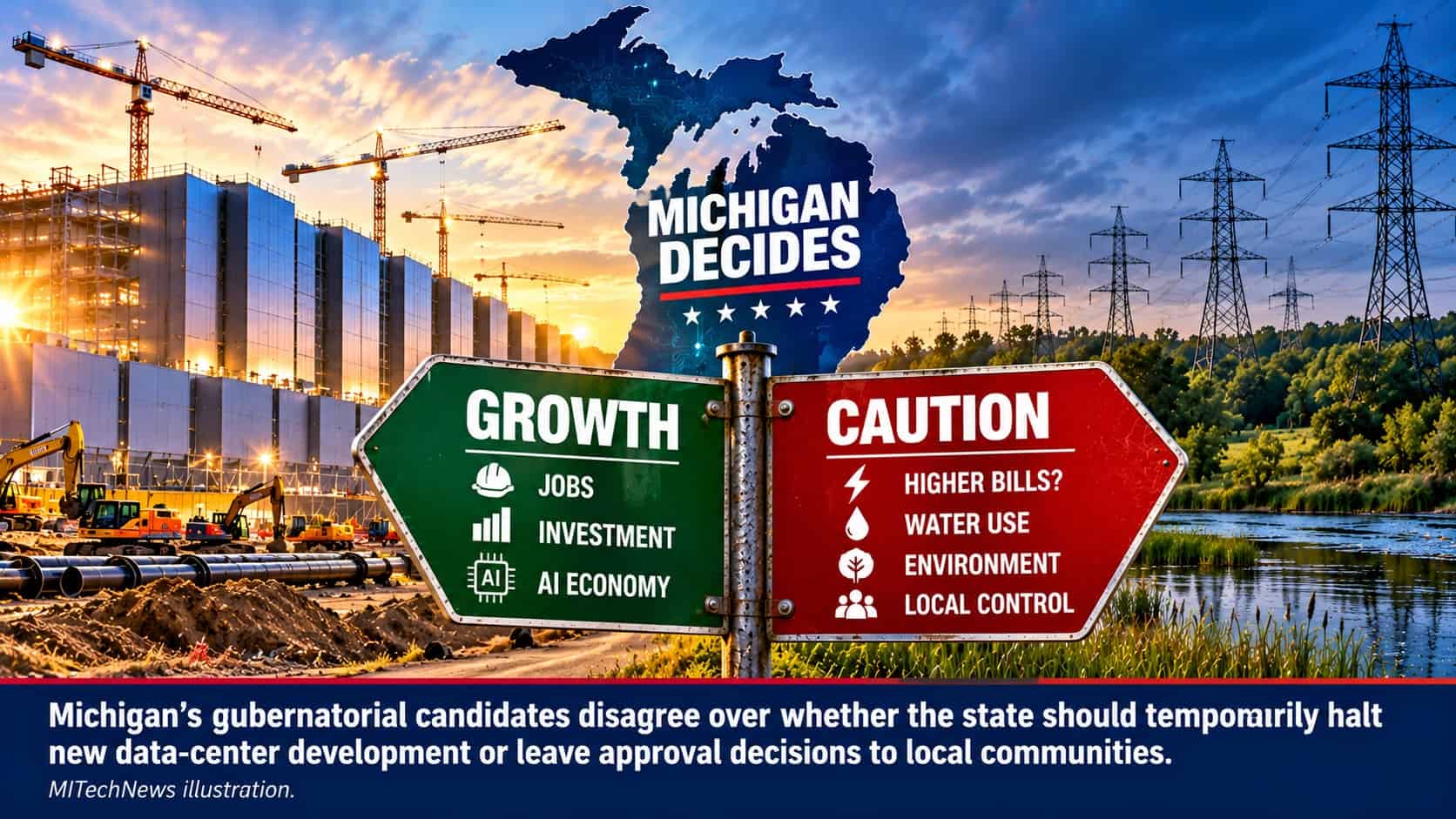
At the same time, several proposed data center developments have sparked debate over electricity demand, water consumption and long-term economic benefits.
Supporters argue Michigan must compete aggressively for AI-related investment or risk falling behind states that are attracting technology companies, startup capital and advanced manufacturing projects.
Critics question whether the economic benefits will justify the costs, particularly if AI adoption does not generate the growth many advocates expect.
The answer remains unclear.
Few experts doubt that artificial intelligence will become a major force in the global economy.
What remains uncertain is how quickly businesses will convert that technological potential into measurable profits.
For Michigan, that question could shape everything from startup funding and workforce development to energy policy and economic growth over the next decade.
And as the state continues building the infrastructure needed to support an AI-driven future, the debate over AI’s return on investment is likely to become even more important.
Conclusion
Michigan’s AI investment ROI question does not have a clear answer yet. The state is betting big on data centers, research and startup funding. Corporate America, meanwhile, wants proof that the spending is paying off. History offers a lesson here. The internet took years to show its full economic impact too. For now, both the investment and the skepticism make sense. Only time will show whether Michigan’s AI bet was the right call.
*In Part 2 of this series, MITechNews will examine how Michigan companies are deploying artificial intelligence and whether local executives are seeing measurable gains in productivity, profitability and growth.*
FAQs:
1. What is Michigan’s AI investment ROI so far?
Michigan’s AI investment ROI remains unclear. While the state has poured funding into data centers, research and startups, a University of Michigan study shows companies are using AI mainly to cut costs rather than drive measurable growth.
2. Why are corporate executives questioning Michigan’s AI investment ROI?
Executives aren’t questioning whether AI works — they’re questioning whether the returns justify rising costs. Many companies still struggle to translate AI-driven efficiency gains into higher revenue or clearer profits.
3. How does the Michigan Innovation Fund relate to Michigan’s AI investment ROI?
The $60 million Michigan Innovation Fund supports tech startups and aims to accelerate AI commercialization, but its long-term impact on Michigan’s AI investment ROI is still being measured.
4. Could Michigan’s AI investment ROI improve over time?
Yes. Economists compare today’s AI spending to the early internet era, when productivity gains took years to appear. If that pattern holds, Michigan’s AI investment ROI may strengthen as adoption matures.