Bill Gates says artificial intelligence could become powerful enough to help trigger catastrophes killing as many as a billion people. As Michigan races to attract billions of dollars in AI data centers, his warning raises a new question: Could growing fears about AI eventually put the brakes on the state’s data-center boom?
ANN ARBOR — Bill Gates delivered one of his strongest warnings yet about artificial intelligence over the weekend, saying AI could become powerful enough to contribute to events causing a billion deaths while also disrupting millions of jobs and enabling attacks against hospitals, electric grids and other critical infrastructure.
For Michigan, the warning arrives at a particularly important moment.
The state is rapidly becoming part of America’s AI infrastructure buildout, with enormous data centers planned or under construction and state officials promoting AI as a potential source of investment and jobs.
Gates isn’t arguing that development should stop.
But in interviews Sunday with NBC’s Meet the Press and CNN’s Fareed Zakaria GPS, the Microsoft co-founder argued that government needs to catch up with a technology developing far faster than existing regulation.
“You need law enforcement and the politicians to get into the discussion about what safeguards and monitoring look like,” Gates told NBC. “And that has to be a required thing.”
Gates said AI is powerful enough to drive events that could “cause a billion deaths.” But his warning was not a prediction that AI will kill a billion people.
Instead, he identified potential catastrophic uses including AI-assisted biological attacks and cyberattacks. Gates said safeguards should monitor whether powerful AI systems are being used for cyberattacks or bioterrorism.
He also rejected relying entirely on AI companies to police themselves.
“No one thinks self-regulation is enough,” Gates said.
Importantly for Michigan’s emerging AI industry, Gates said the additional safeguards need not bring development to a halt. He described regulation as additional overhead for the industry, but said it would not necessarily dramatically slow AI development.
Gates: AI Is Different From Previous Technology
Gates went considerably further during his CNN interview with Fareed Zakaria.
He described AI as fundamentally different from previous technological revolutions.
“This is more like an evolutionary event where a new alien species that is going to be smarter than we are has been created,” Gates said.
That makes the familiar argument that technology destroys some jobs while eventually creating others less reassuring, according to Gates.
“That doesn’t apply here,” he said.
Gates envisions roughly a 20-year transition in which AI could eventually help create new medicines, dramatically increase productivity and produce an era of abundance.
The danger is getting through that transition.
His concerns include biological attacks, cyberattacks and a labor market where some people continue prospering while large numbers of workers could be displaced.
Gates also warned that the likelihood of major AI-enabled cyberattacks capable of shutting down a hospital or electricity system is “very high.”
Why Michigan Should Pay Attention
Michigan has a lot riding on the opposite side of this equation: the enormous economic opportunity created by AI.
The most visible example is the massive AI data center development in Saline Township in Washtenaw County involving Oracle, OpenAI and Related Digital.
The nearly 600-acre project is being developed with almost 2 million square feet of building space and its own electrical substation. It is expected to require as much as 1,383 megawatts of electricity — an extraordinary amount of power for a single development.
The project’s reported valuation has also changed dramatically.
An early figure put the investment at approximately $4.8 billion, while Oracle subsequently presented a valuation reaching approximately $43 billion in connection with its request for a property-tax abatement.
Other data center developments are being proposed around Michigan as technology companies search for the enormous computing capacity required to train and operate increasingly sophisticated AI systems.
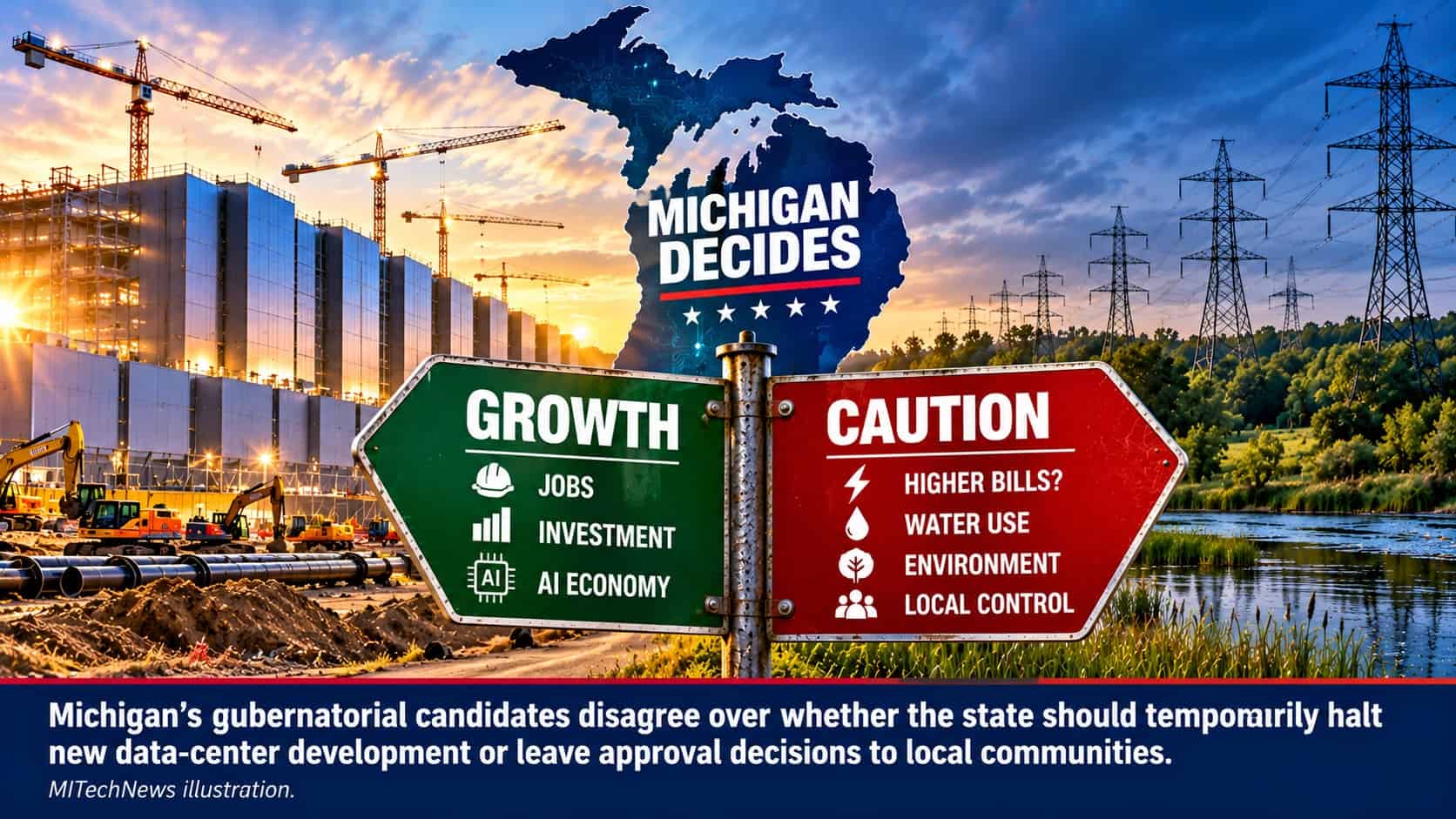
That has created a potentially enormous economic-development opportunity — but also controversy over electricity, water, tax incentives, farmland and the long-term number of jobs these enormous facilities actually produce.
Could Gates’ Warning Slow Michigan’s Data Center Boom?
Possibly — but probably not immediately.
In fact, Gates has directly addressed the idea of communities blocking individual data centers.
In an August CNN interview, Gates said people may believe they can slow AI by stopping a data center.
“That really isn’t going to slow things down,” Gates said. “Data centers will show up somewhere.”
His argument is that society must regulate what powerful AI systems are allowed to do, rather than assuming restricting construction of individual data centers will stop AI development.
That distinction could become important in Michigan.
Data centers are essentially the factories of the AI economy. They contain the processors, servers, networking equipment and storage that provide the computing power AI requires.
Restrictions on advanced AI could therefore affect how quickly demand for additional computing capacity grows.
But Gates isn’t advocating shutting down that infrastructure.
He told Zakaria that adding monitoring and policing systems to detect cyberattacks or biological-weapons development shouldn’t dramatically slow AI development.
For Michigan, the more immediate obstacles to data center expansion may be electricity availability, infrastructure costs and community opposition rather than Gates-style AI safety regulation.
Michigan Already Is Building Data Center Guardrails
Michigan policymakers aren’t starting from zero.
The Michigan Public Service Commission has established special protections designed to prevent massive data centers from shifting their electricity infrastructure costs onto residential and other existing customers.
The MPSC says large-load customers can face longer contracts, guaranteed minimum bills, exit fees and credit requirements.
For the Saline Township development, regulators also approved rules allowing DTE Energy to shed the data center’s enormous electrical load before cutting electricity to other customers during an emergency.
Gov. Gretchen Whitmer announced in July that six AI and data center companies had signed a Michigan Affordability and Responsible Growth Pledge. Participants agreed to pay their own development and operating costs, invest in the electric grid, protect natural resources and hire Michigan workers.
Those safeguards address the physical infrastructure of AI.
Gates is asking governments to address something different: what happens inside the computers after they are built.
Public Skepticism Is Growing
That distinction could become increasingly important politically.
A Reuters/Ipsos poll released last week found 73% of U.S. adults surveyed were concerned AI companies weren’t doing enough to prevent potentially catastrophic consequences.
The poll of 1,277 adults also found 55% thought slowing AI development would be a good thing, while 13% considered it a bad thing. The poll had a margin of error of about three percentage points.
Data centers already face resistance around Michigan.
The Saline Township development encountered intense opposition before ultimately moving forward following litigation and a settlement. Other proposed developments have generated questions about power consumption, water, noise, tax incentives and the conversion of farmland.
Gates’ warnings could add another issue to that debate: What exactly is all this computing power going to be used for?
Michigan’s AI Bet Is Getting Bigger
None of this means Michigan’s emerging data center industry is about to grind to a halt.
The enormous amounts of capital already being committed to AI infrastructure suggest companies remain convinced demand for computing power will continue growing.
And Gates himself remains strongly optimistic about AI’s potential benefits in medicine, agriculture, education and productivity. His foundation recently committed $1 billion toward expanding access to AI in global health, agriculture and education.
His position isn’t that society should stop building AI.
It is that society needs rules powerful enough to keep pace with it.
For Michigan, that creates a new dimension to the data center debate.
Until now, much of the discussion has centered on jobs, investment, electricity, water, taxes and who pays for infrastructure.
Gates is raising a bigger question.
As Michigan helps build the physical infrastructure for one of the most powerful technologies ever created, who makes sure that power remains under human control?