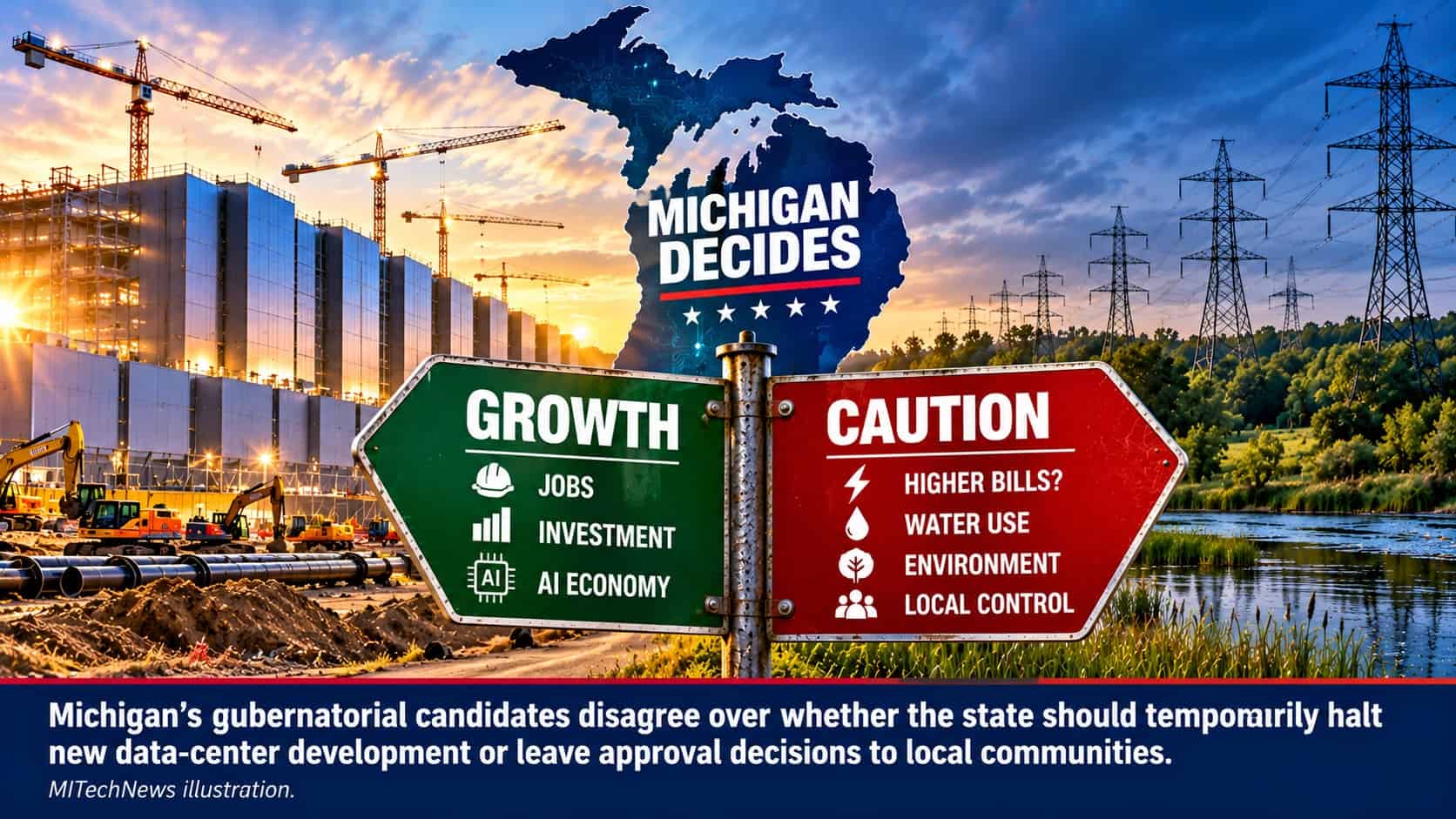
LANSING – The debate over artificial intelligence data centers in Michigan has largely focused on land use, water consumption and local opposition.
But a bigger question may be emerging:
Can Michigan’s electric grid handle the demand?
As Michigan competes for billions of dollars in AI infrastructure, electric vehicle manufacturing and advanced technology investments, energy experts warn that neighboring states may not always have enough electricity available to help during a major power emergency.
The warning comes as utilities across the Midwest invest billions of dollars in grid upgrades and transmission projects that could ultimately affect customer electric bills.
Michigan Grid By The Numbers
10.1 million — Michigan residents dependent on reliable electric service
$717 billion — Michigan’s annual economic output
More than $300 billion — Estimated economic impact of Michigan’s automotive industry
Billions of dollars — Planned utility and transmission investments across the Midwest over the next decade
Thousands of megawatts — Additional electricity demand expected from AI data centers, electric vehicles and industrial electrification
One growing concern — During a widespread emergency, neighboring states may not have enough spare electricity to help Michigan avoid shortages
Most consumers assume that if Michigan runs short on electricity, power can simply be imported from Ohio, Indiana, Illinois or Wisconsin.
Unfortunately, the electric grid doesn’t always work that way.
Researchers writing in The Conversation recently examined why blackout risks are rising across North America and why neighboring power grids cannot always provide assistance when electricity is needed most.
The answer comes down to transmission limits, weather events and the growing strain on regional power systems.
Michigan’s Electric Future Is Becoming More Demanding
Electricity demand is growing again after years of relatively flat consumption.
Michigan utilities are preparing for a future that includes more electric vehicles, electrified manufacturing processes, battery production facilities and energy-hungry artificial intelligence data centers.
The data center issue has become particularly important.
Large AI facilities can consume as much electricity as a small city. Proposed data center developments in southeast Michigan, including projects under discussion in the Ann Arbor region and western Wayne County, have generated debate over how much additional electricity these facilities could require.
Michigan regulators are already preparing for the impact.
Last year, the Michigan Public Service Commission approved utility service provisions designed to ensure residential customers do not subsidize the costs of serving large energy-intensive data centers.
The move reflects growing concern that AI infrastructure could require substantial new investments in power generation and transmission capacity.
At the same time, Michigan’s economy increasingly depends on reliable electric service.
Automotive assembly plants, semiconductor manufacturers, hospitals, logistics centers and cloud computing facilities all require uninterrupted power.
That makes grid reliability an economic development issue as much as an engineering challenge.
How The Midwest Grid Actually Works
Michigan is part of the Midcontinent Independent System Operator, or MISO, which coordinates electricity across much of the Midwest.
The regional network includes Michigan, Indiana, Illinois, Wisconsin, Minnesota and several other states.
Under normal circumstances, electricity flows continuously across state lines. Regions with excess power can often support neighboring areas experiencing temporary spikes in demand.
But those transfers are limited by transmission capacity.
Power lines can only carry so much electricity. When those lines become congested, operators cannot simply push more power through the system.
The concern is not lost on MISO.
In its Reliability Imperative initiative, the regional grid operator has warned that rising electricity demand, renewable energy integration and increasing grid complexity are creating new reliability challenges across the Midwest.
“MISO is helping the region navigate this transition with clarity and confidence,” the organization said in a recent statement outlining the challenges facing the electric grid.
The situation becomes even more complicated during extreme weather events.
If a heat wave stretches across multiple states, everyone may need additional electricity at the same time. If severe storms damage transmission infrastructure, the ability to move electricity between regions can be reduced precisely when demand is highest.
In those situations, neighboring states may have little excess electricity available to share.
Lessons From The 2003 Blackout
Michigan residents have experienced the consequences of grid failures before.
The Northeast Blackout of 2003 left approximately 50 million people across the United States and Canada without power after a series of transmission failures cascaded through interconnected electric systems.
Parts of Michigan were affected along with much of the Northeast and portions of Canada.
The event demonstrated both the strengths and weaknesses of interconnected power systems.
While regional grids provide flexibility and reliability under normal conditions, failures in one area can sometimes spread rapidly across larger networks.
Since then, utilities and grid operators have invested heavily in monitoring systems, reliability improvements and transmission upgrades.
However, new challenges are emerging.
Electricity demand is rising. Data centers are becoming major power consumers. Transportation is increasingly electrified. Manufacturing is relying more heavily on electric-powered technologies.
All of those trends increase pressure on the grid.
Weather Remains Michigan’s Biggest Threat
For most Michigan residents, severe weather remains the largest blackout risk.
Ice storms, thunderstorms, tornadoes and extreme heat can damage power lines, substations and other critical infrastructure.
Michigan has experienced numerous major outages over the past decade, leading to growing criticism of utility reliability and increased pressure on utilities to strengthen the grid.
Michigan regulators have already identified reliability as a growing concern.
In April, the Michigan Public Service Commission announced additional steps to improve utility reliability and grid resilience following years of weather-related outages.
The Commission said it is pursuing new measures to strengthen grid resilience and improve reliability as severe weather increasingly threatens electric infrastructure across the state.
Climate experts expect weather-related disruptions to become more frequent and more intense.
That creates a difficult problem.
When severe weather affects multiple states simultaneously, neighboring regions often face the same challenges at the same time.
The assumption that another state can simply send additional power may no longer hold true during widespread emergencies.
Could AI Data Centers Raise Your Electric Bill?
What supporters say:
• Large data centers create construction jobs and attract technology investment.
• Utilities argue major power users should pay the costs associated with serving their facilities.
• Grid upgrades improve reliability for all customers.
What critics worry about:
• New transmission lines and power plants cost billions of dollars.
• Some infrastructure costs may eventually flow into customer bills.
• Massive AI facilities could significantly increase regional electricity demand.
• Michigan residents already face rising utility, insurance and housing costs.
The key question:
Can Michigan expand its electric grid fast enough to support AI growth while protecting residential customers from excessive rate increases?
Will Reliability Improvements Raise Electric Bills?
One of the biggest questions for Michigan households is how much reliability improvements will cost.
Utilities throughout the Midwest are planning significant investments in transmission lines, substations, grid modernization projects and new generation resources.
MISO has approved one of the largest transmission expansion efforts in American history to improve reliability and accommodate future demand growth.
Supporters argue these investments are necessary to prevent future blackouts and support economic growth.
Critics counter that many of the costs eventually appear on customer utility bills.
Consumer advocates argue that customers are already paying significant costs for reliability improvements.
In a recent filing, the Citizens Utility Board of Michigan said Consumers Energy provides “below-average service in terms of reliability at above-average costs.”
The organization has urged regulators to scrutinize utility spending plans carefully as electric rates continue rising across the state.
That debate is becoming increasingly important as Michigan consumers continue to face higher costs for housing, insurance, groceries and energy.
The challenge for regulators will be balancing affordability with reliability while ensuring the state remains competitive for future business investment.
The Economic Development Challenge
Michigan leaders hope to attract more AI infrastructure, advanced manufacturing, semiconductor development and next-generation mobility companies.
Those industries require large amounts of reliable electricity.
Companies evaluating potential locations increasingly examine electric infrastructure before making investment decisions.
A region with an unreliable grid can quickly fall behind competitors.
That means Michigan’s ability to compete for future investment may depend in part on whether utilities and regulators can successfully modernize the state’s electric system.
The lesson from recent research is straightforward.
Interconnected power grids provide important benefits, but they are not unlimited sources of backup electricity.
When demand spikes across an entire region or transmission systems become constrained, every state may find itself competing for the same supply of power.
For Michigan, that reality means grid reliability is no longer just an engineering issue. It is increasingly an economic development issue that could influence everything from electric rates to AI investment, manufacturing growth and job creation for years to come.