ANN ARBOR – Michigan lost 25,000 employed workers in August, its unemployment rate climbed to 5%, and manufacturing payrolls declined. But West Michigan manufacturers continue to report surprisingly strong business conditions — another sign that Michigan increasingly looks like several different regional economies.
Michigan’s seasonally adjusted unemployment rate increased from 4.9% in July to 5.0% in August, according to the Michigan Department of Technology, Management & Budget. The national unemployment rate remained at 4.1%, leaving Michigan 0.9 percentage points above the national rate.
Employment fell by 25,000 during August, while the number of unemployed people was essentially unchanged. The result was a 25,000-person decline in Michigan’s labor force.
Michigan’s labor-force participation rate also dropped from 59.1% to 58.8%, while the employment-to-population ratio fell to 55.9%.
Over the past year, Michigan’s employment total has fallen 3.2%, compared with a 0.4% decline nationally.
“Payroll jobs declined due to losses in manufacturing this month,” said Wayne Rourke, labor market information director for Michigan’s Center for Data and Analytics.
Michigan employers reported 2,000 fewer nonfarm payroll jobs in August, bringing the statewide total to 4.496 million. Manufacturing recorded the largest monthly decline, losing 2,000 jobs.
Yet Michigan still had 8,000 more payroll jobs than in August 2025, an increase of 0.2%. Government employment increased by 16,000 over the year and private education and health services gained 8,000, while professional and business services lost 6,000.
Those seemingly contradictory numbers come from two different surveys. Labor-force and unemployment estimates are based largely on households, while payroll employment comes from employers. They measure different populations and can diverge, particularly before subsequent revisions.
The larger message from this month’s numbers: There isn’t one Michigan economy.
Southeast Michigan: Unemployment Moves Higher
Southeast Michigan continues to show some of the state’s clearest signs of economic pressure.
The seasonally adjusted unemployment rate for the Detroit-Warren-Dearborn metropolitan area increased from 5.3% in July to 5.4% in August.
Employment fell by 11,000 in one month, while unemployment increased by 1,000. The region’s labor force declined by 10,000.
Compared with August 2025, Detroit’s unemployment rate is 0.7 percentage points higher.
But Southeast Michigan differs from much of the state in one important way: the Detroit metro labor force is 27,000 larger than it was a year ago.
That means Detroit’s higher unemployment rate isn’t simply the product of people leaving the labor market. More people are participating than a year ago, but not all are finding jobs.
Manufacturing bears watching particularly closely because of Southeast Michigan’s concentration of automakers and suppliers. Statewide manufacturing payrolls lost 2,000 jobs in August.
For an economy still heavily dependent on automobiles and advanced manufacturing, what happens to factory employment this fall could help determine whether Southeast Michigan stabilizes or weakens further.
West Michigan: Manufacturing Remains A Bright Spot
West Michigan tells a substantially different story.
Grand Valley State University’s monthly survey of purchasing managers found that August marked the eighth consecutive month of favorable reports for the region’s industrial economy.
GVSU researcher Brian Long reported that the new-orders index remained at a strong +30, while the production index improved from +19 in July to +21 in August.
The employment index increased from +6 to +11.
Business confidence also remains stronger than during 2025 despite tariffs and disruptions to global shipping.
“Both our short- and long-term measures of business confidence are still holding up,” Long said. “In fact, our confidence so far in 2026 is noticeably better than it was in 2025.”
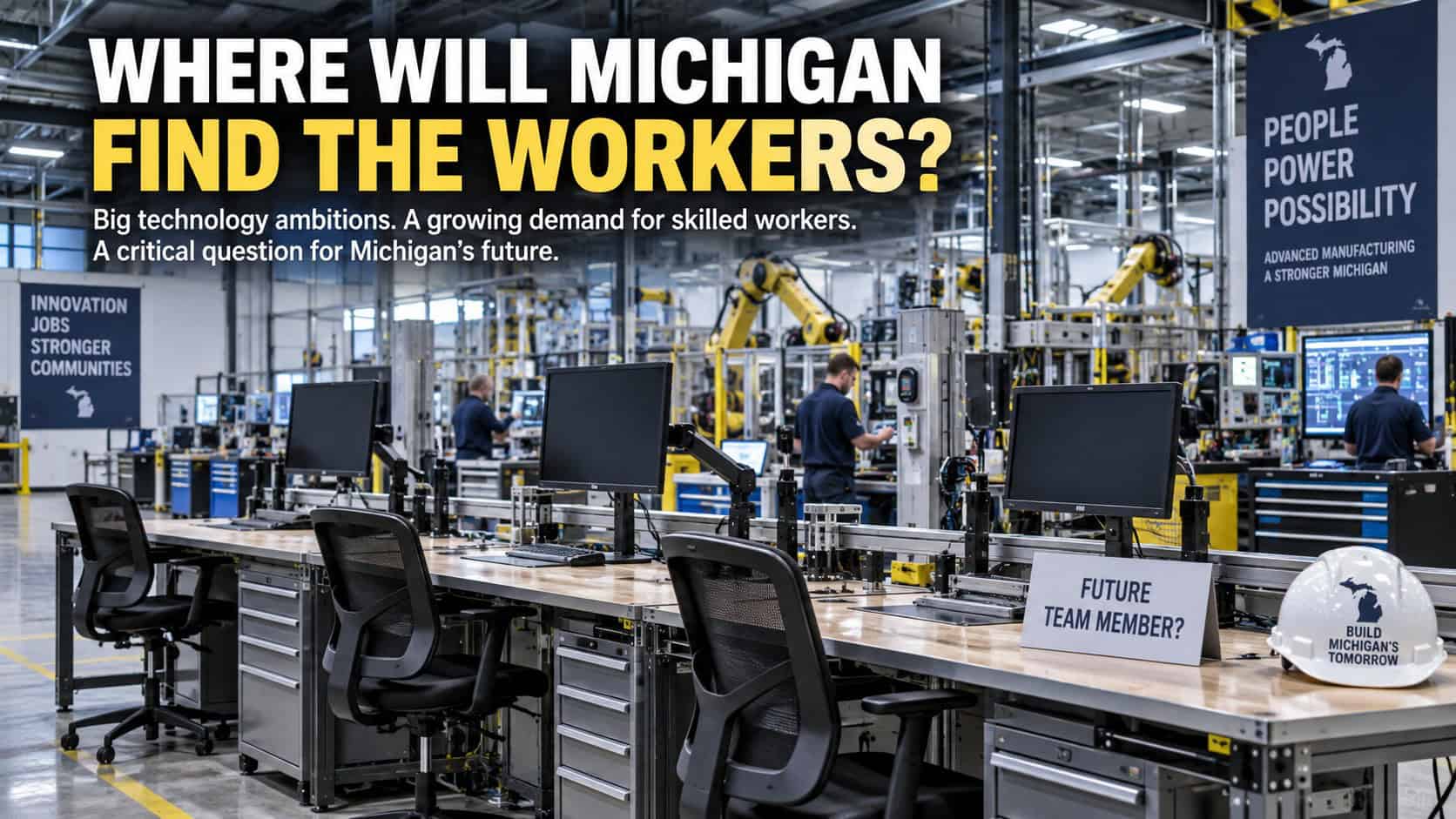
Perhaps the most interesting finding is that some West Michigan manufacturers aren’t talking about eliminating workers. They’re struggling to find them.
Long said respondents continue to report shortages of welders, CNC operators, technicians, mechanical engineers and industrial engineers.
That creates one of this month’s biggest economic contradictions: Michigan manufacturing payrolls declined in August while some West Michigan industrial employers still can’t find enough skilled workers.
Central Michigan: Lower Unemployment Doesn’t Tell The Whole Story
The latest complete regional figures for Central Michigan are July numbers. Michigan’s August local-area statistics are scheduled for release Sept. 24.
Those July figures illustrate why unemployment rates alone don’t necessarily tell us whether a regional economy is expanding.
The Lansing-East Lansing area’s unemployment rate stood at 4.8%, down from 5.9% a year earlier.
But estimated employment was 6.6% lower than in July 2025, while the area’s labor force was down 7.7%.
Midland showed a similar pattern, with a 4.7% unemployment rate but estimated employment down 6.9% from a year earlier.
These local labor-force figures are estimates produced through the federal Local Area Unemployment Statistics program rather than direct head counts and are subject to revision.
Still, Central Michigan is part of a broader pattern: every one of Michigan’s 18 labor-market regions reported a smaller labor force in July than a year earlier.
A lower unemployment rate can mean unemployed workers found jobs. But it can also decline when fewer people participate in the labor market.
Northern Michigan: Summer Boosts Jobs — Winter Brings A Second Season
Northern Michigan demonstrates another complication: seasonality.
Traverse City’s July unemployment rate was just 3.8%, among the lowest in Michigan.
Employment increased 3.4% from June, while the area’s labor force grew 3.3% as tourism, hospitality and recreation businesses moved through the summer season.
But the year-over-year picture was weaker. Traverse City-area employment was estimated 7.0% below July 2025, while its labor force was 7.4% smaller.
Those estimates are subject to revision, but they’re consistent with the broader statewide decline in regional labor forces.
Northern Michigan also has something much of the state doesn’t: a second major tourism season.
As summer tourism winds down, skiing, snowboarding, snowmobiling, lodging, restaurants and other winter recreation businesses provide another economic lift. That can produce another round of seasonal hiring across Northwest and Northeast Lower Michigan.
The Northeast Lower Michigan labor market had a higher July unemployment rate of 5.9%, with estimated employment down 5.5% from a year earlier.
That makes the coming winter an important economic test. Strong snowfall and tourism could boost seasonal employment, but those gains won’t necessarily reverse the region’s longer-term workforce challenges.
Upper Peninsula: Winter Could Provide An Economic Lift
The Upper Peninsula’s July unemployment rate stood at 5.2%, down from 6.2% in July 2025.
That sounds encouraging.
But estimated U.P. employment was 6.1% lower than a year earlier, while its labor force was 6.9% smaller.
Again, those regional figures should be treated as estimates rather than precise worker counts. But they reinforce a statewide pattern that bears watching.
The U.P. also enters one of its most economically important periods as winter approaches.
Michigan has more than 6,300 miles of designated snowmobile trails, and the Michigan Department of Natural Resources estimates snowmobiling contributes about $1 billion in economic activity statewide.
Add skiing, snowboarding, lodging, restaurants and other winter recreation, and snow becomes an economic asset for communities that otherwise face a seasonal slowdown.
A strong winter could therefore produce another employment bump in parts of the U.P.
The larger question is whether seasonal hiring can offset the region’s underlying workforce contraction.
Michigan’s Workforce Puzzle
The regional numbers expose a problem that stretches well beyond any single part of Michigan.
In July, all 18 Michigan labor-market regions reported fewer employed residents than a year earlier, with a median decline of 6.3%. All 18 also reported smaller labor forces, with a median contraction of 7%.
The statewide August report points in the same direction. Michigan’s labor-force participation rate fell again to 58.8%.
Yet employers in West Michigan continue to report shortages of skilled workers.
That raises an increasingly important economic question for Michigan:
How can the state simultaneously have fewer people participating in the labor market and employers who say they can’t find enough qualified workers?
Part of the answer may involve skills mismatches. Other factors can include retirement and an aging population, migration, education, family responsibilities and people who have stopped looking for work.
Determining which factors matter most could become increasingly important as Michigan tries to expand advanced manufacturing, artificial intelligence, defense, aerospace and other technology-driven industries.
What To Watch Next
Michigan enters the fall with a decidedly mixed economic report card.
West Michigan manufacturers continue to report healthy new orders, rising production and demand for skilled workers.
Southeast Michigan has a larger labor force than a year ago but rising unemployment.
Central and Northern Michigan and the Upper Peninsula have relatively modest unemployment rates in some areas, but their estimated employment and labor forces remain well below year-earlier levels.
And statewide, Michigan’s unemployment rate has reached 5%, manufacturing lost jobs in August and labor-force participation slipped again.
The next few months should tell us whether those differences begin to narrow — or whether Michigan’s regional economies continue moving in different directions.