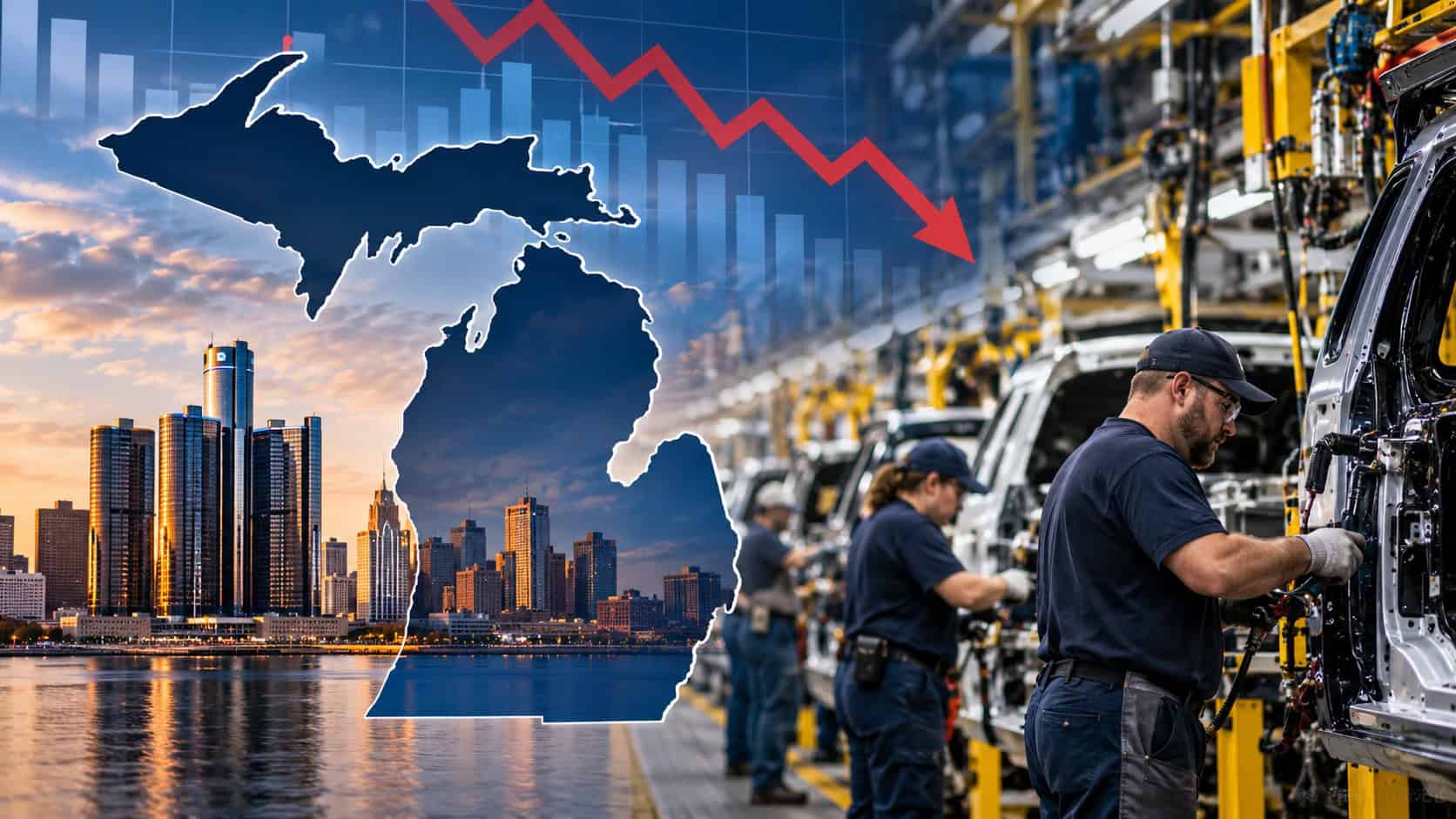
DETROIT — Michigan has absorbed the highest estimated tariff burden per household in America — the equivalent of $5,619 per household since President Donald Trump returned to office — largely because the state’s automotive and manufacturing economy sits directly in the path of the global trade war.
Michigan businesses have been hit with an estimated $23.2 billion in tariffs imposed by executive action since January 2025, according to data from Trade Partnership Worldwide compiled by the National Taxpayers Union Foundation.
California has absorbed more tariff costs overall, at approximately $62.8 billion.
But divide the estimated costs by the number of households and Michigan moves to No. 1.
Michigan: $5,619 per household.
That’s an eye-popping number — but it needs an important qualification.
Michigan families didn’t receive $5,619 tariff bills from the federal government. U.S. companies importing foreign products actually pay the tariffs.
Businesses can then absorb the costs through lower profits, negotiate lower prices from suppliers, reduce spending or investment, or pass some of those costs to customers through higher prices.
And there’s another wrinkle: Some tariffs have now been struck down and are being refunded.
But those refunds go to the companies that paid the tariffs — not directly to consumers who may have absorbed some of the costs through higher prices.
WHAT DOES THE $5,619 FIGURE REALLY MEAN?
Michigan households aren’t receiving a $5,619 tariff bill. The figure represents Michigan’s estimated tariff costs divided by the number of households in the state.
U.S. importers actually pay the tariff. When a Michigan company imports a tariffed vehicle, component, machine or raw material, the importer pays the duty to the federal government.
Consumers can still end up paying part of it. Companies may absorb tariff costs, negotiate with suppliers, reduce investment or pass some of the cost to customers through higher prices.
Michigan’s estimated total: $23.2 billion. That’s the state’s estimated share of executive-order tariffs collected from January 2025 through June 2026 — equivalent to $5,619 for every Michigan household.
Some tariffs are being refunded — but not to households. Eligible importers can seek refunds for duties collected under tariffs that were subsequently invalidated.
Consumers don’t automatically get that money back. There is no general mechanism requiring companies receiving tariff refunds to reimburse customers who previously paid higher prices.
Why Michigan Is No. 1
Michigan’s economy is more deeply connected to international automotive supply chains than almost any other state.
Approximately 64% of Michigan’s estimated tariff costs involve raw materials, parts and equipment, according to the tariff analysis.
That distinction is important.
Tariffs aren’t simply making imported televisions, appliances or finished automobiles more expensive.
They can increase the cost of making things in Michigan.
A Michigan manufacturer importing machinery, steel, aluminum, electronics, batteries, sensors or other components can face higher production costs before a finished product ever reaches a customer.
And nowhere is that vulnerability more apparent than in Michigan’s signature industry.
Autos Put Michigan In The Crosshairs
For decades, the U.S. and Canadian automotive industries have operated essentially as a single North American manufacturing system.
Vehicles assembled in Michigan can contain components from Canada, Mexico and other countries. Some components can cross the Detroit-Windsor border multiple times during production before becoming part of a finished vehicle.
Tariffs imposed at those border crossings can therefore ripple through an extraordinarily complicated supply chain.
The Detroit Three illustrate the enormous sums involved.
General Motors has estimated its 2026 gross tariff exposure at roughly $2.5 billion to $3.5 billion.
Ford expects approximately $1 billion in net tariff costs for 2026 after anticipated reimbursements, while Stellantis has projected roughly €1.3 billion in net tariff costs.
Those figures aren’t directly comparable because the automakers calculate and report tariff impacts differently.
But collectively they demonstrate why Michigan has so much at stake.
Ford Could Get Billions Back
Ford also illustrates a strange consequence of the tariff fight.
The Dearborn automaker expects approximately $3 billion in tariff reimbursements from the federal government and suppliers, including about $1.3 billion associated with tariffs imposed under the International Emergency Economic Powers Act.
Those reimbursements go to Ford and other eligible importers that paid the duties.
They don’t go directly to consumers.
That creates an unusual economic question.
Suppose a company paid tariffs and subsequently raised prices to recover some of those costs. If the tariff is later overturned and the company receives a refund, there is no general requirement that the company locate those customers and return the portion of the price increase attributable to the tariff.
Companies can use refunds to restore margins, offset other tariff costs, invest in their businesses, reduce prices or take other actions.
That doesn’t mean consumers paid Michigan’s entire $23.2 billion tariff burden. Businesses, suppliers and shareholders can absorb portions of tariff costs as well.
But it does mean tariff refunds shouldn’t be confused with consumer refunds.
Not All Of Michigan’s $23.2 Billion Is Coming Back
There’s another important distinction.
The U.S. Supreme Court struck down tariffs imposed under the International Emergency Economic Powers Act earlier this year, opening the door for eligible importers to seek refunds.
But that doesn’t mean Michigan companies will receive refunds for the state’s entire estimated $23.2 billion tariff burden.
Other tariffs imposed under different legal authorities remain in effect.
The Trump administration has also continued pursuing tariffs through other legal mechanisms.
So even as billions of dollars in previously collected tariffs move back to importers, Michigan companies continue confronting substantial trade costs.
Canada Could Raise The Stakes Again
Michigan’s exposure could become even greater because of its enormous trading relationship with Canada.
The United States and Canada failed to reach a new trade agreement this summer, triggering another escalation in a relationship particularly important to Michigan.
Canada imposed retaliatory tariffs on roughly $20 billion worth of American products beginning Sept. 8.
Meanwhile, the Trump administration has threatened 50% tariffs on Canadian automobiles and auto parts beginning Jan. 1, 2027.
Michigan may have more at stake than almost anywhere else.
Detroit Regional Chamber President and CEO Sandy Baruah has described Michigan’s economic relationship with Canada as similar to its relationship with Ohio or Indiana.
Disrupting that integration could raise manufacturing costs on both sides of the border.
Michigan Businesses Get Squeezed From Both Directions
Michigan manufacturers can face higher costs for imported materials and components coming into the United States.
Then retaliatory tariffs imposed by other countries can make Michigan-made products more expensive overseas.
Companies can respond by raising prices, accepting smaller profit margins, postponing investments or cutting costs.
That potentially includes jobs.
Agriculture faces another problem.
When foreign governments retaliate against American tariffs, agricultural products are frequently attractive targets because the economic damage is concentrated in politically important states and rural communities.
Michigan farmers producing soybeans, dairy products and other commodities can therefore lose foreign customers even if they aren’t directly importing tariffed products.
The Jobs Question
That’s potentially the biggest long-term issue for Michigan.
Businesses make investment decisions based partly on what they expect their costs and markets to look like years into the future.
Rapidly changing tariffs make those calculations more difficult.
Consider a company deciding whether to expand a Michigan factory partly because of easy access to Canadian customers and suppliers.
A major tariff can radically change the economics of that investment.
And Michigan’s automotive industry is already navigating weaker vehicle demand, electrification, automation and restructuring throughout the supplier network.
Additional trade costs arrive at an uncomfortable time.
Are Michigan’s Tariffs Worth The Price?
Tariffs can sound like an abstract debate over international economics.
For Michigan, they aren’t.
They potentially affect the price manufacturers pay for materials, the competitiveness of Michigan products overseas, business investment, hiring and ultimately the prices consumers pay for vehicles and other goods.
Michigan’s extraordinary dependence on automobiles and international manufacturing helps explain why the state sits at the top of the nation’s per-household tariff rankings.
And that could become a political issue as the November midterm elections approach.
Voters don’t necessarily make decisions based on trade theory.
They notice whether cars, groceries and other necessities cost more. They notice whether employers are hiring or laying off workers. And they notice whether their paychecks are keeping up.
The Trump administration argues tariffs will ultimately encourage companies to manufacture more products in the United States, create American jobs and reduce dependence on foreign suppliers.
For Michigan voters, that creates a straightforward pocketbook test:
If Michigan is carrying America’s highest estimated tariff burden, are the tariffs ultimately creating enough jobs, investment and higher wages here to justify what Michigan businesses and consumers are paying?