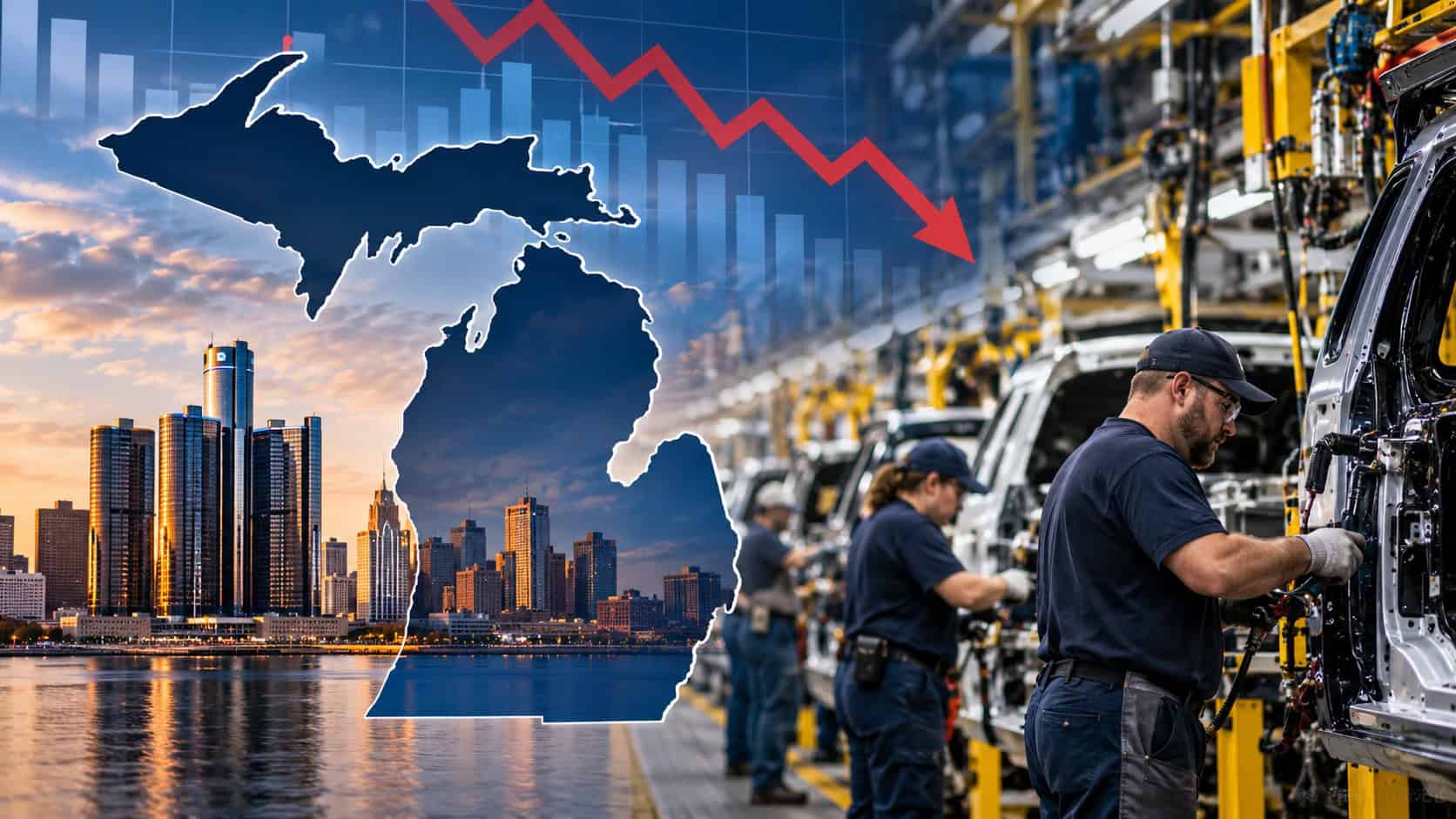
ANN ARBOR – Michigan jobs, auto sales, home purchases and business investment face new pressure after the Federal Reserve raised interest rates Wednesday, making borrowing more expensive at a time when the state’s economy is already growing slowly.
For Michigan families and businesses, the impact can be measured in monthly payments.
A $40,000 five-year auto loan at about 6.9% costs roughly $790 a month.
A $300,000, 30-year mortgage at 6.76% costs about $1,948 a month in principal and interest — before property taxes and homeowners insurance.
And consider a Michigan manufacturer borrowing $500,000 for machinery or a plant expansion. At 8% for five years, the payment is about $10,138 a month. At 10%, it rises to about $10,624 — adding roughly $29,000 in interest over the life of the loan.
Those numbers ultimately become economic decisions.
Don’t buy the car. Don’t buy the house. Don’t buy the machine. Don’t hire the workers.
That’s how higher interest rates move from Washington into Michigan’s economy.
The Federal Reserve raised its benchmark federal funds target range by a quarter percentage point Wednesday to 3.75% to 4.00%, its first increase since 2023.
The Fed is trying to control inflation by slowing demand. But Michigan isn’t entering this period with a booming labor market.
Michigan’s unemployment rate stood at 4.9% in July compared with 4.1% nationally, while the number of employed Michigan residents declined by 23,000 during the month.
That creates the central question for Michigan:
Can the Fed cool inflation without cooling Michigan’s auto industry, housing market and business investment enough to cost the state jobs?
Why Michigan Could Feel Higher Rates Hard
Michigan has particular exposure because its signature industry sells one of the most expensive products American households routinely finance.
Automobiles.
New-vehicle prices climbed above $50,000 in August. At today’s financing rates, a consumer borrowing most of that purchase price can face a payment approaching $1,000 a month.
The alternative is obvious: keep driving the old car.
Multiply that decision across hundreds of thousands of households and it becomes a Michigan manufacturing problem.
If consumers postpone purchases, dealers need fewer vehicles. Automakers have less reason to maintain production at existing levels.
That can ripple through Michigan’s automotive supply chain — parts manufacturers, engineering companies, logistics firms, tool-and-die shops and hundreds of other businesses dependent on vehicle production.
The first effect isn’t necessarily layoffs.
Companies can eliminate overtime, reduce shifts, leave vacancies unfilled or postpone equipment purchases.
If weaker demand persists, jobs can eventually follow.
A $300,000 Mortgage Approaches $2,000 A Month
Housing faces the same affordability problem.
At 6.76%, borrowing $300,000 for 30 years produces a monthly principal-and-interest payment of roughly $1,948.
The Fed doesn’t directly set mortgage rates. Thirty-year mortgages are influenced more heavily by longer-term Treasury yields, inflation expectations and financial markets.
So Wednesday’s quarter-point increase does not automatically mean mortgage rates increase another quarter point.
But buyers care about the final payment.
And when a family decides it can’t afford the house, the impact spreads beyond the buyer and seller.
Builders sell fewer homes. Contractors get less work. Mortgage companies originate fewer loans. Realtors close fewer transactions. Furniture, appliance and home-improvement businesses lose customers.
Housing becomes another Michigan jobs story.
The $500,000 Question For Michigan Businesses
The business impact may be less visible, but it could be just as important.
Imagine a Michigan automotive supplier considering a $500,000 piece of equipment that would increase production and require five additional workers.
At an 8% interest rate, financing that equipment for five years costs about $10,138 a month.
At 10%, the payment rises to $10,624.
That doesn’t automatically kill the investment.
But management now has to decide whether expected sales justify the additional financing expense.
Across thousands of Michigan companies, some projects will move forward.
Others won’t.
And projects that don’t happen can represent buildings that aren’t expanded, machinery that isn’t purchased and workers who aren’t hired.
Consumers Have Another Problem: Credit Cards
Credit-card borrowers could feel higher rates more quickly.
Many cards carry variable rates tied directly or indirectly to the prime lending rate. When benchmark rates increase, those borrowing costs can rise.
For consumers who pay balances in full, the impact is limited.
For households carrying thousands of dollars in revolving debt, more income goes toward interest and less remains for restaurants, clothing, travel, entertainment and other purchases.
Multiply that across Michigan households and another personal-finance problem becomes an economic problem.
Michigan Has Less Room For Error
That’s what makes the Federal Reserve’s decision particularly important for Michigan.
The state’s 4.9% unemployment rate is already eight-tenths of a percentage point above the national rate.
Michigan employment declined by 23,000 during July while the state’s labor force shrank by 29,000.
Those aren’t numbers from an overheated Michigan labor market.
Yet the Federal Reserve is deliberately trying to slow demand nationally to bring inflation under control.
If the strategy works as intended, inflation moderates while employment and economic growth remain relatively stable.
But Michigan’s dependence on automobiles, manufacturing, housing and capital-intensive businesses means the state could feel the effects more sharply.
For Michigan consumers and businesses, the interest-rate story boils down to three questions:
Can I afford the car?
Can I afford the house?
Can I afford to expand my business?
When enough answers become no, the next question is the one Michigan workers care about most:
What happens to jobs?