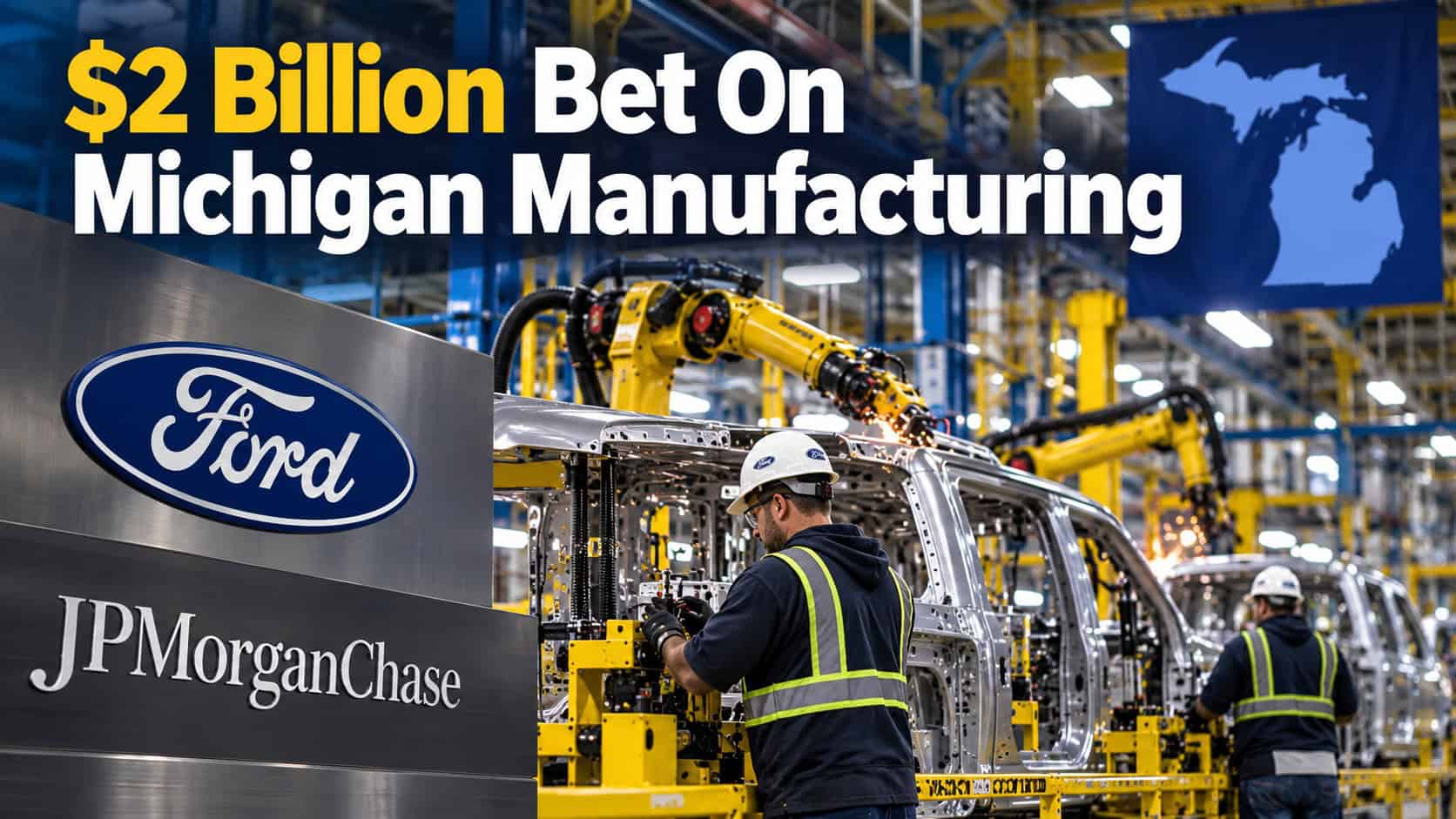
DETROIT — Michigan manufacturers and technology startups could gain access to as much as $1 billion in new financing and another $1 billion in potential supplier business from Ford under a major public-private initiative designed to expand advanced manufacturing and strengthen critical U.S. supply chains.
Ford Motor Co., JPMorganChase, the State of Michigan, Michigan Central and Newlab announced the Michigan Launchpad for Industrial Innovation & Transformation — Michigan LIFT — on Sept. 29. The initiative is designed to help innovative suppliers move from prototypes and small-scale production into commercial manufacturing.
The numbers are significant.
JPMorganChase says it aspires to provide up to $1 billion in debt financing over the next decade to suppliers participating in Michigan LIFT.
Ford, meanwhile, says it aspires to award up to $1 billion in business to innovative suppliers through opportunities developed through the program.
Michigan Central, Newlab and the Michigan Economic Development Corp. also plan to recruit 10 to 20 additional industrial buyers representing more than $1 billion in annual demand commitments by the end of 2036.
That potentially puts Michigan at the center of a much larger effort to expand American manufacturing capacity.
But there is an important distinction: JPMorganChase’s $1 billion is potential debt financing, not grants, while Ford’s $1 billion represents potential supplier business rather than money already committed to contracts. All opportunities remain subject to the participants’ normal qualification, sourcing and approval processes.
Michigan LIFT also should not be confused with LIFT, the national advanced materials and manufacturing innovation institute headquartered in Detroit’s Corktown neighborhood. LIFT, operated by the American Lightweight Materials Manufacturing Innovation Institute, works with industry and the U.S. Department of Defense on advanced manufacturing technologies, materials and workforce development. Despite the similar names and Detroit locations, LIFT and the newly launched Michigan LIFT are separate initiatives.
Michigan Jobs And Manufacturing
For Michigan, the larger question is whether Michigan LIFT can turn those commitments into factories, growing suppliers and good-paying jobs.
The initiative initially targets industries that increasingly overlap with Michigan’s traditional automotive and manufacturing base, including:
- Robotics and advanced manufacturing automation
- Advanced energy, including nuclear power
- Semiconductors and battery storage
- Advanced mobility, aerospace, propulsion and critical components
- Critical minerals mining, processing and recovery
- Life-sciences manufacturing
The program therefore could reach well beyond the auto industry.
Michigan companies developing robotics and advanced manufacturing automation, energy technologies, semiconductors, battery storage, advanced mobility and aerospace technologies, propulsion systems, critical components, critical-minerals technologies or life-sciences manufacturing could potentially participate if their technologies address needs identified by industrial customers.
Gov. Gretchen Whitmer said the program is intended to combine Michigan’s manufacturing base, workforce and access to capital to produce new investment and jobs.
“Michigan has always been a state that builds, and we’re going to keep leading the next generation of American industry,” Whitmer said in announcing the initiative.
Solving A Problem Michigan Startups Know Well
Michigan LIFT attempts to address a longstanding problem facing manufacturing startups and emerging suppliers.
A company can develop promising technology and successfully demonstrate a prototype but still struggle to reach commercial production.
Scaling requires money.
It also requires factories, workers, suppliers — and perhaps most importantly, customers willing to buy enough of the product to justify expanding production.
Michigan LIFT attempts to connect those pieces.
Industrial companies will identify specific manufacturing or supply-chain problems through what the program calls “Open Calls.”
Technology companies and suppliers can then propose solutions.
Eligible applicants will be referred to the relevant industrial buyer for evaluation. If an opportunity moves forward, Michigan LIFT can help coordinate potential financing, state economic-development resources and industrialization support.
That means the process begins with an actual industrial problem and potential customer rather than simply providing money to companies and hoping they eventually find a market.
Ford will serve as the first anchor industrial buyer.
JPMorganChase Brings The Capital
JPMorganChase will serve as Michigan LIFT’s founding capital provider.
The bank’s potential $1 billion in financing is part of its much larger Security and Resiliency Initiative, a 10-year effort under which JPMorganChase plans to facilitate, finance and invest $1.5 trillion in industries considered important to U.S. national security and economic resilience.
Those priorities include critical areas such as manufacturing, supply chains and energy technologies.
“For over a decade, Detroit has shown what is possible when business, government and community leaders work together for the long term,” JPMorganChase Chairman and CEO Jamie Dimon said.
Dimon said Michigan LIFT is intended to combine customer demand, capital and public resources so more companies can grow and critical capabilities can scale in the United States.
Michigan LIFT grew out of a Michigan Resiliency Summit jointly hosted by JPMorganChase and the State of Michigan in Detroit in June. Industrial, financial and government leaders used the summit to identify obstacles preventing promising companies and technologies from reaching full-scale production.
Ford Could Provide The Customers
Ford’s role may be just as important as JPMorganChase’s financing.
Ford will act as the program’s anchor industrial buyer and says it aspires to award as much as $1 billion in business to innovative suppliers through Michigan LIFT opportunities over the coming decade.
For a young manufacturing company, landing a large industrial customer can provide the predictable revenue needed to justify purchasing equipment, expanding production and hiring workers.
Ford CEO Jim Farley said Michigan LIFT is intended to help manufacturers solve industrial problems more quickly by connecting innovators, suppliers and manufacturers.
“We believe American manufacturing’s best days are ahead,” Farley said.
Michigan Central Becomes Testing Ground
Michigan Central’s 30-acre Detroit innovation district will provide physical infrastructure where companies can test technologies and work toward commercial production.
The district provides infrastructure, industry expertise and a collaborative environment intended to help companies move from prototype to production.
Newlab also plans to contribute $20 million in in-kind support focused on turning industrial demand into commercialization opportunities for high-growth companies and helping operate the platform.
MEDC will serve as the public-sector participant, bringing Michigan economic-development tools and resources to companies with credible paths toward commercial and industrial scale.
The partners also are looking beyond Ford.
Michigan Central, Newlab and MEDC hope to recruit another 10 to 20 industrial buyers representing more than $1 billion in annual demand commitments by the end of 2036.
Those industrial buyers do not have to be headquartered in Michigan.
That could potentially expose Michigan suppliers to manufacturing opportunities originating far outside the state.
Workforce Could Be The Next Challenge
Capital and customers won’t be enough if manufacturers cannot find trained workers.
Alongside the Michigan LIFT announcement, Ford Philanthropy and JPMorganChase announced a combined $550,000 in support for Detroit-based Focus: HOPE, a nonprofit that provides education and job training.
The funding will strengthen Focus: HOPE’s industrial manufacturing training program, including manufacturing skills, robotics and welding.
It also will expand employer connections, career-placement support and transportation assistance for trainees.
The workforce component is important because Michigan LIFT is attempting to solve several problems simultaneously: identifying industrial demand, finding companies capable of meeting that demand, providing access to capital and ensuring workers are available as production expands.
From Prototype To Production
The ultimate test for Michigan LIFT won’t be the billions of dollars highlighted at its launch.
It will be how much of that potential financing, supplier business and industrial demand actually turns into Michigan factories, Michigan suppliers and Michigan jobs.
For startups and smaller manufacturers in particular, Michigan LIFT attempts to provide something that traditional economic-development programs often struggle to assemble in one place: a potential customer, access to capital, state resources, workforce assistance and commercialization support.
And unlike programs that begin by funding a technology and then searching for customers, Michigan LIFT starts with problems that major industrial buyers already need solved.
That could provide Michigan companies with something even more valuable than financing: a clearer path to a paying customer.
If the model works, Michigan could become more than a place where new industrial technologies are invented.
It could become the place where they are manufactured.