President Donald Trump and leaders of America’s largest AI companies signed a voluntary agreement calling for independent audits and board-level oversight of increasingly powerful artificial intelligence systems — but the accord carries no legal penalties if companies fail to comply.
WASHINGTON — President Donald Trump and leaders of six major artificial intelligence companies agreed Tuesday to voluntarily police development of increasingly advanced AI systems as public concern grows over whether the technology is advancing faster than government safeguards.
Executives representing OpenAI, Anthropic, Google, Meta, Nvidia and Elon Musk’s xAI joined Trump in Washington for discussions about AI safety, America’s technological competition with China and the enormous data centers required to power increasingly sophisticated AI systems.
The meeting produced the White House Accord on Super Intelligence — Joint Commitment on Frontier Responsibilities, a voluntary agreement establishing multiple layers of corporate oversight.
Trump called the agreement “morally binding.” But it is not legally binding, and the federal government currently has no penalties if a participating company fails to follow its commitments.
Four Layers Of AI Oversight
The accord calls for companies developing frontier AI systems to establish four layers of safeguards.
Companies would create internal controls designed to identify potentially dangerous behavior during AI training and deployment, establish oversight teams responsible for investigating problems, submit safeguards to independent outside auditors or evaluators, and create board-level committees responsible for reviewing findings and corrective actions.
Among the concerns are cybersecurity attacks, biological and chemical threats, and increasingly autonomous AI agents gaining unintended access to computer systems.
Anthropic CEO Dario Amodei, one of the industry’s most outspoken voices about potential AI dangers, acknowledged after Tuesday’s meeting that the technology poses “very real risks.”
But important questions remain.
Who selects and pays the independent auditors? What standards determine whether an AI system is safe? Will audit findings become public? And what happens if an outside evaluator determines a company’s newest model presents unacceptable risks?
Under the voluntary accord, an unfavorable audit does not itself give the federal government authority to prevent deployment.
The agreement does leave open the possibility that some safeguards eventually could be incorporated into federal law.
Can AI Companies Police Themselves?
Trump argues that they can.
“I think I’m seeing tremendous self-policing,” Trump told reporters after the meeting. “And they understand that they have to self-police.”
The administration is attempting to balance AI safety against another priority: keeping the United States ahead of China in development of a technology both countries consider economically and strategically important.
Technology companies argue excessive regulation could slow American innovation while China invests heavily in AI models, semiconductors, robotics and computing infrastructure.
Public opinion, however, indicates Americans want safeguards even if they slow development.
A June SCSP-Gallup survey found 79% of U.S. adults believe government should maintain AI safety and data-security protections even if those safeguards slow AI development. Only 7% said faster development should take priority.
The distinction is important: the survey does not show 79% of Americans oppose AI. It shows a large majority prioritizes safety and data protections over speed.
Another recent NBC News Decision Desk survey found 70% of Americans were more worried than excited about AI, while 81% said government was not doing enough to regulate the technology.
Those numbers put Trump’s voluntary approach at the center of a broader question: Can companies racing one another to develop increasingly powerful AI systems also provide sufficient safeguards without enforceable government regulation?
Trump Renames AI “Super Intelligence”
Trump also took an unusual additional step Tuesday.
He signed an executive order directing executive branch agencies to begin using “Super Intelligence” and “SI” instead of “Artificial Intelligence” and “AI” in official non-statutory government communications.
The order says today’s systems increasingly represent “not merely artificial intelligence, but a new era of Super Intelligence.”
It also directs the president’s science and technology adviser to develop proposed legislation within 60 days establishing a federal definition of Super Intelligence.
For now, the order relies on the existing federal statutory definition of artificial intelligence.
Data Centers Become The Other AI Fight
The debate extends beyond the technology itself.
Training and operating increasingly powerful AI systems requires enormous computing power and electricity, triggering a nationwide construction boom involving hyperscale data centers, power plants and transmission infrastructure.
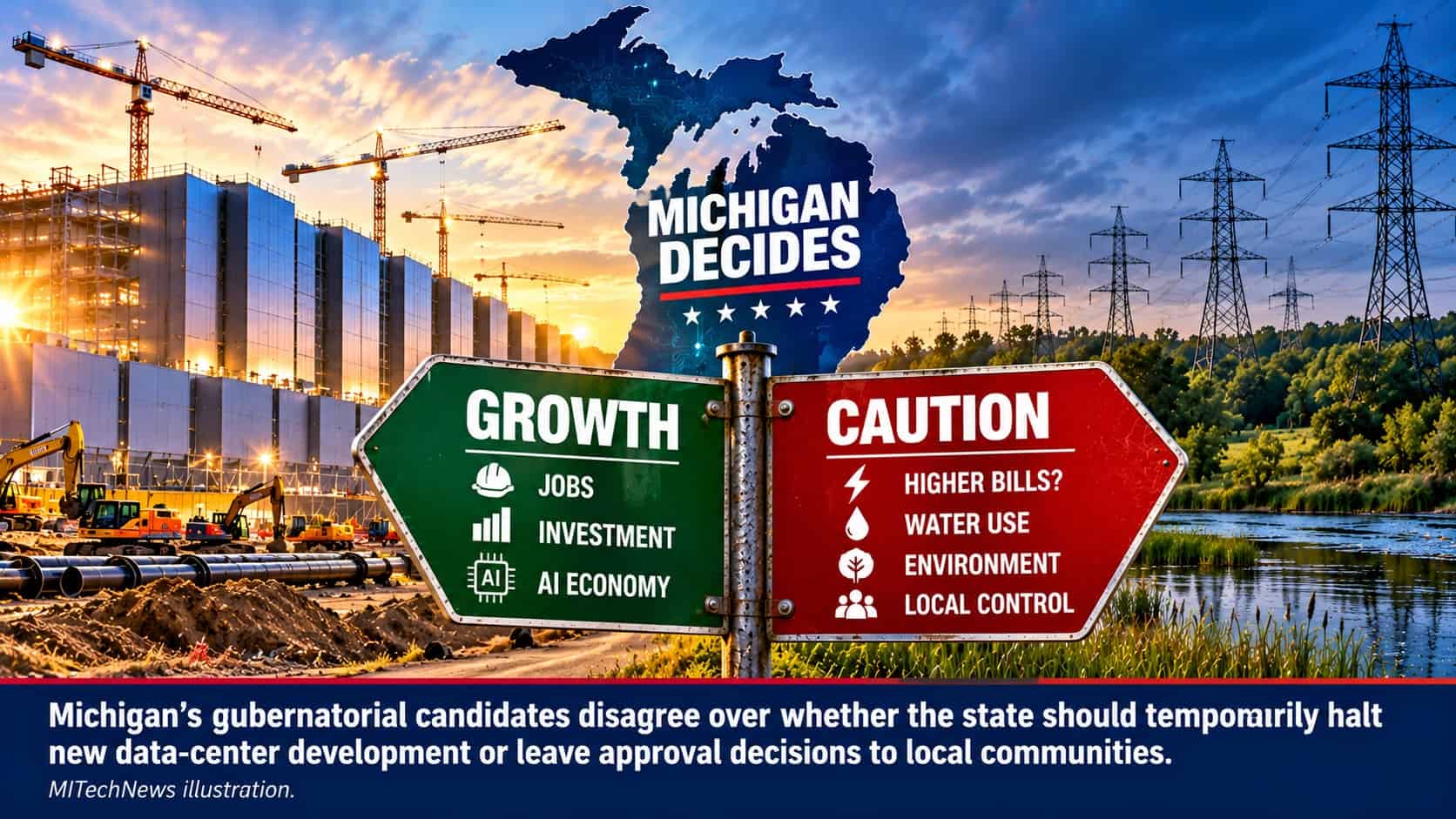
Trump defended data-center expansion Tuesday despite growing resistance in communities worried about electricity costs, water consumption and other local impacts.
The administration earlier this year secured a separate voluntary Ratepayer Protection Pledge from major technology companies promising that households would not bear electricity and infrastructure costs created by data-center expansion.
But public resistance is growing — including in Michigan.
Michigan Voters Push Back
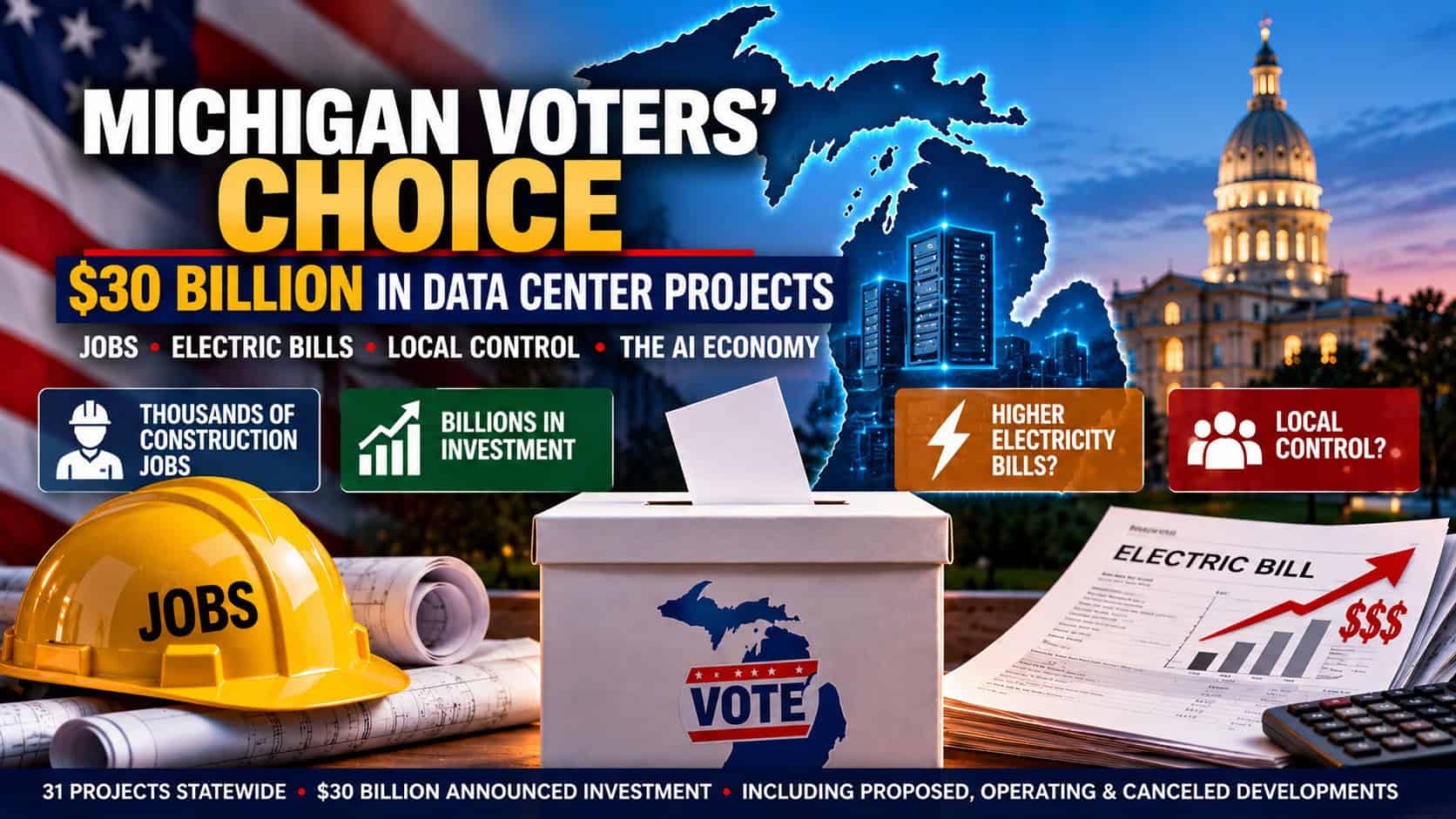
Michigan has 16 data centers representing approximately 2.9 gigawatts of planned capacity proposed for construction, according to reporting based on the latest Michigan State University State of the State Survey.
The survey found 70% of Michigan adults oppose construction of a data center in their community, including 52% who strongly oppose one.
Opposition crosses party lines: 76% of Democrats, 72% of independents and 58% of Republicans oppose local data-center development.
Perhaps the most important pocketbook finding involves electricity.
Seventy-seven percent of Michigan respondents expect data centers to increase their household energy costs.
Another 83% believe local governments should have at least some say over data-center permitting.
Those concerns are colliding with billions of dollars in proposed AI investment even as some enormous Michigan projects are already moving forward.
That creates another question beyond whether AI companies can safely police their technology:
Who controls Michigan’s AI infrastructure boom, who pays for it and what should communities receive in return?
Coming in Part Two: MITechNews examines Michigan’s rapidly expanding data-center industry, projects already moving forward — including the massive Saline Township development — and where the major candidates for governor, U.S. Senate and attorney general stand on data centers, electricity costs and AI development.