Michigan bet billions of dollars and thousands of jobs on an electric-vehicle future. But consumers are increasingly choosing hybrids instead. Before buying your next vehicle, here’s how EVs, hybrids and plug-in hybrids compare on price, charging, long-distance travel — and the Michigan winter penalty that can dramatically reduce battery range.
DETROIT – Thinking about buying an electric vehicle or hybrid? Your decision could affect more than your household budget. In Michigan, billions of investment dollars, thousands of jobs and the tax base of communities across the state are riding on what Americans decide to drive next.
Michigan and Detroit automakers spent years preparing for a rapid transition from gasoline engines to battery-electric vehicles. Taxpayers also committed hundreds of millions of dollars to battery and EV projects expected to create thousands of jobs.
Now that transition is changing course.
General Motors’ Orion Township plant was supposed to build electric trucks. GM now says the Oakland County factory will begin producing gas-powered full-size SUVs and light-duty pickups in early 2027.
Ford’s BlueOval Battery Park Michigan in Marshall is moving forward, but projected employment was reduced from the original 2,500 jobs to about 1,700. Ford says more than 500 workers have been hired and the plant remains on track to ship EV batteries in 2026.
Stellantis is changing course, too. It canceled its planned battery-electric Ram 1500 pickup as part of a broader strategy reset that puts greater emphasis on giving consumers a choice among EVs, hybrids and internal-combustion vehicles.
That leaves Michigan with a multibillion-dollar question:
What happens if consumers don’t buy the vehicles the state spent billions preparing to build?
Americans Are Increasingly Choosing Hybrids
Consumers aren’t necessarily rejecting electrification.
They’re choosing how much electrification they want.
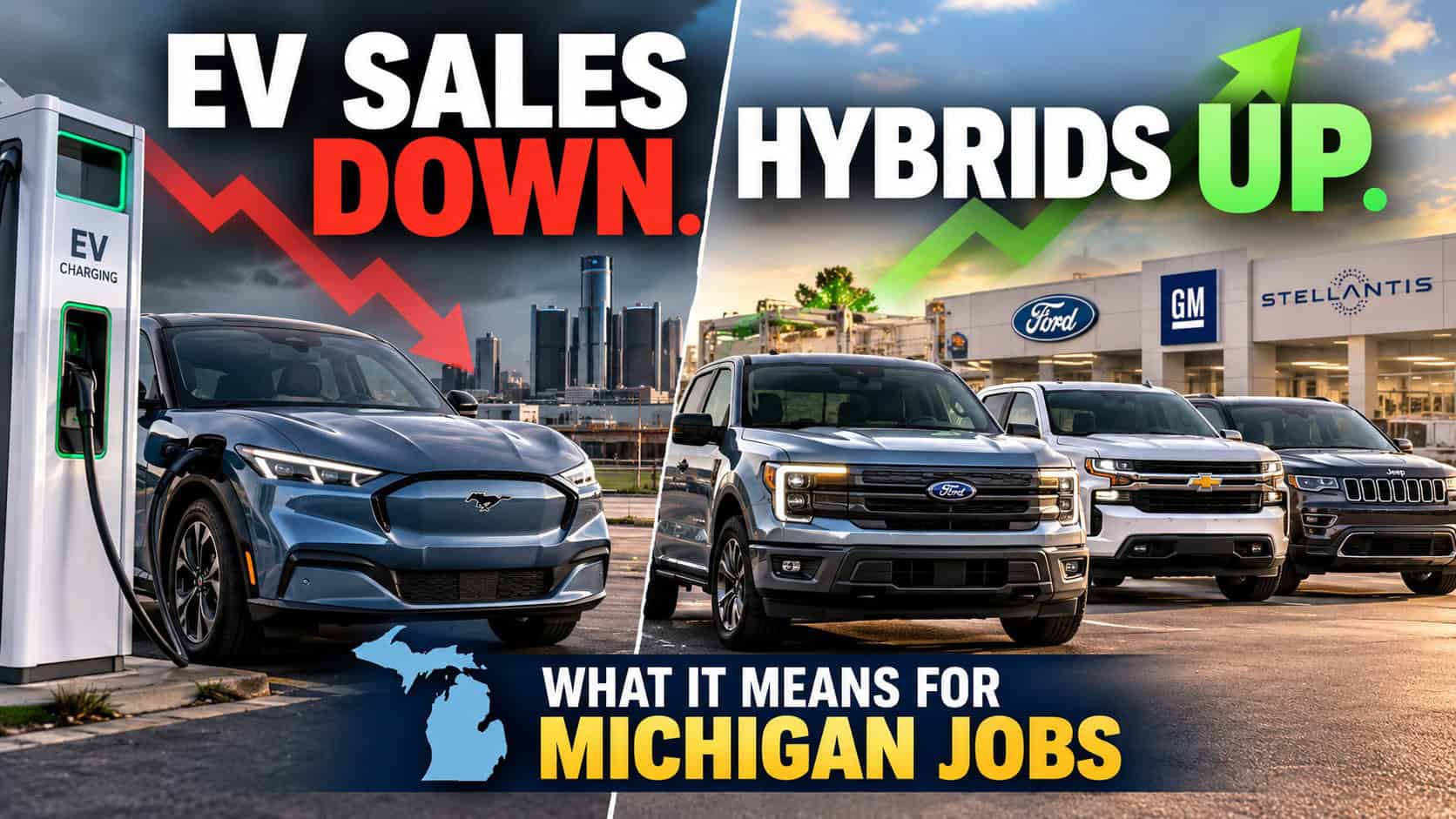
Conventional hybrids captured 15.7% of U.S. new-vehicle sales in August, up 3.1 percentage points from a year earlier, according to the National Automobile Dealers Association.
Battery-electric vehicles moved in the opposite direction, falling from 10.1% of sales in August 2025 to 6.2% this August.
Overall vehicle sales still increased.
Americans are buying vehicles. They’re changing what kind they’re buying.
EV, Hybrid Or PHEV — What’s The Difference?
EV — Electric Vehicle: Runs entirely on batteries. There is no gasoline engine, so it must be plugged in. Examples include the Chevrolet Equinox EV, Ford Mustang Mach-E and Tesla Model Y.
Hybrid: Combines a gasoline engine with a smaller battery and electric motor. You don’t plug it in. The vehicle recharges its battery itself and uses electricity to reduce gasoline consumption.
PHEV — Plug-In Hybrid Electric Vehicle: The middle ground. It has a larger battery that can be plugged in for shorter electric-only trips plus a gasoline engine for longer travel.
ICE — Internal Combustion Engine: The traditional gasoline- or diesel-powered vehicle.
Simply put: EV = electricity only. Hybrid = gas plus electricity without plugging in. PHEV = plug-in electricity plus gasoline backup.
Price matters more than ever. NADA estimates the average monthly payment on a new vehicle reached $812 in August, the highest ever for the month, while the average financing rate remained about 6.55%. With buyers already spending more than $800 a month, choosing the wrong vehicle — or the wrong powertrain — can become an expensive mistake.
What Can You Buy — And For How Much?
Here’s a sampling of current vehicles from Detroit automakers and major competitors.
Vehicle Type Starting MSRP Range/Economy Chevrolet Bolt EV $27,600 262-mile GM-est. range Honda Civic Hybrid Hybrid $29,395 50/47 mpg city/hwy Toyota Prius Plug-In PHEV $33,775 Up to 44 electric miles Ford Escape Hybrid Hybrid $33,890 39 mpg combined* Chevrolet Equinox EV EV $34,995 319-mile GM-est. range Jeep Cherokee Turbo Hybrid Hybrid $35,000 37 mpg combined / 500+ miles Ford Escape PHEV PHEV $35,400 Up to 37 electric miles Honda CR-V Hybrid Hybrid $35,630 43/36 mpg city/hwy Ford Mustang Mach-E EV $37,795 Range varies by version Chevrolet Blazer EV EV $44,700 Up to 312 EPA-est. miles** Jeep Wagoneer S EV $65,200 All-electric
*Ford’s 39-mpg figure cited for the Escape Hybrid Platinum AWD configuration.
*Blazer EV figure applies to the FWD configuration.
Starting MSRPs generally exclude destination charges, taxes, registration, options and dealer fees. Prices, EPA ratings and manufacturer-estimated ranges vary by configuration and can change.
The numbers show why buyers shouldn’t automatically assume an EV costs dramatically more than a hybrid. The Equinox EV, Escape Hybrid, Escape PHEV and Cherokee Hybrid all start in roughly the same $34,000-to-$35,400 neighborhood.
Michigan Winter Changes The Calculation
This may be the most important consideration for Michigan drivers.
AAA tested three EVs and three hybrids at 75 degrees, 95 degrees and 20 degrees, with vehicle climate controls set at 72 degrees.
At 20 degrees, EVs experienced an average 39% reduction in calculated driving range compared with 75 degrees. Hybrid fuel economy fell an average 22.8%.
For illustration, applying AAA’s average result to an EV capable of traveling 300 miles under moderate-temperature conditions would reduce that to about 183 miles.
Actual winter range varies by vehicle, temperature, speed, heating use, wind and road conditions.
But Michigan buyers shouldn’t shop using the advertised range alone.
Cold also changes the economics. AAA found EVs remained cheaper to operate than hybrids at 20 degrees when charged at home, but were more expensive when relying on public charging in its test-cost calculations.
Where Do You Park At Night?
For an EV shopper, this question could be nearly as important as price.
A homeowner with a garage and Level 2 charger can plug in overnight. J.D. Power says 86% of typical EV charging happens at home.
Installation, however, can add additional expense depending on the home’s electrical system.
Renters and apartment dwellers without dedicated charging may depend much more heavily on public chargers.
Michigan is expanding that network. MDOT says 81 NEVI charging stations are being deployed through the first two procurement rounds, with roughly another 60 anticipated through Round 3 and targeted for public use by 2029.
That still makes charging availability particularly important for people regularly traveling through Northern Michigan and the Upper Peninsula.
Why Hybrids Are Finding A Sweet Spot
A conventional hybrid’s biggest advantage may be simplicity.
There’s no charger to install and no charging stop to plan. Fill the gasoline tank as usual while using considerably less fuel than many conventional vehicles.
A PHEV offers another compromise: electric power for shorter everyday trips and gasoline for longer journeys.
But there’s a catch: a PHEV delivers its greatest benefit when the owner actually plugs it in regularly.
Don’t Count EVs Out
People considering their first EV frequently worry about range and charging.
Existing owners tell a different story.
J.D. Power’s 2026 EV ownership study found 96% of new battery-EV owners would consider buying or leasing another BEV. Owner satisfaction reached its highest level since the study began in 2021.
So there isn’t one winner for every Michigan driver.
Reliable home charging and mostly local driving? An EV could make sense.
Want better mileage without changing your driving habits? Consider a hybrid.
Want electric commuting with gasoline available for long trips? Consider a PHEV.
Michigan spent billions preparing for an electric future. Automakers built factories, suppliers retooled and communities counted on jobs and tax revenue.
Consumers now get the final vote — one vehicle purchase at a time.