Michigan hemp businesses have been given another month before sweeping new federal restrictions threaten many currently legal CBD products. But there’s a catch: Congress now must find a solution during a potentially chaotic lame-duck session after the Nov. 3 midterm elections.
WASHINGTON DC – President Donald Trump has signed a stopgap federal spending bill that delays most of the looming federal hemp restrictions from Nov. 12 until Dec. 11.
For Michigan hemp farmers, processors, manufacturers and retailers, the additional 29 days provide some breathing room.
But not much.
“This is certainly good news,” iHemp Michigan President Blain Becktold told MITechNews. “But it only gives us a small reprieve of one month.”
Dave Crabill, founder of iHemp Michigan, is considerably less optimistic about what Congress can accomplish with that extra time.
“This gives us a little time, but when have you seen Congress act responsibly within a short time frame?” Crabill told MITechNews.
His assessment of what happens next is even more pointed:
“I don’t see a good resolution coming out of Washington D.C. This is a mess.”
Hemp Fight Moves Past The Midterm Elections
The Dec. 11 extension introduces another political complication.
It pushes the next major congressional decision over hemp beyond the Nov. 3 midterm elections and into a lame-duck session of Congress.
The timing wasn’t driven exclusively by hemp. The continuing resolution funds the entire federal government through Dec. 11 because Congress has not completed its regular appropriations bills.
But the practical result is that lawmakers won’t have to resolve the controversial hemp issue immediately before voters decide control of Congress.
After Nov. 3, the political landscape could look considerably different.
Some lawmakers returning to Washington may have lost reelection. Others are retiring. And depending upon the election results, control of the House or Senate could be preparing to change hands when the new Congress takes office in January.
At the same time, lawmakers will face a Dec. 11 government-funding deadline and a backlog of unfinished business.
The hemp industry will be competing for attention during one of the most compressed legislative periods of the year.
Congress Has Already Had One Hemp Showdown
There is evidence, however, that a significant number of lawmakers don’t want the broad federal hemp restrictions to take effect without another attempt at regulation.
Sen. Ted Budd, R-North Carolina, tried to remove the hemp extension from the continuing resolution, which would have preserved the original November deadline.
The Senate rejected that effort 61-32.
The Senate then approved the broader continuing resolution 90-6. The House subsequently approved it 370-48 before Trump signed it.
Those votes don’t mean Congress agrees on what should replace the restrictions.
They do show substantial bipartisan support for giving lawmakers more time.
Michigan Hemp Industry: We’re Not Defending Intoxicating Products
Michigan hemp advocates say one distinction is getting lost in the national debate.
They don’t want intoxicating hemp products marketed to children protected.
“We absolutely do not endorse or condone intoxicating hemp products,” Crabill said.
Becktold made the same point.
“The hemp industry strongly opposes intoxicating hemp products marketed or sold to children,” he said.
Becktold said the industry supports “strict age restrictions, child-resistant packaging, responsible labeling, and meaningful enforcement against bad actors.”
He believes the extension could finally force Congress to establish the federal oversight hemp businesses have sought since passage of the 2018 Farm Bill.
“The discussion will allow for sensible regulation, and I do believe that the industry will finally get the oversight they have been asking for since 2018,” Becktold said.
Synthetic Cannabinoids Don’t Get The Same Reprieve
The delay doesn’t protect every product.
Restrictions involving certain synthetic cannabinoids that cannot naturally be produced by the cannabis plant remain scheduled to take effect in November.
Becktold views that as an important distinction.
It potentially allows regulators to begin removing problematic synthetic products while Congress continues debating rules for naturally derived hemp and CBD products.
“The temporary extension included in the CR is not a permanent solution,” Becktold said. “It simply provides Congress with additional time to complete work on a thoughtful, long-term hemp policy rather than allowing a sweeping ban to take effect before those discussions are finished.”
Full-Spectrum CBD Could Become Collateral Damage
This is where the issue becomes particularly important for Michigan consumers and businesses.
The federal crackdown isn’t limited to products designed to get consumers high.
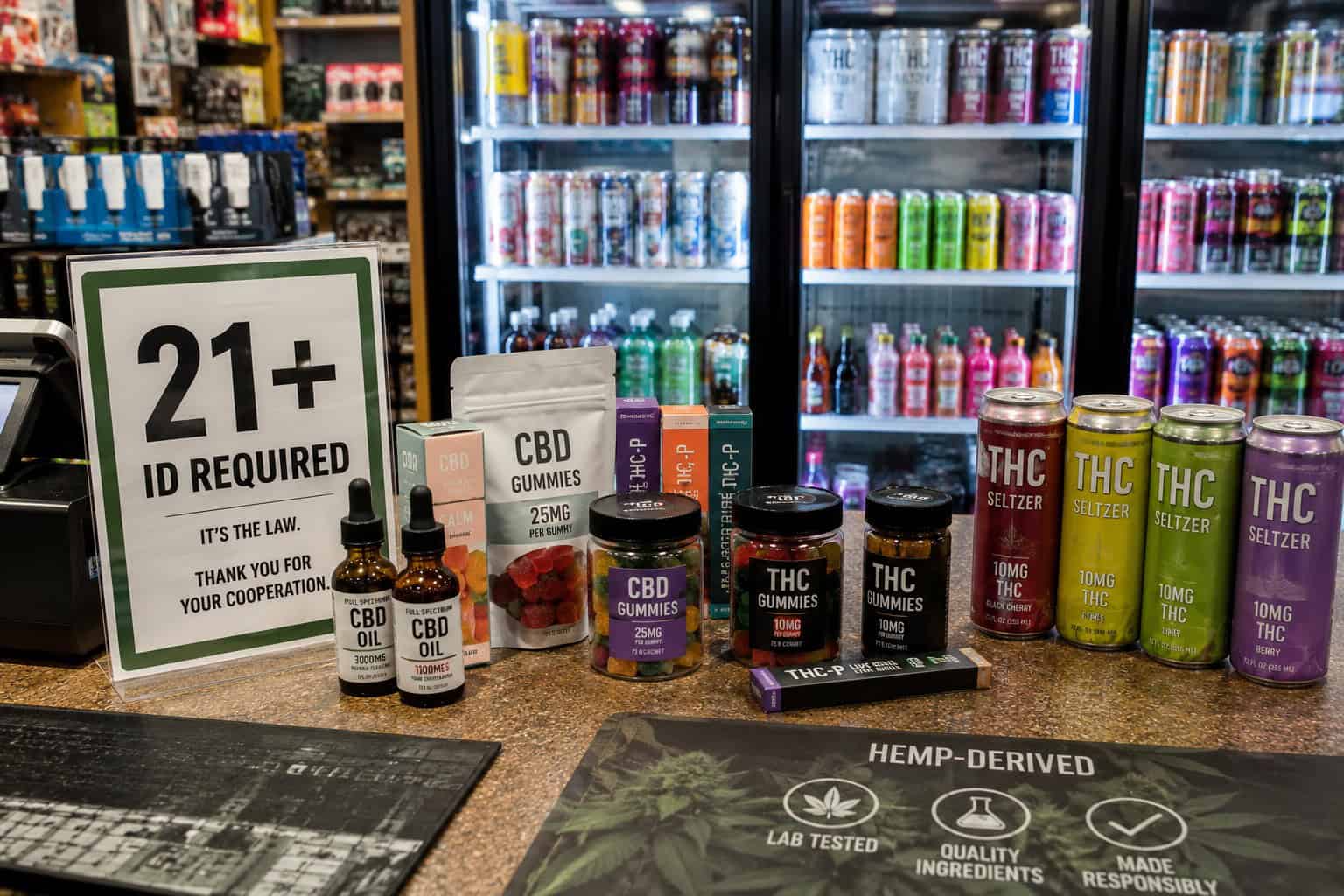
Under the new federal standard, finished hemp-derived cannabinoid products generally would be limited to no more than 0.4 milligrams of total THC and other similarly acting cannabinoids per container.
Full-spectrum CBD products naturally contain trace amounts of THC.
That means some products could exceed the federal limit even though they aren’t manufactured or marketed to produce an intoxicating effect.
“Unfortunately, the way the THC ban is written, it will make any full spectrum products illegal to produce,” Crabill said.
The concern is that Congress could solve one problem — intoxicating hemp products — by creating another: eliminating legitimate products used by CBD consumers.
“Those making the laws need more education on the products we offer and how to fairly regulate,” Crabill said.
“Many people that use CBD for health and wellness are counting on Congress to do its job and provide a legal pathway for safe and reliable products,” Becktold added.
A Bipartisan Alternative Is Already On The Table
Congress does have an alternative to simply letting the restrictions take effect.
Republican Rep. Andy Barr of Kentucky and Democratic Rep. Angie Craig of Minnesota have introduced the Lawful Hemp Protection Act.
The bipartisan legislation would establish a comprehensive federal regulatory framework for hemp-derived consumer products rather than broadly eliminating them.
Among its provisions, the legislation would prohibit synthetic cannabinoids, restrict consumable hemp-derived cannabinoid products to buyers 21 and older and establish manufacturing, testing, labeling, packaging and marketing requirements.
It would also direct the Food and Drug Administration to establish maximum cannabinoid limits for consumable hemp products.
The bill, however, remains in congressional committees.
And that illustrates Crabill’s concern: having a bipartisan proposal is considerably different from getting legislation through Congress before Dec. 11.
Alcohol Industry Wants A Seat At The Table
There is another powerful player in the debate.
The alcohol industry.
Crabill contends that large, well-financed interests are increasingly shaping the congressional discussion around hemp-derived THC beverages.
“Now we see the flailing alcohol lobby and other well-heeled actors pushing for hemp THC drinks,” he said.
There is evidence supporting the underlying point.
The Wine & Spirits Wholesalers of America supports the Barr-Craig legislation, as do the Coalition for Adult Beverage Alternatives, Hemp Beverage Alliance and Total Wine & More.
The Barr-Craig proposal would establish a three-tier system for hemp-derived beverages involving manufacturers, distributors and retailers — a structure resembling alcohol distribution.
It also proposes a federal tax of 5 cents per milligram of THC in hemp-derived beverages.
That creates an unusual contrast in the congressional debate.
While Michigan hemp businesses worry that traditional full-spectrum CBD products could become federally illegal, major beverage and alcohol interests are simultaneously advocating a regulated legal marketplace for hemp-derived THC drinks.
For smaller hemp businesses, the question therefore isn’t simply whether Congress regulates hemp.
It’s what products survive, who gets to sell them and who writes the rules.
Michigan Already Has Hemp Regulation
Michigan isn’t approaching the issue from scratch.
The state already regulates industrial hemp cultivation and processing, with state agencies overseeing different portions of the industry.
Michigan also operates a separate regulated marijuana market.
That makes the federal debate particularly consequential here.
Congress is trying to draw a national line between industrial hemp, traditional CBD products, intoxicating hemp products and marijuana — categories that don’t always fit neatly into the same regulatory system.
Becktold believes regulation rather than broad prohibition remains the better solution.
“There is still a lot of work to be accomplished before we get actual legislation that protects the industry and the consumers that use CBD,” he said.
Congress Has 29 Days — After The Election
Trump’s signature gives Michigan’s hemp industry breathing room.
It doesn’t provide certainty.
Congress now faces three broad choices: allow the new restrictions to take effect Dec. 11, pass legislation establishing a new regulatory framework, or postpone the deadline again.
And the political environment could be very different when lawmakers return after Nov. 3.
Becktold sees an opportunity for bipartisan lawmakers to finally establish the regulatory framework the industry has sought for years.
Crabill sees a dysfunctional Congress being asked to resolve a complicated issue during a short lame-duck session already packed with unfinished business.
But Michigan’s hemp leaders agree on the fundamental objective:
Keep intoxicating hemp products away from children. Regulate the industry. But don’t destroy legitimate CBD and full-spectrum hemp products in the process.
Congress bought itself another 29 days.
After the midterms, the question will be whether it knows what to do with them.