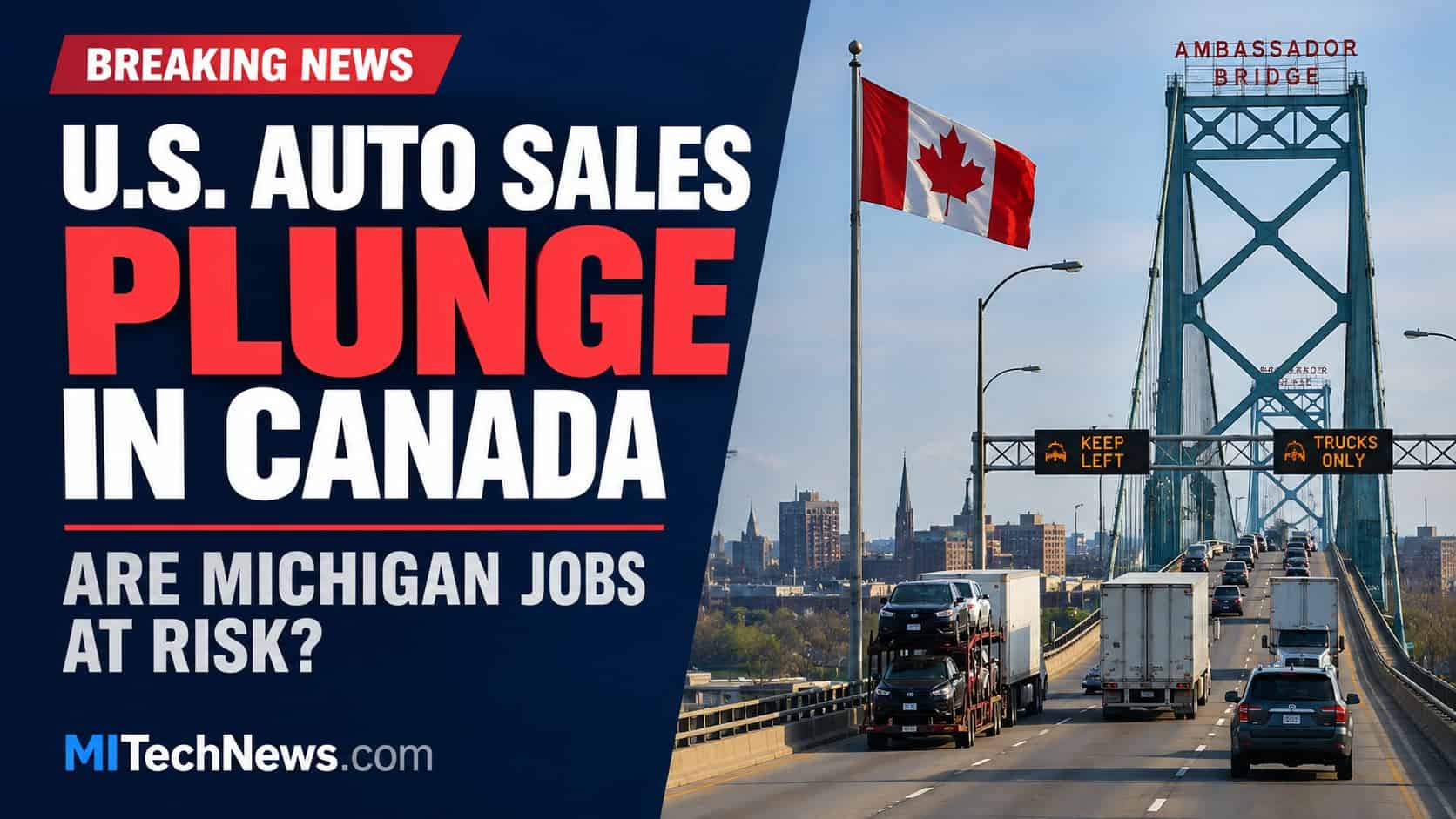
Michigan could be hit “coming and going” as Canada prepares retaliatory tariffs and President Trump threatens 50% tariffs on Canadian vehicles and auto parts.
DETROIT — President Donald Trump says tariffs on Canada will protect American manufacturing and encourage companies to move production and jobs to the United States.
But an escalating U.S.-Canada trade war could produce a very different result in Michigan: higher vehicle prices, delayed investment, factory closings and job losses across the Great Lakes manufacturing belt.
Patrick Anderson, CEO of East Lansing-based Anderson Economic Group, says Michigan may have more at risk than any other state.
“Michigan is the most vulnerable state to a US-Canadian trade war,” Anderson told MITechNews. “We will get hit coming and going, as our agricultural exports, our auto parts exports, auto parts used in our own assembly, and more would all get hit.”
The threat became considerably more serious this week when Trump announced that tariffs on Canadian cars, trucks and automotive parts would increase to 50% beginning Jan. 1, 2027, following the collapse of trade negotiations between Washington and Ottawa.
Anderson said 50% automotive tariffs would be an “absolute body blow” to the industry on both sides of the border.
“It would mean plants closing, and many job losses in Michigan, Ontario, Ohio, Indiana, and Wisconsin,” Anderson said.
Consumers would feel the impact as well.
“Certainly tariffs at 50% would cause prices to rise,” Anderson said. “More importantly, it would cause plants to close. Nobody will win this kind of trade war.”
From Hockey Sticks To An Auto Trade War
Anderson makes an important distinction between the latest tariffs already imposed on Canadian products and the potentially much more damaging automotive tariffs coming Jan. 1.
The United States imposed 50% tariffs under Section 338 of the Tariff Act of 1930 on hundreds of categories of Canadian products.
The list includes goods ranging from honey and clothing to hockey equipment and other consumer products.
Anderson characterized those tariffs as more of an annoyance than a fundamental threat to U.S.-Canada commerce.
“The ‘338’ tariffs the US actually imposed on Canada were more of an annoyance than a real threat to trade with Canada,” Anderson said. “Feathers, honey, cotton sweaters and hockey sticks were on the list; autos and steel and oil were not.”
U.S. Customs and Border Protection confirms that vehicles, automotive parts, steel, aluminum and several other categories are excluded from the new 50% Section 338 duty because they are handled separately under other tariff provisions.
Canada now plans to retaliate.
Beginning Sept. 8, the Canadian government says it will impose counter-tariffs on $27.6 billion worth of U.S. products, matching the latest U.S. tariffs dollar for dollar. The targets include steel and aluminum, dairy products, appliances, agricultural equipment, pulp and paper, plastics and electronics.
That means Michigan businesses potentially get squeezed in both directions: tariffs affecting products they sell to Canada and higher costs involving Canadian products and components used in Michigan.
Michigan And Ontario Make Vehicles Together
The central problem for Michigan is that Canada isn’t simply another country selling products to the United States.
Michigan and Ontario are pieces of the same automotive manufacturing system.
Vehicles, engines, transmissions and thousands of components move between factories and suppliers on both sides of the Detroit River.
Michigan’s dependence on that relationship is particularly pronounced.
Oxford Economics estimates Michigan accounts for roughly 22% of all U.S. imports of intermediate automotive goods from Canada.
That means a tariff aimed at Canadian manufacturing doesn’t necessarily stop at the border.
It can increase the cost of a component that eventually goes into a vehicle assembled by American workers at a Michigan factory.
Glenn Stevens Jr., executive director of MichAuto and chief automotive officer for the Detroit Regional Chamber, told MITechNews that tariffs and continuing trade uncertainty already are increasing automakers’ input costs.
Those costs ultimately contribute to higher vehicle prices, while uncertainty surrounding future trade policy can cause businesses to delay investments, Stevens said during a video interview with MITechNews.
Stevens argues the United States should be strengthening its USMCA partnership with Canada rather than allowing the two countries’ automotive economies to move further apart.
Canadian Plants Build Vehicles Americans Buy
The impact wouldn’t be limited to automotive parts.
Canadian plants manufacture some of the most recognizable vehicles on American roads.
General Motors builds Chevrolet Silverado pickups in Oshawa.
Stellantis builds the Chrysler Pacifica in Windsor.
Toyota manufactures the RAV4 and Lexus models in Canada, while Honda builds Civics and CR-Vs there.
Ford is preparing Oakville, Ontario, to produce F-Series Super Duty trucks to supplement U.S. production.
Canadian-built vehicles represented approximately 6% of U.S. vehicle sales in 2025.
A 50% tariff doesn’t mean the sticker price of a Canadian-built vehicle automatically increases 50%. Automakers can absorb part of the cost, change sourcing, adjust production or potentially qualify for exemptions.
But Anderson says tariffs at that level eventually make some production uneconomic.
And that’s why he is more worried about shuttered factories than sticker prices.
Business Groups Call For A Truce
Business organizations on both sides of the border increasingly are warning against further escalation.
The Canada-U.S. Business Association this week called on both governments to suspend the latest tariffs and counter-tariffs and return to negotiations under the USMCA framework.
The Canadian American Business Council similarly warned that tariff costs won’t stop at the border. They will move through integrated supply chains, raising prices, discouraging investment and putting jobs at risk.
There is evidence tariffs already are affecting prices.
Research cited by the Canada-U.S. Business Association estimates that broader U.S. tariffs implemented through November 2025 increased core goods prices by approximately 3.1% through February 2026.
Ontario also faces potentially serious consequences.
Its Financial Accountability Office estimated under a sustained tariff scenario that Ontario could have approximately 119,000 fewer jobs in 2026 and manufacturing output 8% below a no-tariff scenario.
Those are projections, not actual job losses.
But Michigan and Ontario’s manufacturing economies are so closely connected that economic damage on one side of the Detroit River can quickly cross to the other.
“This may have started with playground taunts and annoying tariffs on feathers and hockey sticks,” Anderson said, “but it will lead to shuttered plants if we don’t find a way to climb down.”
Tariffs Could Become A Midterm Issue
The trade war is also unfolding against a political clock.
Canada’s new counter-tariffs begin Sept. 8.
The U.S. midterm elections follow on Nov. 3.
Trump’s 50% Canadian automotive tariffs are scheduled to begin Jan. 1.
That could put Republican candidates in Michigan and other industrial states in the position of defending Trump’s tariff strategy as voters consider concerns about vehicle prices, manufacturing jobs and the broader cost of living.
The issue is already surfacing in Michigan’s open U.S. Senate race.
Republican nominee Mike Rogers has supported Trump’s broader trade strategy, while Democratic nominee Abdul El-Sayed is attempting to turn the Canada tariffs into an affordability and jobs issue.
Rogers has previously called Chinese-made automobiles an existential threat to U.S. auto workers and companies. His campaign had not publicly addressed the latest Canada tariff escalation as of Wednesday, according to published reports.
MITechNews has asked the Rogers campaign whether he supports Trump’s 50% Canadian automotive tariffs and whether he believes those tariffs will strengthen or weaken Detroit’s ability to compete globally.
Could China Ultimately Benefit?
That question points toward an even larger issue.
While the United States and Canada fight over tariffs, Chinese automakers are rapidly expanding production and exports into many of the international markets Ford, General Motors and Stellantis need for future growth.
Stevens told MITechNews that trade disputes and uncertainty risk distracting U.S. automakers at precisely the time they need to concentrate on competing globally.
Anderson warns the tariffs could shutter plants.
And Michigan sits directly in the middle.
“Nobody will win this kind of trade war,” Anderson said.
But there may be one major automotive country positioned to benefit if North America’s manufacturing system becomes more expensive and less competitive.
China.
Friday: MITechNews examines whether Trump’s Canada trade war could inadvertently give China’s rapidly expanding auto industry an even greater global advantage.