Michigan has hundreds of thousands of unemployed workers. Small businesses say they still can’t find qualified people to hire. New employment data help explain why both things can be true at the same time.
LANSING – Michigan appears to have a labor-market contradiction.
The state’s unemployment rate stood at 4.9% in July, compared with 4.1% nationally, leaving roughly 241,000 Michigan residents officially unemployed.
Yet employers continue to complain that they can’t find workers.
A new August jobs report from the National Federation of Independent Business underscores the problem. Nationally, 35% of small-business owners reported job openings they could not fill.
Among businesses that were hiring or trying to hire, the problem was much more pronounced: 82% reported finding few or no qualified applicants for the positions they were trying to fill.
So how can Michigan have relatively high unemployment while businesses still can’t find workers?
The answer may lie in a combination of a shrinking labor force, a mismatch between the skills employers need and those job seekers possess, where workers and jobs are located, and intensifying competition for qualified employees.
And buried in Michigan’s latest employment report is an especially troubling number:
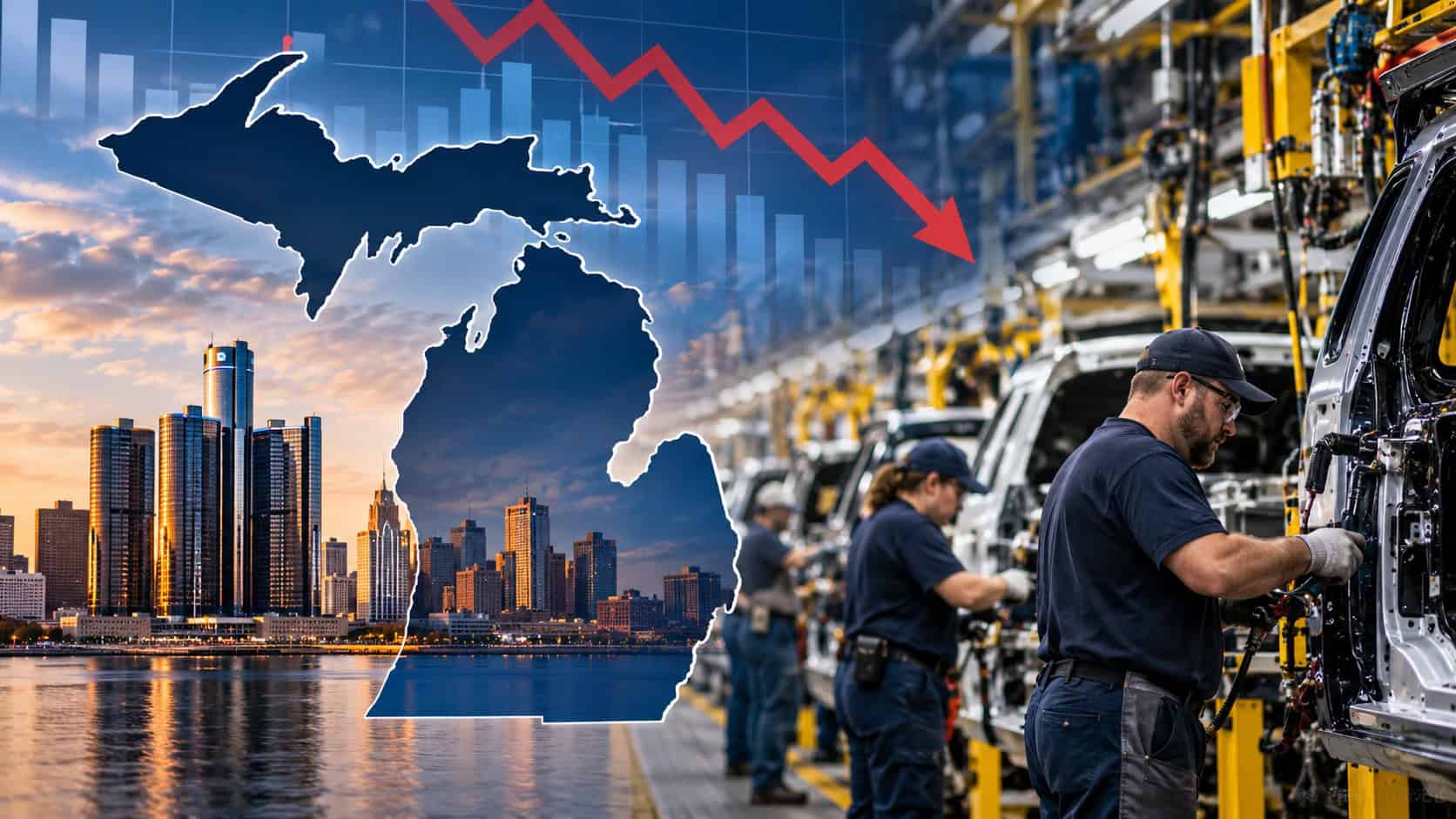
Michigan’s labor force has shrunk by approximately 143,000 people in just one year.
Michigan Isn’t Just Losing Jobs — It’s Losing Workers
Michigan’s civilian labor force declined from approximately 5.02 million people in July 2025 to 4.88 million in July 2026, according to state labor-market data.
That’s a decline of about 143,000 workers, or 2.8%, in one year.
Over the same period, Michigan employment declined by approximately 136,000, while the number of people classified as unemployed actually declined by about 7,000.
That seemingly contradictory combination illustrates an important distinction in employment statistics.
To be counted as unemployed, someone generally must be without a job and actively looking for work.
Someone who retires, stops searching for a job or otherwise leaves the labor force isn’t counted as unemployed.
Michigan’s labor-force participation rate fell to 59.1% in July, another indication that fewer residents are participating in the state’s workforce.
The employment numbers alone don’t explain why Michigan’s labor force declined so sharply. Retirement, demographics, migration, discouraged workers and other factors could potentially contribute.
Determining exactly what happened to those 143,000 workers deserves a closer examination of Michigan’s demographic and labor data.
But regardless of the cause, the decline presents employers with a basic mathematical problem:
There are fewer people participating in Michigan’s labor market.
Having Unemployed Workers Doesn’t Mean Having The Workers Employers Need
The second part of Michigan’s labor puzzle involves skills.
NFIB’s August survey found 31% of small businesses nationally had openings for skilled workers, compared with just 13% reporting openings for unskilled labor.
That difference matters.
A worker who loses an administrative job doesn’t automatically have the training necessary to become an electrician, CNC machine operator, nurse, automotive technician or another worker requiring specialized skills.
Michigan employers may therefore face labor shortages even while thousands of people remain unemployed.
The Michigan Center for Data and Analytics provided another indication of the problem this week when it released the state’s new Hot 50 occupational outlook identifying high-demand, high-wage occupations expected to offer significant employment opportunities through 2034.
Many require specialized education, technical skills, professional credentials or training.
The problem isn’t simply whether Michigan has people looking for jobs.
It’s whether those workers have the skills employers are looking for.
Michigan’s Labor Problem Isn’t The Same Everywhere
Geography adds another complication.
The Detroit-Warren-Dearborn metropolitan area’s unemployment rate stood at approximately 5.3% in July, higher than Michigan’s statewide rate.
Yet the Detroit area’s labor force increased by about 35,000 people over the previous year, even as Michigan’s overall labor force declined by 143,000.
That suggests Michigan may not have a single statewide labor problem.
Workers may be available in one region while employers struggle to fill jobs somewhere else.
A skilled worker in Southeast Michigan isn’t necessarily going to relocate to Northern Michigan or West Michigan for an available job — particularly if housing, commuting costs, wages or family considerations make the move unattractive.
That can create labor shortages locally even when statewide unemployment remains elevated.
Small Businesses Are Feeling The Squeeze
The August NFIB report suggests labor shortages remain particularly challenging for small employers.
While hiring activity softened nationally during August, 35% of small businesses still reported jobs they couldn’t fill.
That figure remains 11 percentage points above NFIB’s historical average.
Even more revealing, 23% of small-business owners identified labor quality or labor availability as their single most important business problem, nearly twice NFIB’s historical average of 12%.
Michigan businesses have been reporting similar concerns.
In NFIB’s July Michigan report, 27% of owners identified labor quality or availability as their biggest business problem, while 36% reported positions they couldn’t fill.
That creates another challenge for smaller companies.
Large corporations may have more resources to increase salaries, offer richer benefit packages, provide signing bonuses or recruit workers from outside Michigan.
A small manufacturer, technology company, restaurant, construction contractor, home-care provider or other small business often has considerably less room to compete.
Hiring May Only Be Half The Problem
Michigan employers traditionally approach labor shortages by asking a straightforward question:
How do we find more workers?
The emerging labor-market numbers suggest businesses may need to ask another question:
How do we keep the workers we already have?
NFIB reported that a net 31% of small businesses raised compensation during August, while another 18% planned compensation increases during the next three months.
Both readings remain above their historical averages.
But compensation isn’t limited to hourly wages or salaries.
Employers increasingly compete through health benefits, flexible schedules, paid time off, training opportunities, career advancement and other benefits that can make the difference between an employee staying or accepting another job.
That equation becomes more important when replacing an employee means returning to a labor market where qualified applicants are already scarce.
Employee retention therefore isn’t simply a human-resources issue.
It is becoming an economic competitiveness issue.
Michigan’s Labor Paradox By The Numbers
- 4.9% — Michigan unemployment rate in July 2026
- 4.1% — U.S. unemployment rate
- 241,000 — Michigan residents classified as unemployed
- 143,000 — Approximate decline in Michigan’s labor force from July 2025 to July 2026
- 59.1% — Michigan labor-force participation rate
- 35% — Small businesses nationally reporting job openings they couldn’t fill
- 31% — Small businesses nationally reporting openings for skilled workers
- 82% — Businesses trying to hire that reported few or no qualified applicants
So Where Did Michigan’s Workers Go?
Michigan’s employment numbers help answer the question of how the state can have relatively high unemployment while employers simultaneously struggle to hire.
Unemployment and worker availability aren’t the same thing.
Some people are unemployed and actively looking for jobs.
Others have left the labor force altogether.
Some job seekers don’t possess the skills required for available positions.
And workers with the right skills may not live where employers need them — or may be unwilling to take available jobs at the compensation and benefits being offered.
The result is an increasingly complicated Michigan labor market: businesses need workers, unemployed Michiganders need jobs, yet the two don’t necessarily match.
But Michigan’s latest employment report raises an even bigger question.
What happened to the 143,000 people who disappeared from Michigan’s labor force over the past year?
Understanding whether that decline is being driven primarily by retirements, demographics, migration, workers giving up their job searches or other forces could help determine whether Michigan’s labor shortage is temporary — or a structural economic problem that could persist for years.
That’s a question Michigan employers, policymakers and economic-development officials increasingly need answered.
COMING NEXT WEEK: Where Did 143,000 Michigan Workers Go?
Michigan’s labor force has shrunk by approximately 143,000 people in just one year — even though Census estimates don’t show anything approaching that number of residents leaving the state. MITechNews will examine what’s behind the decline, including Michigan’s aging population, Baby Boomer retirements, migration, declining workforce participation and other factors that could reshape the state’s economy for years to come.