Ohio’s recreational marijuana industry has generated $1.67 billion in sales since launching in August 2024. Michigan still sells far more cannabis at dramatically lower prices — and Ohio customers have helped turn Monroe into a marijuana retail powerhouse. But as Ohio’s market grows and its prices fall, how long can Michigan maintain its border advantage?
ANN ARBOR – Michigan remains one of America’s largest recreational marijuana markets.
But just across the state line, a much younger competitor is growing quickly.
Ohio recreational marijuana sales reached $1.67 billion as of July 11, according to the Ohio Department of Commerce Division of Cannabis Control.
That number needs some explanation.
The $1.67 billion is not annual sales and does not include Ohio’s older medical marijuana market. It represents cumulative recreational marijuana sales since Ohio launched adult-use sales Aug. 6, 2024.
At the beginning of 2026, cumulative Ohio recreational sales stood at $1.09 billion after the state generated more than $836 million in recreational sales during 2025, its first full calendar year.
Michigan remains the considerably larger market.
Michigan marijuana stores generated approximately $3.17 billion in adult-use revenue during 2025.
And the Michigan Cannabis Regulatory Agency reported approximately $270.5 million in adult-use sales during July 2026 alone, plus a comparatively tiny amount of medical marijuana sales.
But Ohio’s rapidly growing industry matters to Michigan for another reason.
Ohio consumers have helped turn Monroe into one of Michigan’s most important marijuana border markets.
And Michigan’s biggest weapon for keeping them coming north is price.
Ohio Customers Helped Build Monroe’s Marijuana Boom
Monroe Township has developed a cluster of marijuana dispensaries along I-75 just north of Toledo.
The concentration of stores isn’t being supported by Monroe residents alone.
Before Ohio launched recreational sales, Bridge Michigan reviewed vehicles in Monroe Township dispensary parking lots and found that roughly half of the customers were from Ohio.
That’s a remarkable figure for a township with only about 14,000 residents.
Ohio’s decision to launch recreational marijuana sales in August 2024 created an obvious threat.
Why would Ohio consumers continue driving into Michigan when they could legally purchase recreational marijuana closer to home?
Nearly two years later, the answer appears largely to come down to two words:
Michigan prices.
Michigan Won The Marijuana Price War
Michigan cannabis remains dramatically cheaper than marijuana sold in Ohio.
At the end of July, the median price of an eighth of cannabis flower was about:
Ohio: $35
Michigan: $20
The city-by-city comparison makes Michigan’s advantage even clearer.
The median price of an eighth was approximately:
Columbus: $36.40
Cincinnati: $32
Cleveland: $30.80
Lansing: $25
Detroit: $20
Monroe: $20
Morgan Fox, political director for the National Organization for the Reform of Marijuana Laws, or NORML, told the Ohio Capital Journal that price will be one of the most important factors determining where consumers buy cannabis.
“People were already used to driving to Michigan to purchase cannabis, so as long as there’s still a massive price differential, they’re probably going to continue doing so at least for the foreseeable future,” Fox said.
That’s potentially very good news for Monroe marijuana retailers.
But there’s an important legal distinction.
Crossing The Border With Marijuana Violates Federal Law
Michigan can legally sell recreational marijuana under state law to an Ohio resident who is 21 or older while that customer is in Michigan.
That does not make it legal under federal law to transport recreational marijuana from Michigan into Ohio.
Marijuana remains federally controlled, and state legalization does not override the federal Controlled Substances Act.
So an Ohio resident may make a purchase that complies with Michigan law while standing inside a Michigan dispensary, but taking that marijuana across the state line remains prohibited under federal law.
Ohio has tightened its own law as well.
Senate Bill 56 criminalized bringing marijuana legally purchased in another state back into Ohio.
Fox told the Ohio Capital Journal that consumers accustomed to buying cannabis in Michigan may nevertheless continue doing so while the price difference remains large.
That produces an unusual interstate cannabis market.
Ohio has its own legal recreational marijuana industry.
Michigan marijuana remains considerably cheaper.
Ohio consumers have historically represented roughly half of the customers at Monroe Township dispensaries.
But legally transporting that marijuana home across the state line is prohibited.
Ohio Is Growing Fast
None of that means Michigan can assume its price advantage will last indefinitely.
Ohio’s recreational market is growing rapidly.
Ohio generated more than $242 million in recreational marijuana sales during the partial 2024 launch year.
Sales exceeded $836 million during 2025, the first full calendar year of recreational sales.
Cumulative recreational sales reached $1.09 billion by Jan. 3, 2026.
By July 11, that figure had climbed to $1.67 billion.
Ohio had 223 dual-use marijuana dispensaries by mid-August.
Michigan, by comparison, had more than 800 active retail licenses as of June.
That difference is critical.
Michigan has nearly four times as many marijuana retailers despite having a smaller population than Ohio.
Ohio also has more than 160 municipalities and townships maintaining moratoriums on adult-use cannabis sales.
The result is a much more restricted marketplace.
Fox said Michigan’s larger number of dispensaries and licensed businesses is partly because Ohio artificially capped its market.
More Michigan businesses mean more competition.
And more competition helps produce lower prices.
Michigan’s Success Created A Problem
That’s where Michigan’s cannabis story gets complicated.
Michigan’s marijuana prices are extraordinarily attractive to consumers.
They’re considerably less attractive to the businesses trying to make money selling marijuana.
Michigan generated approximately $3.27 billion in adult-use marijuana sales during 2024.
Revenue slipped to about $3.17 billion in 2025 despite Michigan consumers continuing to purchase enormous quantities of cannabis.
The problem wasn’t necessarily disappearing demand.
The product became cheaper.
Years of expanding cultivation, retail competition, promotions and discounting have pushed prices downward.
That has been terrific for consumers.
It has been brutal for some growers, processors and retailers.
Michigan therefore finds itself in a peculiar competitive position:
The low prices squeezing Michigan marijuana businesses are also one of the industry’s biggest advantages over Ohio.
How Cheap Does Ohio Need To Get?
Ohio doesn’t necessarily have to match Michigan prices to change consumer behavior.
It only needs to narrow the gap enough that traveling to Michigan becomes less attractive.
When an eighth costs about $35 in Ohio and $20 in Monroe, the savings can become substantial, particularly on larger purchases.
But what happens if Ohio’s price falls to $28?
Or $25?
At some point, convenience, gasoline and travel time could outweigh the savings from shopping in Michigan.
Ohio marijuana prices are already moving downward as the state’s recreational market matures.
Michigan went through the same process.
More cultivation increased supply.
More retailers increased competition.
Competition pushed prices lower.
If Ohio follows that trajectory, its cannabis prices could gradually move closer to Michigan’s.
Michigan Adds A 24% Wholesale Tax
Michigan marijuana businesses entered 2026 with another financial pressure.
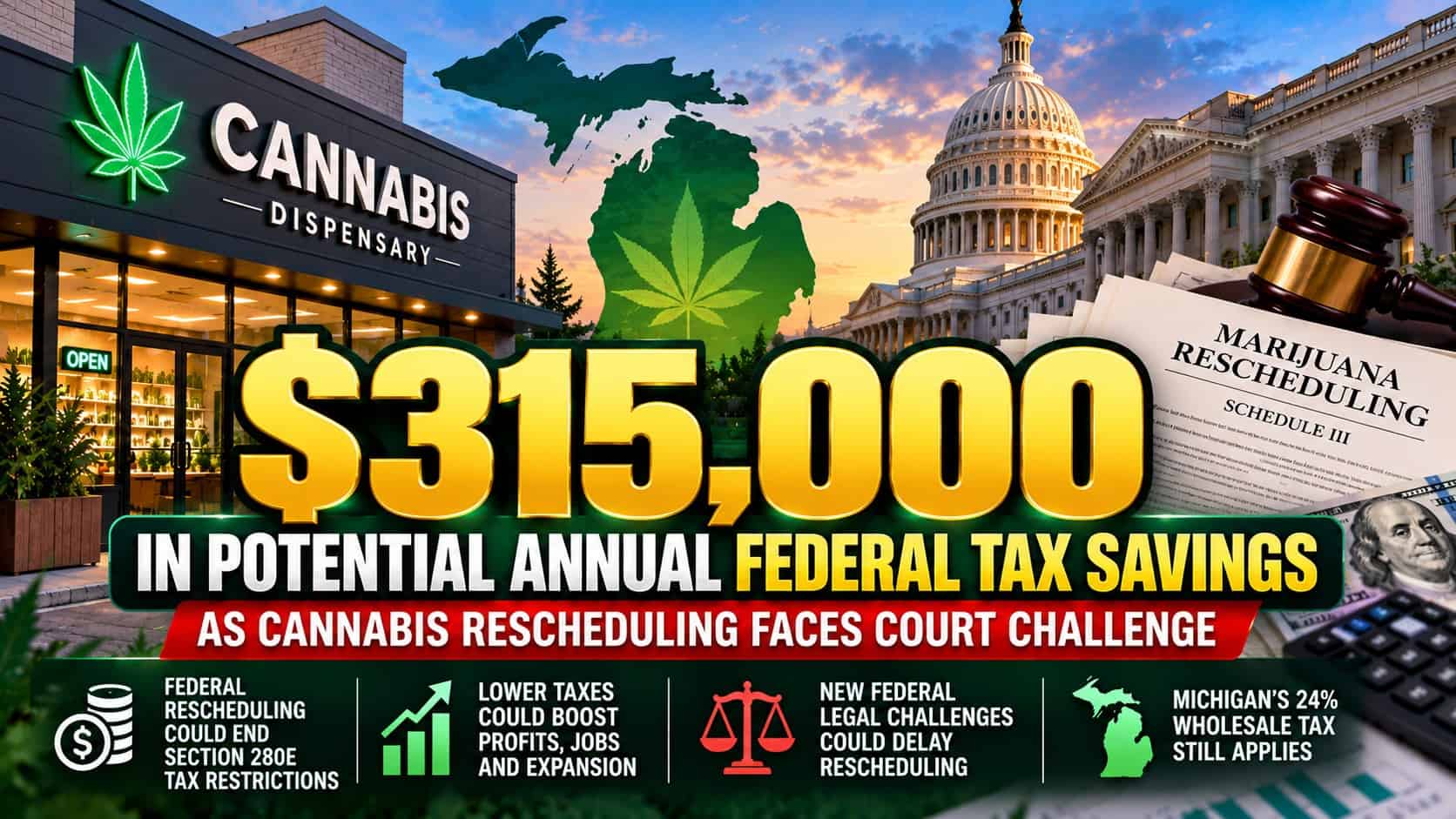
The state’s new 24% wholesale marijuana tax took effect Jan. 1, adding another cost to an industry already struggling with compressed margins and intense competition.
That creates an additional challenge.
Michigan retailers need attractive prices to compete for consumers.
Growers, processors and retailers also need sufficient margins to remain financially viable.
Ohio currently sits on the other side of that equation.
Its consumers pay considerably more while fewer marijuana businesses compete for their dollars.
Whether that continues depends partly on how aggressively Ohio expands cultivation and retail licensing.
Two States, Two Cannabis Experiments
Michigan and Ohio have inadvertently created one of the Midwest’s most interesting marijuana-market experiments.
Michigan shows what happens when cannabis becomes plentiful and retail competition becomes intense:
Consumers get extremely inexpensive marijuana. Businesses fight over shrinking margins.
Ohio shows what happens when a recreational market expands under tighter licensing constraints:
Consumers pay more. Businesses face less competition.
But Ohio sales are rising rapidly.
And Ohio prices are falling.
That’s why the most important number for Michigan may not be Ohio’s $1.67 billion in cumulative recreational sales.
It’s the price on an Ohio dispensary shelf.
As long as an eighth costs roughly $35 in Ohio and $20 in Monroe, Michigan maintains a powerful economic advantage.
If that gap shrinks substantially, the equation changes.
And nowhere will that change be felt more quickly than Monroe, where Ohio residents historically have accounted for roughly half of dispensary customers.
Michigan won the first round of the cannabis price war.
The question now is whether Ohio is beginning to catch up.