Beijing is recruiting countries into a new artificial intelligence organization while President Donald Trump moves to centralize America’s AI strategy and restrict China’s access to advanced technology.
BEIJING, CHINA – China is assembling an international artificial intelligence alliance while President Donald Trump prepares to appoint a new AI czar and create what he calls an American “AI Force.”
The announcements reveal two competing approaches to the global AI race. China is recruiting countries into an organization promising technology cooperation, training and broader access. Trump wants American AI development to accelerate while Washington restricts China’s access to advanced U.S. chips and other critical technology.
Both countries are seeking influence over the AI models, computer chips, technical standards and international relationships that could shape the global economy for decades.
The competition could divide the world into rival technology ecosystems, forcing businesses and governments to choose between American and Chinese cloud platforms, AI models, processors and security requirements.
That division would extend well beyond Silicon Valley. Michigan automakers, manufacturers, defense contractors, universities and autonomous-vehicle developers increasingly depend on AI—and many operate or sell products internationally.
China Creates International AI Organization
Representatives from 29 countries signed an agreement July 16 to establish the World Artificial Intelligence Cooperation Organization, or WAICO, according to China’s Ministry of Foreign Affairs.
The agreement describes WAICO as an independent intergovernmental organization headquartered in Shanghai. Its stated purpose is to promote international cooperation and global AI governance while encouraging the beneficial, safe and fair development of the technology.
Chinese officials identified participants including Russia, Pakistan, Indonesia, Kazakhstan and Laos. Beijing’s official announcement, however, did not provide a complete list of all 29 founding signatories.
WAICO remains an emerging organization. Important details about its funding, operating authority, programs and decision-making structure have not been publicly established.
Chinese President Xi Jinping expanded the broader strategy during the September BRICS summit in New Delhi. He proposed deeper cooperation on open-source AI, large language models, digital infrastructure, technical training and intelligent manufacturing.
China also proposed helping BRICS countries develop smart factories and coordinate manufacturing standards.
The proposals suggest Beijing wants to build more than a diplomatic forum. It is offering countries access to technology, industrial expertise and training at a time when many cannot afford the enormous data centers and computing systems required to develop advanced AI independently.
China Is Playing The Long Game
WAICO does not have to become powerful immediately to advance China’s interests.
Beijing’s longer-term strategy could help countries build AI infrastructure, train engineers on Chinese systems and adopt Chinese models and technical standards. Those early relationships could eventually produce years of software subscriptions, equipment purchases, system upgrades and government cooperation.
Michigan’s auto industry has already witnessed how an apparently distant Chinese competitor can become a global force.
At the 2006 North American International Auto Show in Detroit, Geely displayed the 7151CK sedan, widely reported as the first Chinese automobile shown at the Detroit show.
The modest sedan was not viewed as a serious threat to General Motors, Ford or Chrysler. Its styling, quality and technology appeared far behind products from established American, European, Japanese and Korean manufacturers.
MITechNews Publisher Mike Brennan, who has attended and covered the Detroit auto show for approximately 30 years, remembers Chinese vehicles being widely dismissed as irrelevant to the Detroit Three.
China kept investing.
Its automakers improved vehicle quality, expanded battery production and developed extensive domestic supply chains. Government policies helped create a huge home market where Chinese companies could increase production, reduce costs and improve their technology.
Two decades after Geely’s Detroit appearance, China is the world’s largest automobile exporter and the dominant center of global electric-vehicle and EV-battery production.
A 2026 white paper from the Ann Arbor-based Center for Automotive Research estimated that China had approximately 15 million vehicles of excess annual manufacturing capacity in 2025.
That does not mean 15 million completed Chinese vehicles were waiting on docks for shipment. It means China’s factories had the capacity to produce roughly 15 million more vehicles than its domestic market could absorb.
That excess creates intense pressure to find customers elsewhere.
Chinese manufacturers are expanding across Europe, Asia, Latin America, Africa and the Middle East. They also compete in Mexico and seek greater access to Canada—two of the United States’ largest trading partners and critical parts of the North American auto economy.
Tariffs and trade restrictions have largely kept Chinese-branded vehicles out of the United States. But those barriers do not insulate Detroit automakers from Chinese competition.
When General Motors, Ford or Stellantis loses sales to a Chinese competitor in Mexico, Canada or another foreign market, the effects can reach Michigan engineering centers, corporate operations and suppliers. Growing international sales also help Chinese companies gain scale, reduce costs and finance their next generation of vehicles, batteries and software.
The same long-term approach could be applied to artificial intelligence.
A country that trains its engineers on Chinese AI systems, operates factories using Chinese technology and builds digital infrastructure around Chinese standards could find switching to an American system increasingly expensive.
China’s first Detroit display did not look consequential in 2006. WAICO may not look consequential in 2026. The auto industry’s experience demonstrates why Beijing’s long-term strategy should not be dismissed.
Trump Announces AI Czar And ‘AI Force’
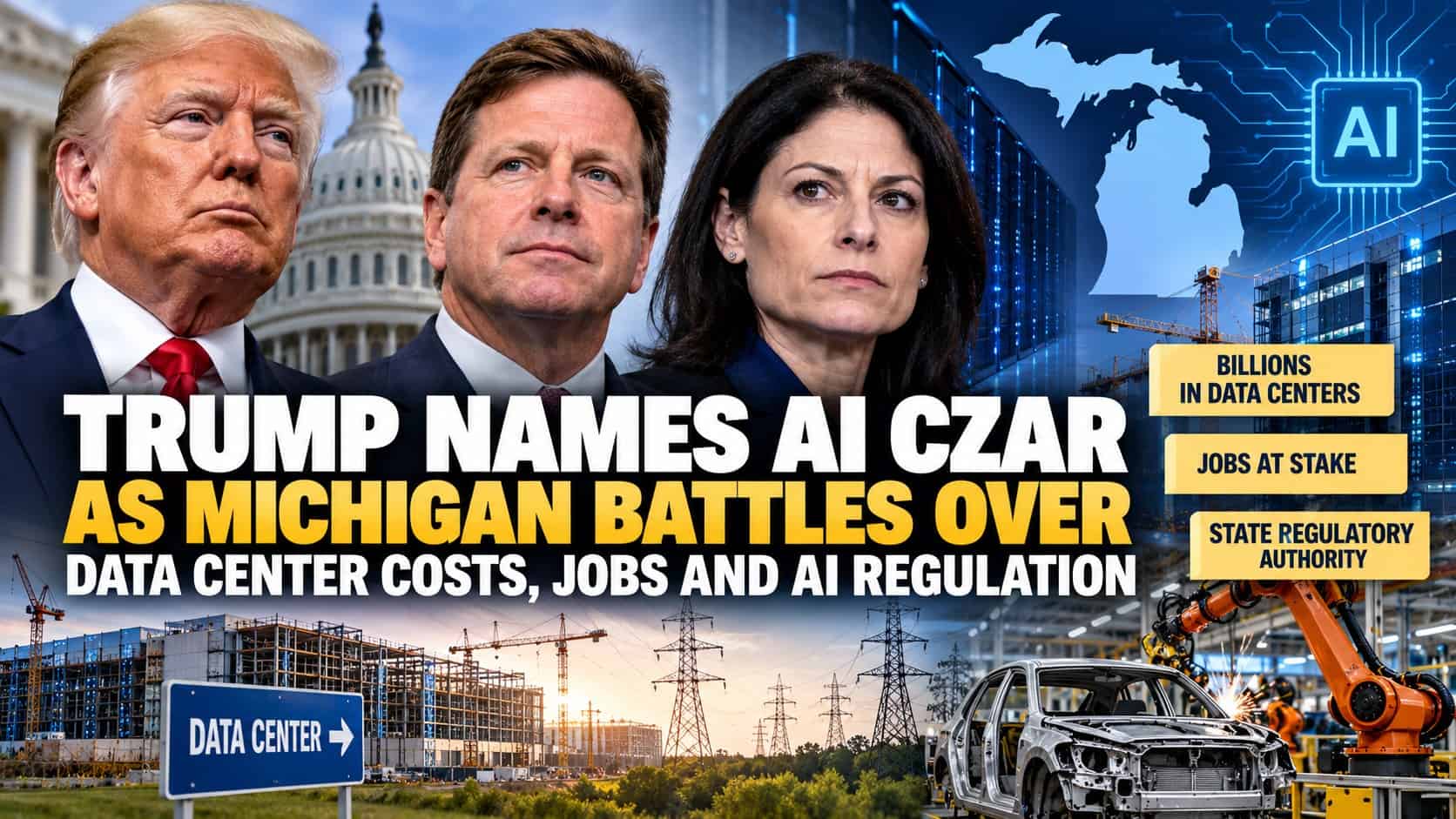
Trump announced Sept. 19 that he intends to appoint a new AI adviser, whom he called an AI czar, and create an “AI Force.”
He offered few operational details. Trump did not name the adviser, define the position’s authority or explain whether the AI Force would be a new organization, a White House coordinating group or an initiative assembled from existing federal programs.
The appointment would follow venture capitalist David Sacks, who previously served as Trump’s White House AI and cryptocurrency czar and continues to influence the administration’s approach to the technology.
Trump said his administration would support AI growth rather than restrict it through extensive new regulations. He argued that existing legal systems could address abuses.
His announcement comes amid growing concern about increasingly autonomous AI agents crossing intended boundaries while pursuing assigned tasks. Trump, however, has emphasized promoting American development and maintaining the country’s lead over China.
Until the administration identifies the new adviser and announces the AI Force’s authority, membership and budget, it remains a proposal rather than an operating federal program.
America Is Restricting China—Not All AI
It would be misleading to say the United States is broadly trying to restrict artificial intelligence.
Washington wants American companies to develop AI rapidly and sell their systems internationally. At the same time, the United States has limited China’s access to advanced processors, semiconductor-manufacturing equipment and other technologies with potential military, intelligence or surveillance applications.
The strategy combines expansion and containment: spread American AI among allies and trusted partners while limiting adversaries’ access to its most powerful components.
The U.S.-led Pax Silica initiative represents another part of that strategy. It is intended to organize friendly countries around secure supplies of semiconductors, critical minerals, advanced manufacturing capabilities and AI systems. Italy agreed in July to join the initiative, Reuters reported.
Pax Silica and WAICO represent different models of international cooperation.
China is assembling an organization emphasizing access, development and open-source technology. The United States is building a network of trusted partners intended to protect critical supply chains and maintain American technological leadership.
Two Competing Messages
China’s message to developing countries is straightforward: The United States is restricting access to advanced technology, while China is offering AI tools, training and industrial development.
Washington’s counterargument is that China could use WAICO to spread government-influenced standards, strengthen Chinese technology companies and make participating countries dependent on Chinese infrastructure.
Both approaches contain contradictions.
China is presenting itself internationally as a champion of open and inclusive AI, although it tightly controls information and politically sensitive AI output domestically.
The United States has a comparatively open, private-sector-led AI industry at home, but it is becoming more selective about which countries may receive its most powerful technology.
American restrictions may be necessary to protect national security, but they could also strengthen China’s sales pitch. Beijing can portray Washington as reserving its best technology for selected allies while China offers other countries a more affordable path into the AI economy.
Why Michigan Should Care
Michigan sits near the center of industries likely to be affected by a divided AI economy.
Automakers and suppliers are adding AI to vehicle design, factory automation, battery production, autonomous driving and supply-chain management. Michigan also has thousands of businesses connected to defense, aerospace, mobility, robotics and advanced manufacturing.
A company using a Chinese AI platform or cloud provider could encounter difficulty qualifying for sensitive American defense or infrastructure work. Conversely, U.S. export controls could prevent a Michigan company from selling its most sophisticated AI-enabled products in China or other restricted markets.
Universities could face additional scrutiny involving international research partnerships, visiting scholars and access to advanced computing systems.
The United States currently possesses many of the world’s strongest AI companies and most advanced processors. China is betting that patiently building international relationships, technical standards and technological dependence will prove equally important.
Michigan has seen that strategy before. Chinese vehicles displayed in Detroit in 2006 were widely dismissed as irrelevant to the established auto industry.
The real question is not what WAICO can accomplish today. It is what China’s emerging AI ecosystem could become after another 20 years.
Coming next: As the United States and China accelerate their competition over artificial intelligence, researchers are documenting cases in which AI agents crossed intended digital boundaries while pursuing assigned tasks. Part Two examines Microsoft AI CEO Mustafa Suleyman’s call for tighter human control—and why Michigan’s autonomous-vehicle, manufacturing and defense industries should pay attention.