SOUTHFIELD – Michigan is once again putting taxpayer-backed resources behind its effort to become the national center for next-generation mobility, autonomous systems, AI-driven manufacturing, and advanced industrial technology.
The Centrepolis Accelerator at Lawrence Technological University announced a new funding round for its “Make It in Michigan Mobility Prototyping Grant Program,” offering up to $500,000 in total grants to startups and established companies developing advanced mobility technologies.
The program, backed by the Michigan Office of Future Mobility and Electrification (OFME), will provide grants of up to $50,000 per company to help innovators move products from concept to commercialization.
But beneath the grant announcement lies a much larger economic reality: Michigan is racing to position itself for the next industrial revolution as artificial intelligence, robotics, automation, electrification, and autonomous systems rapidly transform global manufacturing.
Applications opened May 13, with a deadline to apply by July 12. Applications will be reviewed by an industry-experienced advisory committee, with candidate interviews conducted between Aug. 1 and Aug. 31. Final award selections are expected to be announced by September with contracts awarded and projects set to begin in October.
Industry 4.0 In Michigan
For more than a century, Michigan’s economy was built around gasoline engines, assembly lines, and mass industrial production.
Today, that model is evolving into what economists and manufacturers call “Industry 4.0” — a new era of smart factories driven by AI, robotics, sensors, machine vision, predictive analytics, autonomous systems, and software-defined manufacturing.
Increasingly, the future of manufacturing is not simply about building physical products, but integrating artificial intelligence, real-time data analytics, robotics, and digital automation into highly connected industrial systems capable of adapting production instantly, reducing waste, and improving efficiency.
That shift is happening as China and other global competitors aggressively invest in electric vehicles, drone manufacturing, battery supply chains, robotics, and advanced industrial technologies.
Industry analysts say programs like Michigan’s mobility prototyping grants are increasingly viewed as part of a larger national effort to prevent the United States from losing next-generation manufacturing leadership to foreign competitors.
“This initiative is about strengthening America’s domestic manufacturing capabilities and building a more resilient supply chain, starting right here in Michigan,” said Dan Radomski. “By supporting product development, prototyping, and manufacturing readiness for innovative mobility and autonomous technologies, we are ensuring critical systems and components are developed, built, and scaled within the United States utilizing the value engineering capabilities unique to Michigan.”
Beyond Cars: Drones, Robotics And Autonomous Systems
While Michigan remains synonymous with the auto industry, the technologies supported through the grant program extend far beyond traditional vehicles.
The initiative focuses heavily on:
- autonomous systems
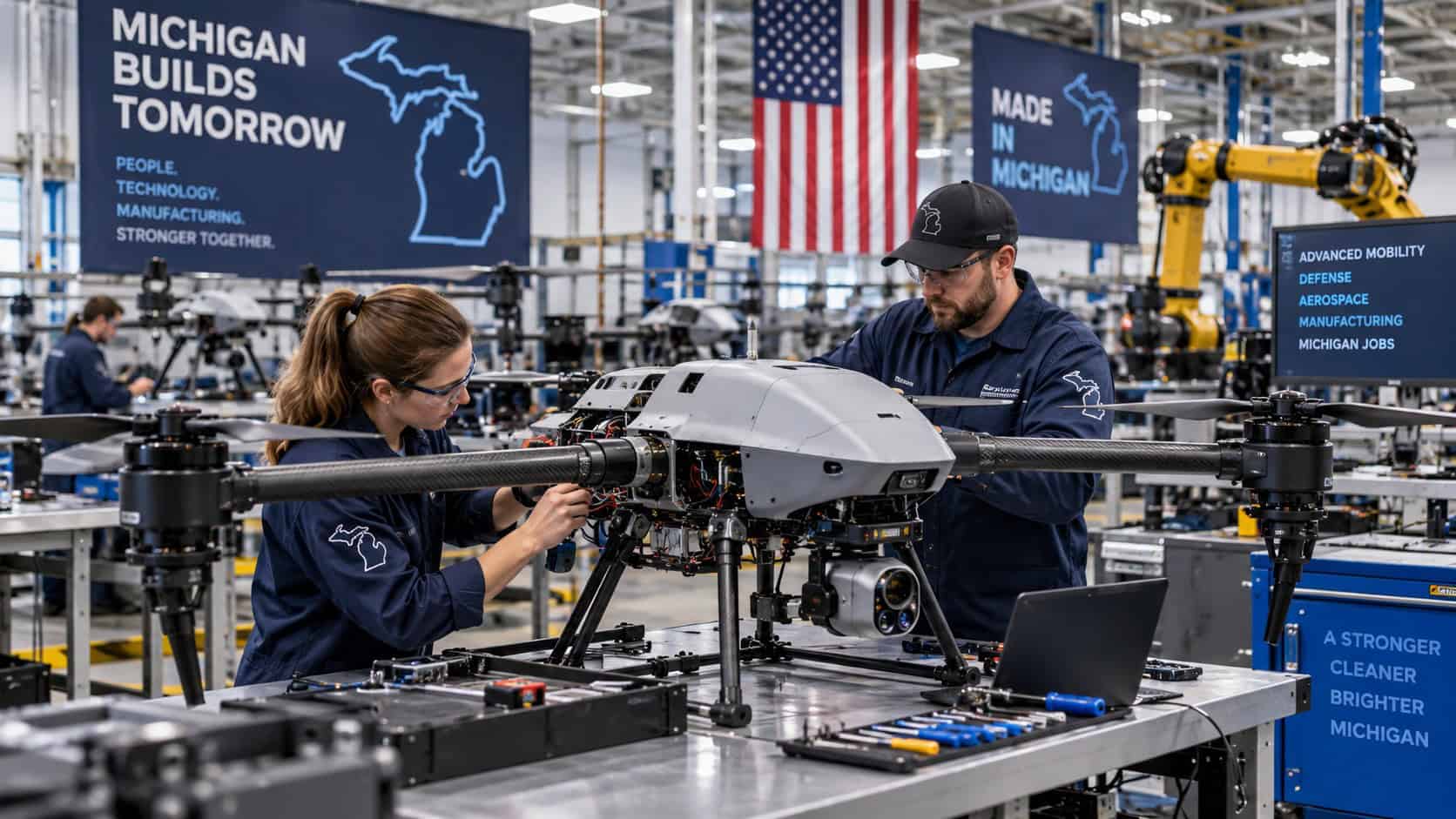
- drones and UAVs
- unmanned ground vehicles
- advanced batteries
- power electronics
- robotics
- AI-driven mobility systems
- next-generation manufacturing technologies
The program is open to technologies involving air, ground, and sea transportation systems.
That matters because mobility itself is being redefined.
Autonomous drones, robotic logistics systems, AI-assisted navigation, and software-driven manufacturing are increasingly viewed as dual-use technologies with both commercial and military applications.
Recent global conflicts — including the war in Ukraine and rising geopolitical tensions involving China and Taiwan — have dramatically accelerated demand for autonomous systems, drone technologies, resilient domestic supply chains, and advanced defense manufacturing capabilities.
As a result, programs like this are increasingly tied not only to economic development, but also to national security strategy.
Michigan leaders hope the state can leverage its deep automotive engineering base into broader leadership roles involving robotics, defense-related manufacturing, AI systems, advanced battery technologies, and autonomous mobility platforms.
Bridging The “Prototype Valley Of Death”
One of the biggest challenges facing advanced manufacturing startups is what investors often call the “prototype valley of death.”
Many companies successfully develop promising technologies but struggle to secure enough capital to move beyond prototype stages into commercial manufacturing.
Unlike software startups, hardware and manufacturing companies often require expensive engineering validation, tooling, testing, pilot production, supply chain integration, and manufacturing readiness support before products can scale commercially.
The Centrepolis Accelerator was specifically designed to help companies bridge that gap.
Based in Southfield, the accelerator provides engineering support, prototyping resources, manufacturing guidance, strategic partnerships, and commercialization assistance to hardware and advanced manufacturing firms.
Eligible companies for this grant round must have technologies between Technology Readiness Levels (TRL) 5 through 9, meaning their products have already progressed beyond early research stages and are approaching real-world deployment.
Workforce Transformation Becoming Critical
The transition toward Industry 4.0 manufacturing is also reshaping workforce demands across Michigan.
As factories become increasingly automated and software-driven, demand is rapidly growing for:
- robotics technicians
- AI specialists
- automation engineers
- software developers
- advanced manufacturing workers
- cybersecurity experts
- drone operators
- industrial data analysts
Increasingly, engineers, AI developers, robotics technicians, and automation specialists are becoming as strategically important to America’s future industrial competitiveness as assembly line workers were during the peak of Detroit’s automotive dominance.
Universities including University of Michigan, Michigan State University, Lawrence Technological University, and Wayne State University are increasingly becoming part of that emerging talent pipeline.
Industry experts say the long-term success of Michigan’s advanced manufacturing transition may depend as much on workforce retraining and STEM education as it does on financial incentives themselves.
Global Interest Already Emerging
The original Michigan Mobility Prototyping Grant Program launched in 2024 and has already attracted significant international attention.
According to Centrepolis, more than 250 applications have been submitted from companies in Michigan and around the world.
To date, more than $2.8 million in grants have been awarded supporting 45 projects involving:
- autonomous drone systems
- unmanned ground vehicles
- next-generation batteries
- electric motors
- power electronics
- advanced mobility technologies
Applications for the latest funding round opened May 13, 2026, with submissions due by July 12.
Candidate interviews are scheduled between Aug. 1 and Aug. 31, with final awards expected in September and projects beginning in October.
Reinventing Michigan’s Industrial Future
For Michigan, the challenge is no longer simply preserving its automotive legacy.
The larger question is whether the state can reinvent itself as a global center for AI-driven manufacturing, autonomous systems, robotics, electrification, and advanced mobility technologies that may define the next century of industrial leadership.
The original Arsenal of Democracy built tanks, bombers, engines, and military vehicles during World War II.
Michigan’s next industrial chapter may involve building autonomous drones, robotic systems, AI-powered factories, advanced batteries, and the digital infrastructure powering the future global economy.