Michigan’s statewide labor force is down 124,000 from a year ago as West Michigan growth slows and tariffs, oil prices and uncertainty squeeze businesses
GRAND RAPIDS – Michigan’s workforce is shrinking — and the problem stretches across nearly the entire state.
Seventeen of Michigan’s 18 regional labor markets reported smaller workforces in June than a year earlier, according to the latest state employment report. Metro Detroit was the lone exception.
Statewide, Michigan’s seasonally adjusted labor force declined by 124,000 people, or 2.5 percent, over the past year, while the state’s labor-force participation rate fell to 59.5 percent.
The numbers raise an increasingly important question for Michigan’s economy:
Where will the workers come from to fill the jobs the state is trying to create?
Michigan is simultaneously trying to expand advanced manufacturing, attract billions of dollars of data-center investment, increase defense production and build larger technology, artificial intelligence and aerospace industries.
But those ambitions require workers.
At the same time, the freshest reading on Michigan business conditions provides another warning.
West Michigan’s industrial economy continued growing in July, according to a new Grand Valley State University survey, but new orders, production and especially employment slowed sharply from June.
“July was another good, but not exceptional, month for the West Michigan Industrial economy,” said Brian Long, director of supply management research at GVSU’s Seidman College of Business. “Again, we need to keep an eye on business confidence.”
Long said West Michigan companies are benefiting from increased demand from data centers, but tariffs, higher oil prices and uncertainty surrounding the Iran war are pushing costs higher.
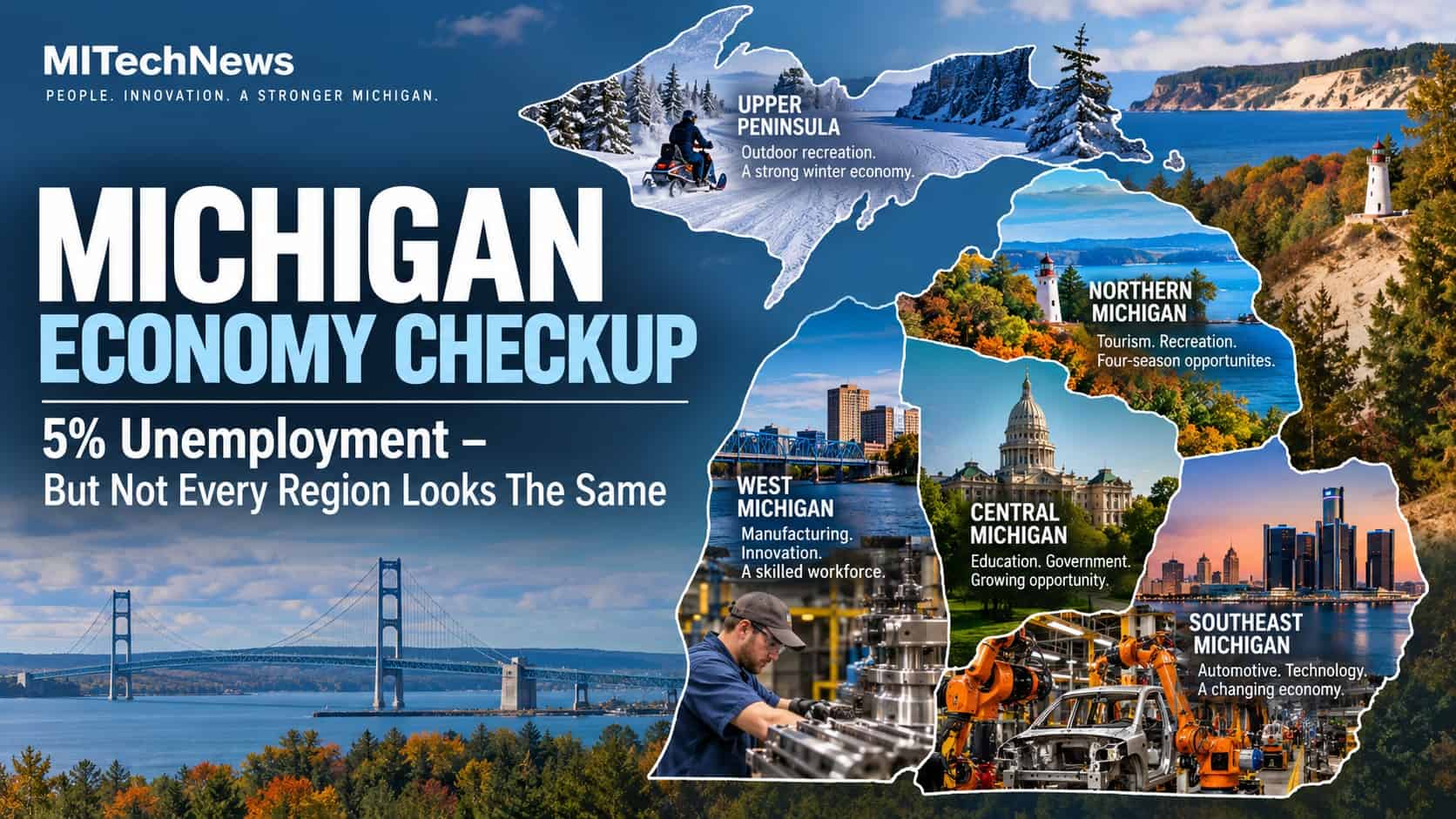
Taken together, the numbers in MITechNews’ latest regional economic report show an economy that isn’t collapsing, but one facing growing constraints — with conditions varying considerably depending on where in Michigan you look.
Michigan Regional Economy Scorecard
|
|
|
|---|---|---|
|
|
|
|
|
|
|
|
|
|
|
|
|
|
|
The important question isn’t simply whether unemployment is rising or falling.
It’s whether Michigan has enough workers to support economic growth.
What Does A Smaller Labor Force Mean?
The labor-force numbers require an important explanation.
They don’t necessarily mean all of those people left Michigan or lost their jobs.
The labor force consists of people who are either employed or unemployed and actively looking for work.
Someone who retires, moves away or stops searching for a job leaves the labor force. That person is no longer counted as unemployed.
Consequently, a region can report both declining employment and a shrinking labor force while simultaneously posting a lower unemployment rate.
That’s happening in several parts of Michigan.
It’s also why the unemployment rate alone doesn’t tell the state’s economic story.
West Michigan: Growth Continues, But Hiring Slows
The newest economic reading comes from West Michigan, where Grand Valley State University surveys supply chain managers every month.
The region remains in growth territory.
But July was considerably weaker than June.
New orders, GVSU’s measure of business improvement, fell to +30 from +49 in June.
Production declined to +19 from +35.
Most important for workers, the employment index dropped to +6 from +25.
Lead times were the exception, edging higher to +28 from +27.
All the major growth indicators remain positive, meaning the survey isn’t signaling contraction.
But the direction changed noticeably.
That becomes more significant when viewed against the trend MITechNews has been following throughout 2026.
West Michigan entered the year soft. Growth began returning in February. The industrial economy then expanded for several consecutive months before June produced one of its strongest readings in roughly five years.
July now looks less like the beginning of a boom and more like a return toward moderate growth.
Data Centers Are Creating Michigan Manufacturing Demand
One of the more surprising findings in Long’s latest survey involves data centers.
Several West Michigan companies reported strong sales, with some respondents attributing increased demand to data-center construction.
That’s important because Michigan’s data-center debate has focused largely on electricity consumption, utility rates, water, tax incentives and the relatively small number of permanent employees required once a hyperscale facility is operating.
Construction tells another story.
Data centers require transformers, switchgear, generators, cooling equipment, electrical systems, steel, concrete and numerous other manufactured products.
Some of that spending is apparently already flowing through Michigan’s industrial supply chain.
That potentially makes the data-center boom a manufacturing story as well as an energy story.
But companies benefiting from those orders are simultaneously confronting higher costs.
Tariffs And Oil Prices Squeeze Michigan Businesses
Long said price pressures are becoming increasingly difficult for West Michigan companies to absorb.
“This past month, we did not have a single survey participant reporting lower prices, but way over half of the participants are buried under higher prices that they are having difficulty negotiating,” Long said.
“Tariffs are, of course, part of the problem, and higher oil prices drive a myriad of costs higher. Almost all the participants are still hanging on, but this can’t last forever.”
Higher oil prices ripple through Michigan manufacturing far beyond gasoline.
They increase diesel and freight costs along with the cost of plastics, chemicals, lubricants, packaging and other petroleum-derived products.
The Iran war creates another layer of uncertainty because companies don’t know how long elevated energy prices or potential supply-chain disruptions will persist.
For employers, uncertainty can mean delayed investment, postponed expansion and greater reluctance to hire.
That makes the drop in GVSU’s employment index from +25 to +6 particularly important to watch.
Southeast Michigan: The Statewide Exception
Metro Detroit is moving in the opposite direction.
The Detroit-Warren-Dearborn metropolitan area’s labor force increased by approximately 35,000 people, or 1.6 percent, from a year earlier.
Employment increased by about 21,000.
But unemployment increased by approximately 14,000.
As a result, the Detroit area’s unemployment rate rose to 5.4 percent from 4.8 percent a year earlier.
That produces an unusual combination:
Metro Detroit has more employed people — and more unemployed people — than it did a year ago.
From a longer-term perspective, its expanding labor force could become an advantage.
Employers have a growing pool of potential workers.
The immediate problem is that employment hasn’t increased quickly enough to absorb everyone entering or returning to the workforce.
Manufacturing remains Southeast Michigan’s major vulnerability.
Metro Detroit’s dependence on automobiles and suppliers puts the region directly in the path of tariffs, changing vehicle demand and the auto industry’s technological transformation.
Whether Detroit can turn its expanding workforce into stronger employment growth will be one of the most important regional trends to watch through the remainder of 2026.
Central Michigan: Some Of The Biggest Declines
Central Michigan contains some of the most troubling numbers in the latest regional report.
Midland’s labor force was approximately 9.2 percent smaller than a year earlier, the largest percentage decline among Michigan’s regional labor markets.
Employment was also down approximately 9 percent.
Lansing-East Lansing showed another warning.
Employment fell approximately 2.9 percent from May to June, while the region’s labor force was substantially smaller than a year earlier.
Yet Lansing’s unemployment rate declined from its year-earlier level.
That apparent contradiction illustrates why unemployment rates must be viewed alongside employment and labor-force data.
Fewer unemployed people sounds positive.
A substantially smaller workforce is a different economic signal.
Northern Michigan: Low Unemployment Doesn’t Tell The Whole Story
Traverse City’s unemployment rate fell to approximately 3.8 percent in June, among Michigan’s lowest.
The region also received its normal summer employment boost, with Traverse City posting one of Michigan’s strongest monthly increases in payroll employment.
At first glance, Northern Michigan appears to be booming.
The year-over-year numbers tell a more complicated story.
Traverse City’s labor force was approximately 8.3 percent smaller than a year earlier.
Across Northwest Lower Michigan, the labor force was down approximately 8.4 percent.
For employers, that’s potentially a bigger long-term concern than temporarily elevated unemployment.
Northern Michigan already faces an aging population, housing affordability challenges and heavy seasonal demand for employees.
Restaurants, resorts, hospitals, manufacturers, construction companies and other businesses can’t expand without enough workers.
A 3.8 percent unemployment rate therefore can signal both a tight labor market and a shortage of available workers.
Upper Peninsula: Unemployment Falls As Workforce Shrinks
The Upper Peninsula shows a similar pattern.
The UP unemployment rate fell to approximately 5.2 percent in June from 6.1 percent a year earlier.
Normally, that would be an encouraging economic headline.
But the region’s labor force declined approximately 7.2 percent year over year, while employment was down approximately 6.3 percent.
Again, fewer unemployed workers doesn’t necessarily mean a stronger economy.
The UP faces an especially difficult demographic challenge because its communities are spread across a large geographic area and younger residents frequently leave for education or employment elsewhere.
For businesses hoping to expand in the region, worker availability could increasingly become as important as customer demand.
Why Is Michigan’s Workforce Shrinking?
The numbers tell us that Michigan’s labor force has contracted.
They don’t, by themselves, tell us precisely why.
Retirement likely accounts for some of the decline as Michigan’s population ages.
Migration may play a role.
Other people may have stopped actively searching for employment and therefore are no longer counted in the labor force.
Longer-term demographic trends could also mean fewer younger workers are entering the workforce to replace retiring Baby Boomers.
Determining how much each factor contributes requires additional demographic and migration data.
But the economic consequence is easier to identify.
A smaller labor pool makes economic expansion harder.
Michigan Wants More Jobs. Who Will Fill Them?
Michigan is simultaneously pursuing several major economic-development goals.
The state wants to remain the center of North American automotive manufacturing.
It wants more advanced-manufacturing and semiconductor investment.
Billions of dollars of data centers are being proposed.
Michigan hopes to capture increased federal defense spending and potentially revive part of its historic Arsenal of Democracy role.
Economic-development officials also want Michigan to become a bigger player in artificial intelligence, aerospace, mobility and other emerging industries.
Every one of those strategies eventually runs into the same question:
Where will the workers come from?
Companies can build factories.
Governments can approve incentives.
Utilities can build power plants and transmission lines.
Universities can develop new technologies.
But economic growth ultimately requires people to design, build, operate and maintain those businesses.
That’s why the shrinking labor force may ultimately matter more to Michigan’s economic future than a one-month change in the unemployment rate.
Jobs Become The Number To Watch
West Michigan’s latest GVSU survey reinforces that concern.
Its employment index fell from +25 to +6 in one month.
Metro Detroit is adding workers, but employment isn’t growing quickly enough to absorb everyone entering its labor market.
Central Michigan is reporting significant declines in employment and workforce participation.
Northern Michigan and the Upper Peninsula have substantially smaller labor forces than they did a year ago.
None of those indicators individually says Michigan is headed toward recession.
Together, however, they suggest the availability of workers could increasingly become a brake on economic growth.
Michigan Isn’t One Economy
That’s the pattern emerging from MITechNews’ regional economic reports throughout 2026.
There isn’t one Michigan economy.
West Michigan can continue expanding while growth slows.
Metro Detroit can add employed workers while unemployment rises.
Traverse City can report unemployment below 4 percent while its labor force shrinks.
Lansing can report lower unemployment while employment declines.
And the Upper Peninsula can show improving unemployment while having fewer people participating in its labor market.
That’s why looking at Michigan region by region provides a different picture than simply reporting the statewide unemployment rate.
And after tracking these regions throughout the year, another advantage is emerging.
A single month’s economic report provides a snapshot.
Six months of regional reports begin to reveal a trend.
For the remainder of 2026, the numbers to watch are increasingly clear: jobs, labor-force participation, manufacturing orders, business confidence, tariffs and energy prices.
The freshest signal comes from West Michigan.
Business is still growing.
But growth slowed sharply in July.
And Long’s warning about businesses absorbing higher costs may apply well beyond West Michigan:
“Almost all the participants are still hanging on, but this can’t last forever.”