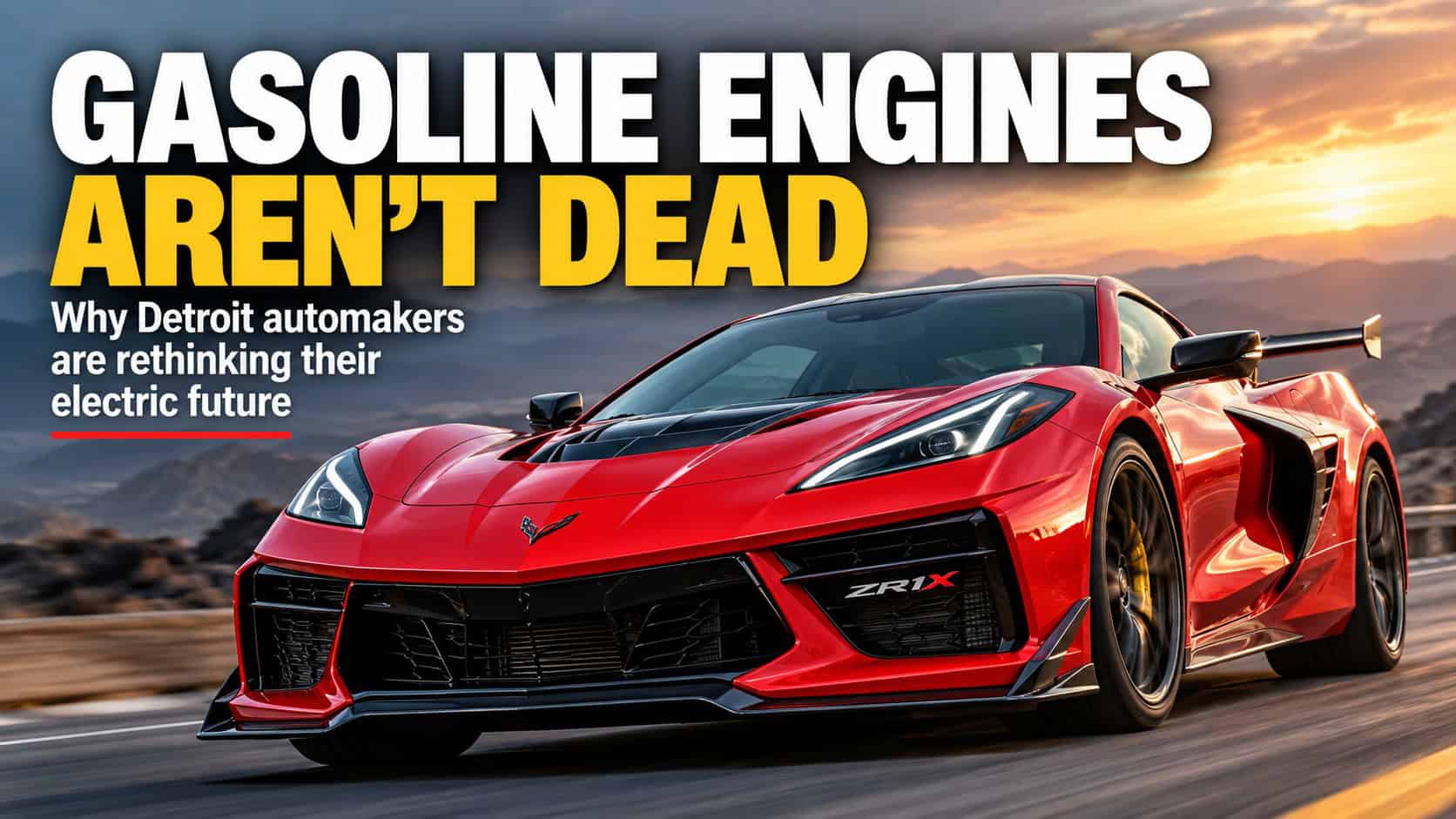
DETROIT – General Motors is pouring more than $6 billion into U.S. manufacturing in just 12 months, a massive capital commitment that underscores a growing reality inside the auto industry: the transition to electric vehicles isn’t happening as fast as expected.
The latest piece of that investment—about $830 million across key Midwest plants—is aimed squarely at boosting production of gas-powered engines, transmissions, and propulsion systems used in GM’s most profitable vehicles: full-size trucks and SUVs.
That’s not just a routine upgrade. It’s a strategic pivot—with major implications for Michigan jobs, wages, and the future of the auto industry.
What GM Actually Announced
GM’s latest round of spending targets three core facilities:
- Romulus, Michigan – expanding 10-speed transmission production
- Saginaw, Michigan – increasing V-8 engine casting capacity
- Toledo, Ohio – boosting propulsion system output
These upgrades are designed to support the next generation of internal combustion vehicles, particularly trucks and SUVs that continue to generate the bulk of GM’s profits.
Zoom out, and the picture becomes clearer: GM has now committed more than $6 billion to U.S. plants in a single year, one of the most aggressive domestic manufacturing pushes in decades.
Michigan: Jobs First, Growth Second
For Michigan, this investment is less about flashy expansion—and more about protecting the economic backbone of the state.
GM did not disclose how many new jobs will be created, but the employment impact could still be significant.
The Romulus propulsion plant alone employs about 1,000 workers, and the broader investment across Romulus and Saginaw is expected to secure well over 1,200 to 1,800 existing jobs tied to engine and transmission production.
New hiring is likely—but measured.
A conservative estimate suggests:
- 150 to 400 new direct GM jobs over the next 1–3 years
- 300 to 900 additional jobs supported across suppliers and related industries
That includes machining, logistics, tooling, maintenance, and component manufacturing—jobs that ripple across Michigan’s industrial base.
These Are High-Paying Jobs
This is where the story gets real for readers.
These are not low-wage positions—they are some of the strongest middle-class jobs left in the U.S. economy.
- Production workers: roughly $70,000 to $90,000+ annually with overtime
- Skilled trades: often $90,000 to $110,000+
- Engineers/technical roles: frequently $100,000+
Federal labor data shows auto manufacturing workers averaging around $40 per hour nationally, while union contracts are pushing top-tier wages even higher.
In short:
This investment isn’t just about machines—it’s about sustaining Michigan’s middle class.
The Real Story: EV Transition Hits a Speed Bump
Here’s what’s really driving this move.
Electric vehicle demand has cooled—faster than automakers expected.
- EV sales growth has slowed
- Some models are underperforming
- Consumer adoption remains uneven
- Pricing and charging infrastructure remain barriers
GM, like much of the industry, is adjusting in real time.
Instead of going all-in on EVs immediately, the company is doubling down on what works now: gas-powered trucks and SUVs that deliver strong margins and steady demand.
This isn’t a retreat. It’s a recalibration.
Back to the Alfred Sloan Playbook
There’s a deeper strategic shift happening—and it echoes GM’s past.
Under legendary leader Alfred P. Sloan, GM dominated the auto industry by balancing innovation with profitability and offering a wide range of vehicles rather than betting everything on one technology.
That same philosophy is resurfacing today.
GM is now:
- Continuing EV development
- While reinforcing its gas-powered lineup
- And investing heavily in U.S.-based manufacturing
Translation:
Don’t bet the company on a future that isn’t fully here yet.
A Broader Industry Reality Check
GM isn’t alone.
Across the auto industry, the same pattern is emerging:
- EV timelines are being pushed back
- Hybrid and gas vehicles are sticking around longer
- Capital is shifting back toward proven platforms
The early narrative of a rapid, all-electric transition has given way to something more complex:
A slower, more uneven evolution.
Even as billions continue to flow into EV development, automakers are quietly acknowledging that internal combustion engines will remain a critical part of the mix for years to come.
What Happens Next
GM’s strategy now looks like a dual-track approach.
Short term (next 3–5 years):
- Gas-powered vehicles dominate profits
- Manufacturing investments focus on existing platforms
- Michigan plants remain central to production
Long term:
- EV development continues—but with tighter cost discipline
- Investments become more targeted
- Profitability becomes as important as innovation
That’s a major shift from the earlier “all-electric by 2035” push.
GM’s $6 billion manufacturing surge isn’t just an investment story—it’s a reality check.
The company is:
- Protecting its most profitable vehicles
- Stabilizing thousands of high-paying Michigan jobs
- Creating selective new hiring opportunities
- And buying time for EV adoption to catch up
For Michigan, the message is clear:
The future may be electric—but for now, the engines of the economy are still running on gasoline.