ANN ARBOR -Artificial intelligence is rapidly reshaping Michigan’s economic outlook, but the debate in Lansing is no longer just about algorithms and productivity. It is increasingly about the massive physical infrastructure required to power AI — and whether the state is moving too fast to welcome it.
During recent legislative hearings and public discussions, lawmakers, economists, industry advocates and local officials have laid out sharply different views on the rapid expansion of AI data centers across Michigan. At stake are billions of dollars in investment, mounting pressure on the electric grid, and growing concern over water use, transparency and public trust.

A Historic Opportunity, Supporters Say
State leaders backing large-scale AI and data center development describe the moment as a once-in-a-generation economic opportunity.
Gov. Gretchen Whitmer has framed Michigan’s pursuit of hyperscale AI infrastructure as part of a broader strategy to reposition the state as a leader in next-generation industries. In announcing one of the state’s largest proposed AI-related developments, Whitmer said Michigan was competing — and winning — on a global stage.
“Today, we won the largest economic project in Michigan history,” Whitmer said in a public statement. “I’m grateful to these cutting-edge companies for betting on Michigan, building on our work to compete for and win big projects in next-generation industries from cars and clean energy to semiconductors and batteries.”
Industry advocates argue that AI data centers are not isolated projects, but foundational infrastructure that will support future innovation across manufacturing, health care, mobility and advanced research.
Dan Diorio, vice president of state policy for the Data Center Coalition, said recent policy changes have already positioned Michigan as an emerging player in the sector.
“The data center industry is now investing billions of dollars in Michigan, and the state is quickly becoming a growing data center market,” Diorio said, pointing to new tax and economic development programs designed to attract large-scale facilities.
Local economic development officials have echoed that view, emphasizing the strategic value of anchoring AI infrastructure in Michigan.
Phil Santer, chief operating officer of Ann Arbor SPARK, said large data centers could strengthen the state’s broader AI ecosystem. “A data center of this scale in our backyard just adds to our assets,” Santer said. “We’re thinking about where this can go toward an overall AI strategy for the state.”
Why AI Data Centers Matter
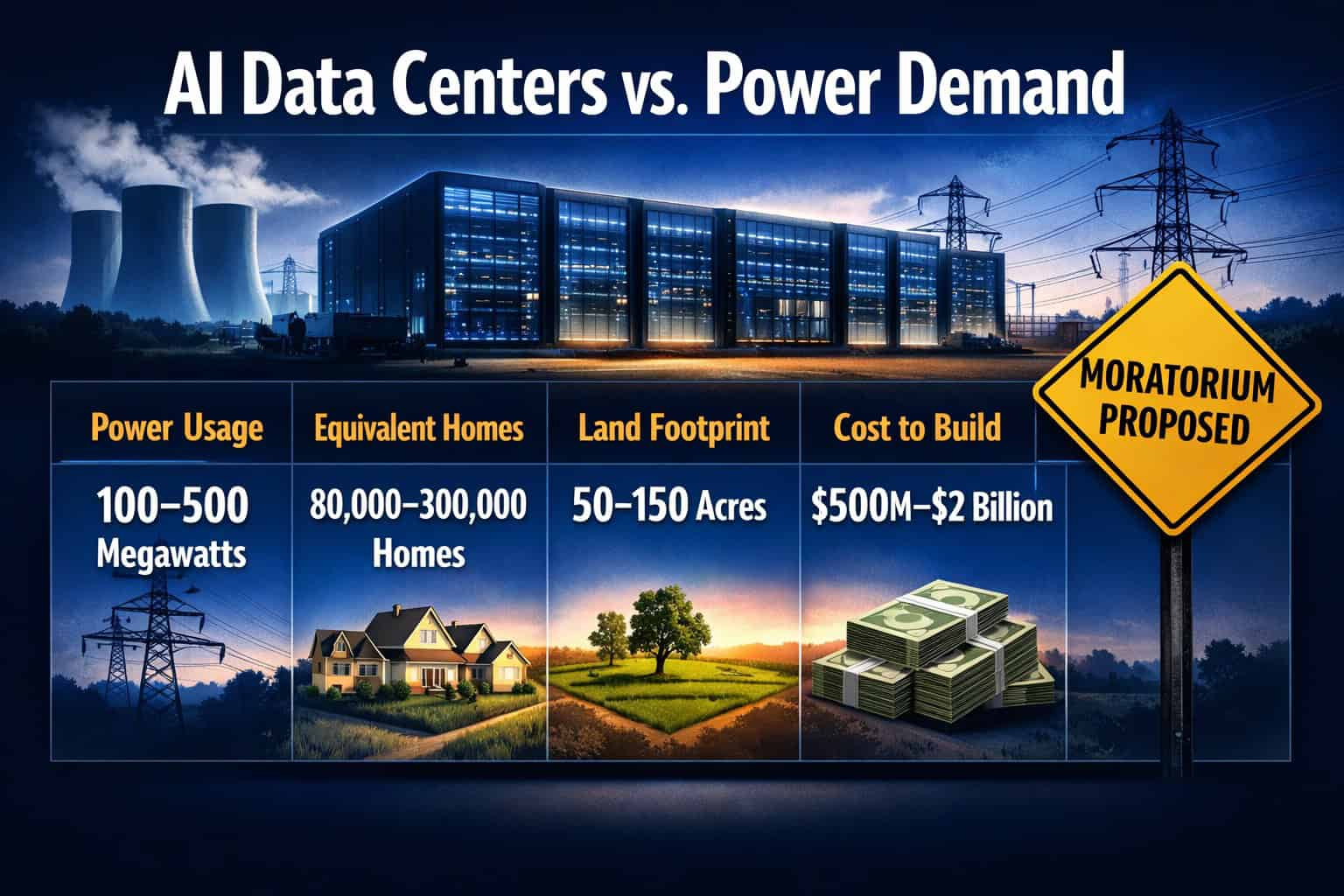
Behind the policy debate is a fundamental shift in how AI is built and deployed. Unlike traditional data centers that support websites or cloud storage, AI facilities must run dense clusters of high-performance processors around the clock. Training and operating advanced AI models requires enormous amounts of electricity and sophisticated cooling systems — making these facilities among the most energy-intensive users on the grid.
Economists testifying before lawmakers have said AI could significantly boost productivity over time, but warned that its benefits will not be automatic. Without careful planning, they said, infrastructure strain and workforce disruption could offset broader gains.
Nationally, investment in AI data centers has surged into the tens of billions of dollars, and economists have noted that spending on data centers and information processing has become a
major contributor to U.S. economic growth. Michigan’s industrial base, access to land and existing utility networks have made it an attractive target for that investment.
Rising Opposition and Environmental Concerns
As proposals accelerate, opposition has grown — particularly in communities near planned data center sites.
Michigan Secretary of State Jocelyn Benson, now a candidate for governor, has emerged as one of the most prominent critics, focusing on environmental risk and long-term costs.
“We welcome the technology support and the job creation that data centers and other new employers bring to Michigan,” Benson said, “but we cannot welcome them at the behest or the loss of what makes Michigan truly an incredible state, and that is our water.”
Environmental advocates and local residents have raised concerns about the sheer scale of power and water consumption required by hyperscale facilities, as well as the secrecy surrounding some early negotiations between utilities, developers and regulators.
Critics argue that while construction jobs are significant, long-term employment at data centers is limited — leaving communities with the environmental and infrastructure burden but fewer lasting economic benefits than promised.
Lawmakers Seek Guardrails
Those concerns have prompted several lawmakers to push for tighter oversight. Democratic legislators have introduced bills aimed at increasing transparency around energy and water use, limiting nondisclosure agreements, and ensuring residents are not left subsidizing grid upgrades for private facilities.
Supporters of regulation say the goal is not to block AI investment outright, but to slow the pace enough to ensure public resources are protected and communities have a voice.
Economists have cautioned lawmakers that AI’s economic impact will play out over decades, not election cycles. The decisions Michigan makes now — on infrastructure planning, utility regulation and workforce development — could determine whether AI becomes a broad engine of growth or a source of long-term tension.
A Defining Economic Debate
As Michigan weighs its AI future, the debate over data centers has become one of the most consequential economic policy discussions in the state.
Supporters see AI infrastructure as essential to remaining competitive in a global technology race. Opponents warn that unchecked expansion could strain the grid, threaten water resources and erode public trust.
What is clear is that artificial intelligence is no longer an abstract concept for Michigan policymakers. It is arriving in the form of massive buildings, megawatts of power demand and billion-dollar decisions — and the choices made now will shape the state’s economy for years to come.
— MITechNews