ANN ARBOR – The artificial intelligence boom is fueling an unprecedented global race to build massive data centers. But while most of the public discussion has focused on electricity demand and water usage, researchers now say another environmental issue is rapidly emerging: heat.
In some cases, that heat may be raising temperatures for miles around the facilities themselves.
A recent study highlighted by Futura Sciences found that giant AI-focused “hyperscale” data centers can create localized heat islands that increase nearby temperatures by an average of roughly 2 degrees Celsius, or 3.6 degrees Fahrenheit. In extreme situations, researchers reported temperature spikes exceeding 9 degrees Celsius — more than 16 degrees Fahrenheit.
Researchers said the warming effect can remain measurable more than 10 kilometers — roughly six miles — from the data center campus itself.
The findings arrive as companies including Amazon Web Services, Microsoft, Google Cloud and Meta rapidly expand AI infrastructure to support generative AI systems, cloud computing, and autonomous AI agents.
Amazon Outage Highlights Growing Heat Problem
The issue moved from theoretical to practical this week when an overheating event at an AWS data center in Northern Virginia reportedly triggered service disruptions affecting multiple online platforms.
The incident underscored a growing challenge facing the tech industry: AI servers generate enormous amounts of heat, and traditional cooling systems are struggling to keep pace.
The problem is intensifying because newer AI chips consume dramatically more electricity than earlier generations of processors. Nvidia’s latest AI accelerators, for example, are designed for extremely dense computing loads, but that also means far greater thermal output.
Industry analysts estimate cooling systems can consume up to 40% of a data center’s total energy usage.
The “Cloud” Has A Physical Footprint
For years, data centers were marketed as an invisible “cloud.” In reality, they are gigantic industrial facilities filled with tens of thousands of servers operating 24 hours a day.
Those servers generate constant waste heat.
Traditionally, most facilities relied on massive air conditioning systems and evaporative cooling towers to manage temperatures. But AI workloads are so intense that companies increasingly are turning to liquid cooling systems, chilled water loops, and advanced thermal management technologies.
The side effect is that enormous amounts of heat are ultimately discharged back into the surrounding environment.
That has prompted some researchers to describe hyperscale facilities as “digital heat islands” — similar to traditional urban heat islands created by concrete, asphalt, and industrial development.
The concern is especially significant because many new AI-focused facilities are being built near growing suburban communities rather than isolated industrial zones.
Water Concerns Emerging Nationwide
Water access also is becoming an increasingly sensitive issue as AI infrastructure expands.
Large data centers require enormous cooling capacity, and depending on location, operators may rely on municipal water systems, recycled water, or groundwater tied to underground aquifers.
In some parts of the country, residents have raised concerns that expanding industrial-scale water demand could eventually place pressure on rural wells or local groundwater supplies, particularly during drought conditions or periods of rapid development.
Analysts say those concerns may become increasingly relevant as AI infrastructure spreads beyond major urban centers into smaller communities seeking economic development opportunities.
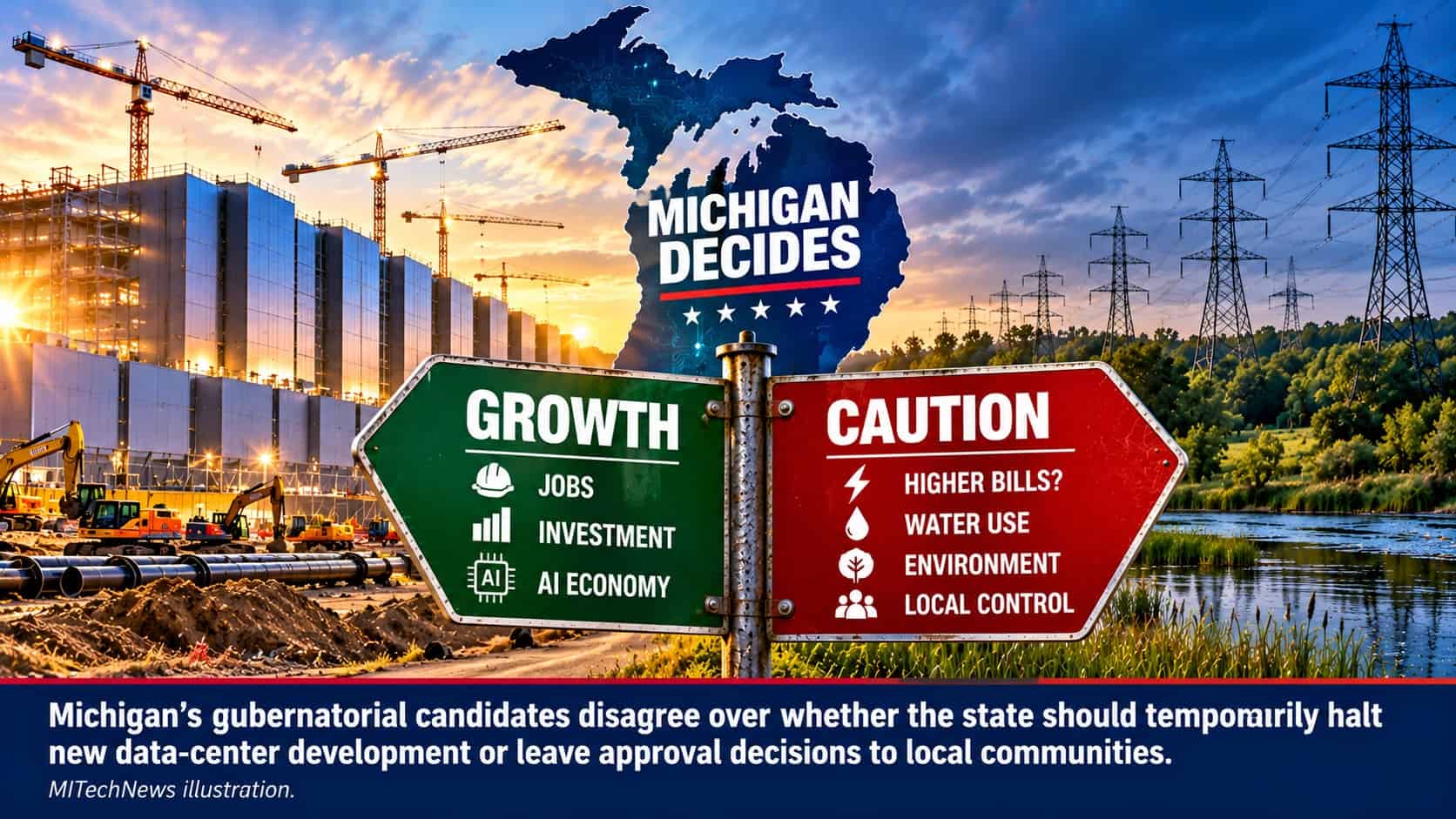
The debate could become increasingly relevant in Michigan as large-scale data center development expands across the state. One example is the proposed data center project near Saline south of Ann Arbor, which has generated local discussion about power demand, infrastructure needs, land use, and long-term environmental impacts.
Supporters argue such facilities can attract investment, tax revenue, and high-tech jobs. Critics, meanwhile, have raised broader questions about electricity consumption, water use, and community impacts.
Michigan’s abundant freshwater resources and relatively cool climate could make the state increasingly attractive for future AI infrastructure projects. Cooler climates can reduce cooling costs and lower water demand compared with hotter regions such as Arizona, Texas, or parts of California.
Some analysts now argue many early-generation hyperscale facilities were built in locations that may become harder to sustain as AI computing demands continue rising.
Michigan May Become A Strategic AI Hub
That could create new opportunities for Midwestern states like Michigan, which already are positioning themselves as centers for advanced manufacturing, semiconductor development, battery production, and AI innovation.
But environmental researchers warn policymakers may need to rethink zoning, utility infrastructure, water management, and environmental oversight before approving large hyperscale campuses.
The future debate over AI infrastructure may not simply focus on technological innovation or economic development.
It may increasingly center on how communities balance growth, energy demand, water resources, and environmental sustainability in an AI-driven economy.
Because unlike the metaphorical “cloud,” artificial intelligence infrastructure is becoming impossible to ignore physically.