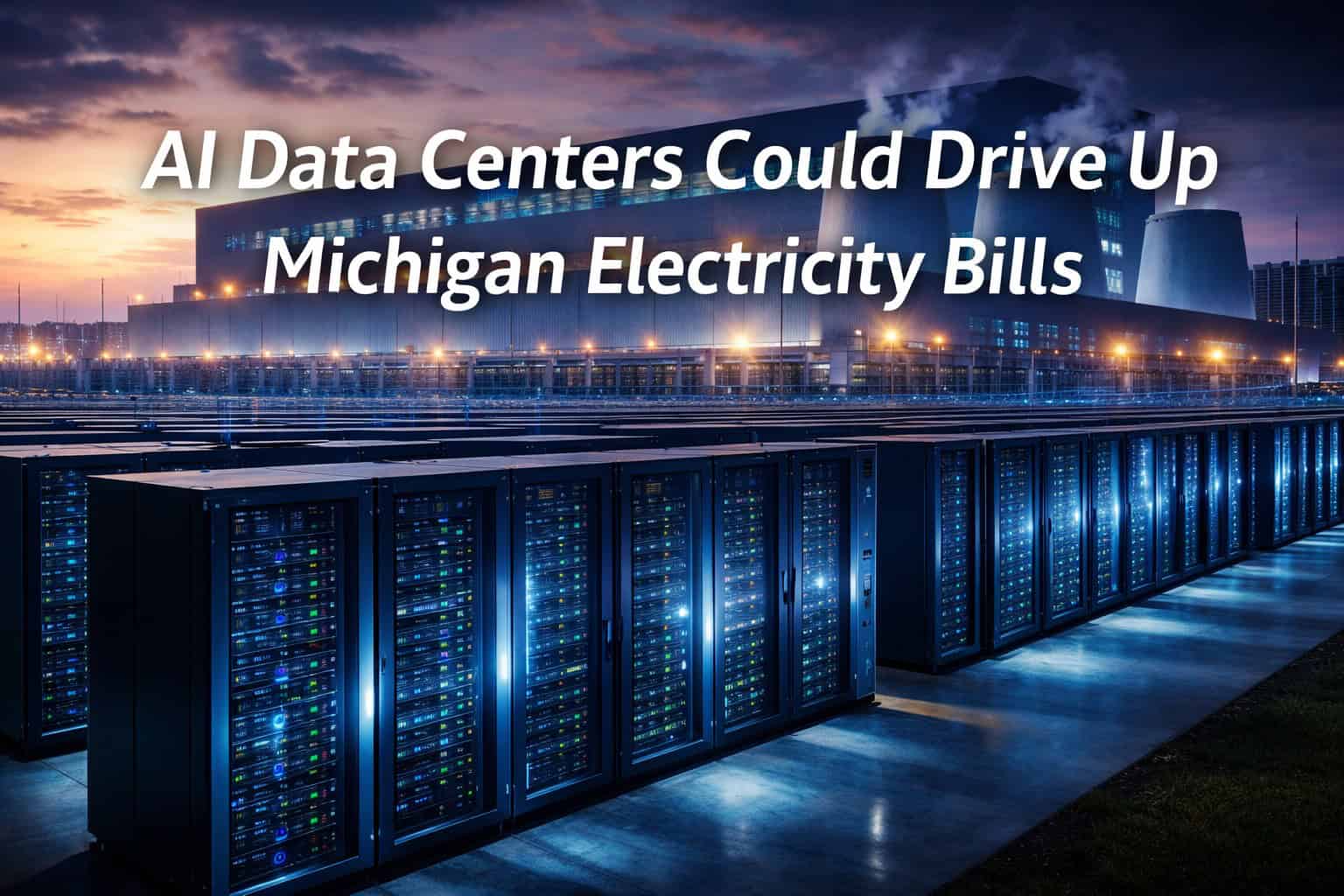
DETROIT – In a decision that could reshape Michigan’s energy and economic landscape, DTE Energy has agreed to stringent conditions attached to long-term power supply contracts for a planned 1.4-gigawatt hyperscale data center being developed by OpenAI and Oracle on roughly 575 acres of farmland south of Ann Arbor in Saline Township. The approval by the Michigan Public Service Commission (MPSC) clears a major regulatory hurdle for what backers describe as one of the state’s largest tech infrastructure investments.
What Was Approved — and With Conditions
The MPSC approved DTE’s proposal to supply electricity to the sprawling project, including setting terms intended to protect everyday utility customers from shouldering project costs. These conditions require DTE to:
-
Absorb financial risk if projected cost savings tied to the data center do not materialize.
-
Document how the data center’s energy needs will be served without subsidies from other ratepayers.
-
File quarterly and annual reports tracking electricity demand and associated financial dynamics.
-
Within 90 days, propose a standard tariff for major power users like hyperscale centers to avoid one-off contract reviews in the future.
-
Ensure that, in times of supply constraints, the facility’s load can be curtailed ahead of service interruptions for residential and small commercial customers.
DTE has publicly stated that none of the costs tied to powering the data center will be passed on to its broader base of customers, and that battery storage and other investments tied to the deal could ultimately benefit the grid.
Broad Economic Stakes
Supporters of the project — including business leaders and state officials — have touted its potential economic benefits. They estimate it could generate millions in annual tax revenue and create roughly 450 permanent jobs alongside thousands of construction jobs during the build-out phase. For a state actively seeking to grow its technology sector, these figures are being cast as a strategic win.
Yet the sheer scale of the facility — which would require energy on par with what a large American city consumes — has triggered both local and statewide debate about the future direction of Michigan’s energy grid and land use.
Controversy and Public Response
The approval process was contentious. Opponents — including environmental groups, ratepayer advocates, and the Michigan Attorney General — argued that the commission’s fast-tracked, largely ex parte review did not allow sufficient transparency or public input on how the data center might affect energy costs, reliability, or state clean energy goals. They also raised concerns about the secrecy of portions of the contract and the lack of opportunity for a full contested case hearing.
Environmental advocates, including Earthjustice and the Michigan Environmental Council, have criticized the process as opaque, arguing that agreeing to conditions after approval rather than vetting impacts upfront leaves key issues unresolved and could weaken enforcement of protections. They say the decision punts critical questions about renewable energy commitment and cost impacts into future proceedings without adequate public scrutiny.
Locally, residents in Saline Township and nearby communities have expressed mixed reactions. Some see the development as a major economic opportunity, while others lament the loss of farmland, potential increases in local infrastructure burden, and environmental footprint. Discussions around new transmission lines, substations, and other utility upgrades needed to serve the data center remain part of broader negotiations and permits outside the MPSC’s direct purview.
What Comes Next
With the power contracts now conditionally accepted, developers still must secure a range of environmental permits, including approvals from the Michigan Department of Environment, Great Lakes, and Energy for impacts on wetlands and waterways in and around the site. Those proceedings are set to include public hearings and comment periods.
Meanwhile, the data center deal is likely to remain a touchstone in debates over data center incentives, land use policy, energy planning, and utility regulation across Michigan — as the state grapples with how to balance economic development, environmental stewardship, and energy affordability
1. Why Hyperscale Data Centers Require Huge Amounts of Power
Hyperscale data centers — especially ones designed to support artificial intelligence computing — are not like the average server room. They’re among the most energy-intensive industrial facilities in the world.
What “Hyperscale” Means
A hyperscale data center is built to support massive computing loads — far beyond a typical corporate or colocation facility. They often host tens of thousands of servers running 24/7 to perform large-scale processing like AI training, cloud services, or real-time global data distribution.
In the case of the planned project south of Ann Arbor — sometimes referred to as Project Stargate — the center’s expected energy demand is about 1.4 gigawatts — roughly equivalent to the annual electricity use of more than a million homes when you account for constant operation.
Why the Power Demand Is So High
-
Compute-Intensive Workloads
— AI model training and inference require massive sustained computation, which draws heavy electrical loads on servers. -
Cooling at Scale
— Running that many processors generates heat that must be removed continuously and reliably. Even when advanced cooling systems are used, keeping equipment within safe temperature thresholds consumes significant energy. -
24/7 Reliability and Redundancy
— These facilities must run without interruption — no brief power cuts. That means backup systems, power conditioning, and sometimes even dedicated generating assets. -
Ancillary Infrastructure
— Beyond servers, the center will need power for lighting, networking, building systems, security, and other support systems.
Broader Grid Impacts
-
Meeting this kind of demand can ripple through a utility’s planning, potentially prompting grid upgrades like new transmission lines, substations, and capacity planning to maintain reliability.
-
Utilities may even postpone retiring fossil fuel plants or bring new generation resources online to make sure there’s always enough capacity.
In short: this is not just a large customer plug-in — it’s effectively a small city’s worth of steady energy demand that must be managed around the clock.
2. Environmental Permits and Oversight Required in Michigan
Even with the utility contracts now conditionally approved, numerous environmental and construction permits must still be secured before the data center can be built and operated. These fall into state and — in some cases — broader regulatory categories.
State-Level Permits from Michigan EGLE
The Michigan Department of Environment, Great Lakes, and Energy (EGLE) regulates activities that can affect water, wetlands, air quality, and other environmental resources.
Key permits likely required for the data center include:
Wetlands and Waterway Permits
-
The site where the facility is planned includes areas near wetlands and the Saline River.
-
Developers must obtain wetlands disturbance permits before any construction that would alter or fill wetland areas.
-
Similar permits are required for any work impacting the waterway itself.
-
These reviews include public hearings and comment periods, where residents and environmental groups can voice concerns or raise issues.
Air Quality and Diesel Generator Permits
-
Backup diesel or other generators — which are needed for grid reliability — may require separate air quality permits under state standards because of emissions.
-
EGLE oversees emissions compliance and may require mitigation efforts depending on capacity and projected pollutants.
Stormwater & Construction Controls
-
Large construction projects must file stormwater pollution prevention plans and comply with erosion and sedimentation controls during grading and building phases.
EGLE’s permitting process is not automatic — each application must be reviewed individually, and the agency has authority to approve, deny, or condition permits based on environmental impact.
What the Public Service Commission Does Not Control
It’s worth underscoring that electric utility regulatory approvals and environmental permitting are separate:
-
The Michigan Public Service Commission (MPSC) can set the terms of how DTE sells power and protects ratepayers.
-
The MPSC does not have authority to issue water use permits, wetlands approvals, or other environmental authorizations.
So even though power contracts were approved, developers still must satisfy a range of state environmental requirements before any large-scale earthwork or construction begins.
Federal and Other Considerations
While the core permits for this project are state and local, large energy infrastructure tied to data centers can also involve federal jurisdiction in some cases — especially for transmission lines, wetlands under the Clean Water Act, or energy generation equipment — though specific federal permits depend on project details and location.
In sum:
Still pending before construction can proceed:
-
Wetlands impact and mitigation approvals
-
Waterway disturbance permits
-
Permits for backup generators and related air emissions
-
Stormwater and erosion control compliance
Already completed (for power contracts):
-
Conditional approval of power supply contracts with DTE by MPSC
Big Picture Summary
| Aspect | Status | What It Means |
|---|---|---|
| Energy Contracts | Approved with conditions | DTE can serve the data center under safeguards for ratepayers |
| Electricity Demand | Extremely high (~1.4 GW) | Comparable to a city’s needs; grid upgrades likely required |
| Environmental Approvals | Still pending | EGLE permits for wetlands, water, and air impact must be obtained |
| Public Input | Required in environmental permitting | Includes hearings and comment periods under state law |
Michigan’s Clean-Energy Goals and Data Center Power Use
1. Michigan’s Clean Energy and Jobs Act
Michigan’s climate law sets a goal for the state to get all electricity from carbon-free sources by 2040. This means utilities must increasingly rely on renewable and low-carbon generation (like wind, solar, possibly gas with carbon capture) as they update their generation portfolios.
However, the way the law treats how utilities meet that goal when big new loads enter the grid is important — and data centers are testing its limits.
2. Clean-Energy Requirements Specifically for Data Centers
Michigan law includes a tax exemption for data centers only if they procure 90 % of their power from clean energy sources after they’re built. That’s a pretty strong statutory goal, but critics say the enforcement guidance issued so far has a big loophole:
-
Currently, utilities in Michigan do not have 90 % clean energy portfolios, and none are required to get there immediately.
-
Simply contracting with a utility that supplies power is not enough on its own to guarantee the data center will actually be powered by clean energy that counts toward the 90 % goal.
Environmental and clean-energy advocates argue this could undermine the intent of the law by letting data centers claim exemptions without actually matching that clean-energy threshold.
Why this matters: If data centers don’t genuinely pull most of their electricity from renewable sources, the increased demand could force utilities to run more fossil fuel plants or delay retiring them — which risks slowing overall progress toward the state’s clean-energy mandate.
3. Utility Planning & Renewable Energy Integration
Utility Resource and Clean Energy Plans
When utilities plan for the future (e.g., in Integrated Resource Plans or Renewable Energy Plans), they must show how they anticipate meeting both future load growth and clean-energy targets. In the case of the DTE–data center deal:
-
The Michigan Public Service Commission (MPSC) directed DTE to amend its renewable energy plan in its next filing to analyze how the data center’s power needs interact with clean-energy compliance. That includes comparing requirements with and without the large new load and how additional costs are recovered.
This step means data center power demand will be factored into longer-term planning and an assessment of how utilities can align that with Michigan’s clean energy standards — not just the short-term contract terms.
4. Regulatory Action and Legislative Responses
Regulatory Tools Being Developed
Michigan regulators have begun adopting new rates and tariffs designed to handle large loads like data centers without disadvantaging everyday customers. For example, the MPSC has approved a special tariff for heavy energy users that’s intended to protect ratepayers — but it doesn’t yet force data centers to hit clean-energy percentages on their own.
Meanwhile, stakeholder processes are underway to update interconnection standards and fairness in how customer-owned resources (like renewables tied into the grid) connect and contribute.
Legislative Proposals
State lawmakers are also responding to concerns from voters and advocacy groups:
-
Bills introduced would mandate reporting on energy and water use by data centers to the Public Service Commission, increasing transparency.
-
Other proposed legislation would limit large water withdrawals and protect taxpayers from infrastructure costs.
-
Some lawmakers are even moving to repeal data center tax incentives, in part because of fears these projects could undermine climate goals.
5. Broader Impacts on Meeting Clean-Energy Targets
How Data Centers Could Affect the Clean-Energy Transition
Because data centers demand large, steady power supplies, they could influence whether utilities need to:
-
Delay retiring fossil fuel plants if renewable additions can’t keep up with immediate demand.
-
Build new capacity that might include gas plants under current definitions of “clean” if renewables are not yet sufficient.
-
Buy or contract additional renewables specifically tied to new load — something environmental groups are pushing for as essential.
This tension highlights a risk: Michigan’s ambitious 100 % clean electricity goal could be harder to achieve in practice if major new energy demands aren’t aligned with additional clean energy supply rather than simply drawing more electricity overall from the grid.
Key Takeaways for Reporting or Planning
| Element | Current Status | What It Means |
|---|---|---|
| 90 % Clean Energy Tax Exemption | Required by law, enforcement still debated | Risk of exemptions without real clean power procurement unless guidelines tighten. |
| Utility Clean Energy Plans | Must incorporate new loads in future renewable planning | Data center demand now part of planning, not just rate contracts. |
| MPSC Authority | Can set contract terms and tariffs but not enforce clean energy mandates directly | Clean energy compliance is tied to separate state laws and utility resource plans. |
| Legislative Action | Bills proposed for transparency, water and cost protections | Growing political focus on balancing economic development with environmental limits. |
Bottom Line
Data centers in Michigan sit at the intersection of economic development and energy transition policy:
-
They bring investment and jobs, but also huge power demands.
-
Michigan has strong clean-energy goals, yet current regulatory and incentive structures don’t fully guarantee that hyperscale facilities help achieve, rather than hinder, those goals.
-
Regulatory and legislative efforts are now underway to align energy usage, clean-energy procurement, and transparency — but how effective those efforts will be remains a core question in both utility planning and climate policy debates.